At Piazza Trieste e Trento in central Naples, Antica Pizza Fritta da Zia Esterina represents the street-food tradition that predates the wood-fired oven as the city's dominant pizza format. The kitchen fries rather than bakes, producing the folded, golden crescents that fed postwar Naples when wood and oven space were scarce. It sits at a price point where the format itself is the draw, not the dining room.
Pearl is the En Primeur Club membership app — saves, bookings, and concierge access live there. Same editors, same standards.
- Address
- Piazza Trieste e Trento, 53, 80132 Napoli NA, Italy
- Phone
- +393981416306
- Website
- sorbillo.it
- Directions
- Get directions
 Saves & bookings on Pearl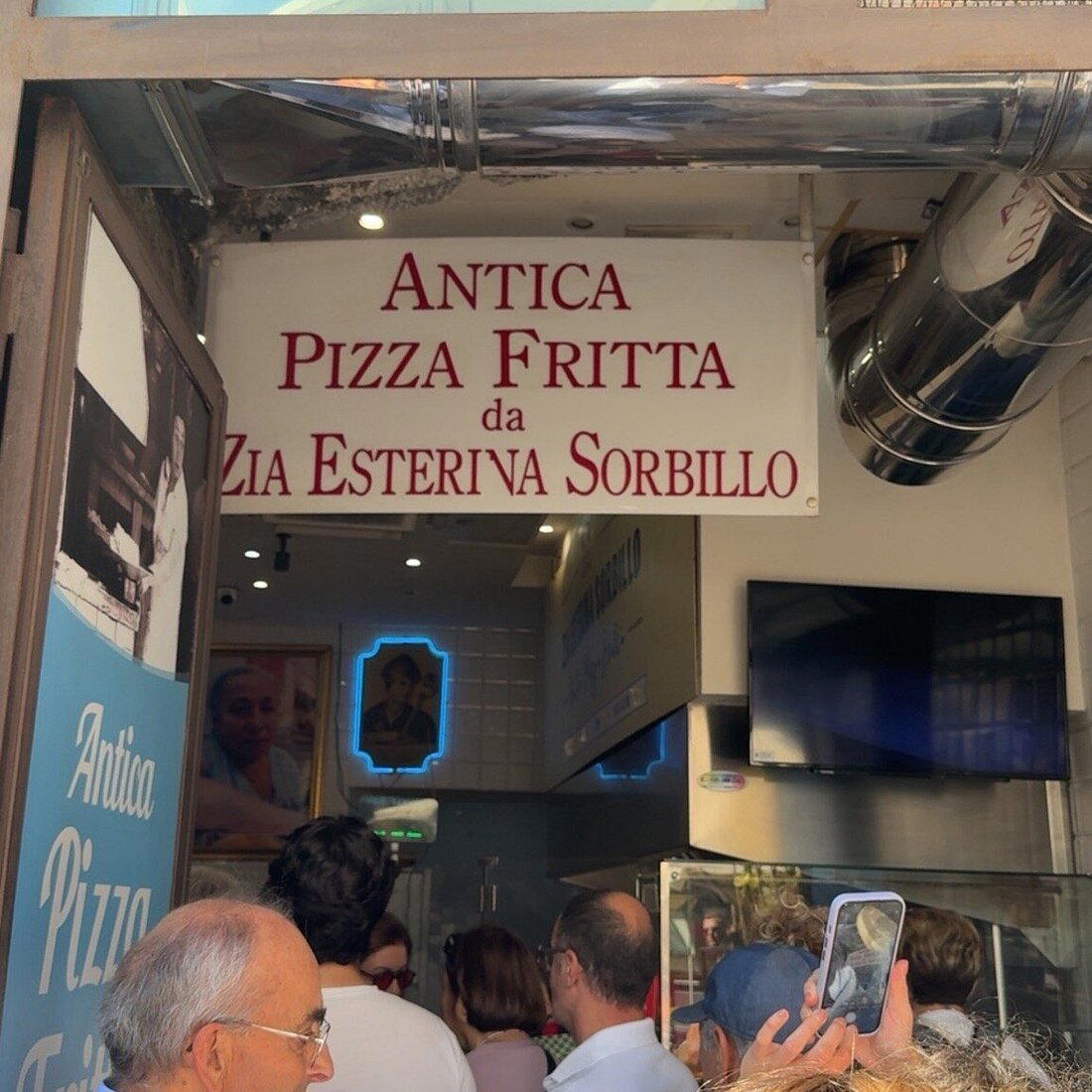
Fried Before Baked: Naples and the Older Pizza Tradition
Most visitors arrive in Naples with a mental image fixed by a century of culinary storytelling: the wood-fired Neapolitan pie, its charred cornicione and wet centre, the object of international pilgrimage and protected designation. What that story crowds out is older. Pizza fritta, the fried and folded version, fed the city through the lean decades of the mid-twentieth century, when fuel for ovens was expensive and street corners were not. The form preceded the mythology, and it survives today as both working-class staple and, increasingly, a subject of serious food-cultural interest. Antica Pizza Fritta da Zia Esterina, at Piazza Trieste e Trento in the centro storico, occupies exactly that intersection.
The address matters. Piazza Trieste e Trento sits at among the more trafficked points in central Naples, a few metres from the Galleria Umberto I and within walking distance of the Teatro San Carlo. This is not a neighbourhood tucked into the Quartieri Spagnoli or down an unmarked vicolo; it is a high-visibility position in a city that treats its piazzas as civic rooms. That placement shapes the atmosphere considerably, particularly in the daytime, when the square fills with a mixture of office workers, tourists crossing between sites, and locals treating a fried pizza as a punctuation mark rather than a destination.
The Lunch Hour Versus the Evening Pull
The editorial angle that most honestly describes pizza fritta is one of time of day. Lunch, here and at comparable counters across Naples, operates on different logic than evening service. The midday crowd is faster, more local in composition, and less inclined toward deliberation. A fried pizza is a street-food transaction: you order, you wait briefly, you eat standing or moving. The product is hot, substantial, and priced for repetition rather than occasion. That efficiency is part of its social function, and venues like Zia Esterina are calibrated around it.
Evening changes the arithmetic. The piazza shifts toward tourists and couples, and the decision to stop for a fried pizza becomes more considered, more comparative. Against the evening options available within a short radius, including George Restaurant at the contemporary fine-dining tier or Veritas with its Campanian focus, pizza fritta operates as a deliberate contrast: low price, high informality, immediate gratification. The evening visitor who chooses it is usually seeking a quick meal rather than a formal dinner.
That divide, lunch as reflex and evening as choice, is one of the defining structural features of street-food culture in any dense European city, and Naples makes it legible more than most. The city's food geography layers formal restaurants, trattorias, and street counters in proximity unusual for its size. 12 Morsi and 177 Toledo represent the sit-down middle tier; pizza fritta counters sit below that in formality and price, but not in cultural weight.
What Pizza Fritta Actually Is
The format deserves direct description because it is frequently misunderstood by visitors who expect something adjacent to a baked Neapolitan pizza. It is not. The dough is submerged in hot oil rather than placed in a 450-degree wood-fired oven. The result is a folded crescent or oval, its exterior golden and slightly blistered, its interior dense and yielding in a way that baked pizza is not. Fillings are typically ricotta, cicoli (rendered pork fat), and provola, though variations exist. The whole thing is eaten hand-held, immediately, while hot. It does not travel well and it is not meant to.
The postwar Neapolitan context is not incidental to understanding the dish. In the late 1940s and into the 1950s, pizza fritta was street food for a city rebuilding under economic constraint. Lard was cheap, ovens were not universally accessible, and a fried pizza delivered more caloric density per lira than most alternatives. Sophia Loren famously ate pizza fritta in the 1954 film L'Oro di Napoli, a scene that embedded the format in wider Italian cultural memory even as baked pizza was beginning its international rise. That cinematic association gives pizza fritta a cultural timestamp that baked pizza, for all its global reach, does not quite replicate.
Where This Sits in Naples's Broader Dining Picture
Naples has many ways to spend considerably more on dinner. At the fine-dining end, the gap between a pizza fritta counter and a tasting-menu restaurant is measured not just in euros but in entire frameworks of expectation. Venues like Quattro Passi in Marina del Cantone or, further afield in Italian fine dining, Osteria Francescana in Modena and Piazza Duomo in Alba represent the opposite pole of the Italian restaurant spectrum. Even within Campania, Reale in Castel di Sangro and, across broader Italian reference, Dal Pescatore in Runate, Uliassi in Senigallia, Le Calandre in Rubano, Enoteca Pinchiorri in Florence, Enrico Bartolini in Milan, and Atelier Moessmer Norbert Niederkofler in Brunico signal how wide that spectrum runs.
Pizza fritta counters are not competing with any of those. They are competing with Gino Sorbillo and L'Antica Pizzeria da Michele for the same casual, high-turnover slot, and the competition is primarily about format preference rather than quality signalling. Among baked pizza's canonical Naples addresses, L'Antica Pizzeria da Michele has operated on Via Cesare Sersale since 1870 and represents the austere, two-option school of Neapolitan pizza. Zia Esterina's fried format is a deliberate alternative to that tradition, not a lesser version of it.
Internationally, the contrast with tasting-menu experiences like Le Bernardin in New York City or Lazy Bear in San Francisco is not an apples-to-apples one, but it is a useful frame for understanding where street-food counters sit in the global hierarchy of intentional eating: at the opposite end in format and price, but not in cultural seriousness.
Planning Your Visit
Piazza Trieste e Trento is a short walk from Toledo metro station. The counter accepts walk-ins. Neither window is wrong, but the lunchtime version of the experience is more authentically embedded in the working rhythms of the city.
Cuisine and Awards Snapshot
Comparable venues nearby, for context on price, style, and recognition.
| Venue | Cuisine | Price | Notes |
|---|---|---|---|
| Antica Pizza Fritta da Zia EsterinaThis venue — the venue you are viewing | Neapolitan Fried Pizza | $$ | Not listed |
| Pizzeria De' Figliole | Traditional Neapolitan Fried Pizza | $$ | Il Vasto |
| Pastfood | Neapolitan Street Food | $ | Mater Dei |
| Ventimetriquadri - Specialty Coffee | Specialty Coffee & Cafe | $$ | Vomero |
| Fresco Trattoria Pizzeria | Neapolitan Pizza Trattoria | $$ | Acquario |
| Vasinikò | Neapolitan Pizza | $$ | Antignano |
Continue exploring
More in Naples
Restaurants in Naples
Browse all →
Bars in Naples
Browse all →
Hotels in Naples
Browse all →
At a Glance
- Lively
- Rustic
- Well Known
- Casual Hangout
- Historic Building
Current opening hours
- Monday
- 11 AM–10 PM
- Tuesday
- 11 AM–10 PM
- Wednesday
- 11 AM–10 PM
- Thursday
- 11 AM–10 PM
- Friday
- 11 AM–11 PM
- Saturday
- 11 AM–12 AM
- Sunday
- 11 AM–11 PM
Hours can change for holidays and private events. Last verified .