Our verdict
On a narrow street in the old Giudecca quarter, Pizzeria De' Figliole represents the kind of Neapolitan pizza tradition that has outlasted every culinary trend the city has produced. The format is stripped back, the prices are low, and the product is the point. For anyone tracing how Naples shaped pizza into a globally influential form, this address belongs on the itinerary.

Pearl is the En Primeur Club membership app, where members save venues, book tables and use the concierge.
What a Street-Corner Pizzeria in the Giudecca Quarter Tells You About Naples
Via Giudecca Vecchia sits in one of the older residential folds of central Naples, a few turns away from the tourist circuits that thread between the Spaccanapoli and the port. The street itself is functional rather than scenic: narrow, shaded, the kind of address that appears on no curated walking tour but that Neapolitans navigate without thinking. It is exactly this kind of location that tends to house the most instructive examples of the city's pizza tradition, the ones that exist because the neighbourhood demands them, not because a dining market does.
Pizzeria De' Figliole operates within that logic. The name, the address, the format all signal a business oriented around regulars and proximity rather than destination traffic. In Naples, that orientation carries a particular kind of authority. The city's pizza canon was built on neighbourhood anchors long before Michelin inspectors or international food media arrived to document it, and the shops that survived without external validation tend to carry the most unedited version of the tradition.
The Naples Pizza Tradition as Technical Benchmark
Understanding where any Neapolitan pizzeria sits requires some sense of what the tradition actually demands. The Associazione Verace Pizza Napoletana, founded in Naples in 1984, codified a set of production rules that the city had been practising informally for well over a century before that: specific flour grades, San Marzano tomatoes grown in the volcanic soil of the Agro Nocerino Sarnese, fior di latte or buffalo mozzarella sourced from Campanian producers, and a wood-fired dome oven running at temperatures that cook the base in under ninety seconds. The margin for error in that window is almost zero, which is why the technique demands years of practice rather than weeks of training.
This is the context in which Pizzeria De' Figliole should be read: not as a singular phenomenon but as a practitioner of one of the world's most technically demanding and geographically specific bread traditions. The ingredients are local by definition, the method is the product of accumulated neighbourhood knowledge, and the price point reflects the fact that the business model was never built on imported premium positioning. Across Naples, comparable neighbourhood operations hold their prices at the lower end of the city's already affordable range, making them accessible to residents in a way that the destination-tier pizzerias, however skilled, are not.
For context on the city's wider dining range, our full Naples restaurants guide maps the spectrum from addresses like this one through to the city's contemporary fine-dining tier, represented by places like George Restaurant and Veritas. The distance between those poles in terms of format, price, and intent is considerable, but both ends are engaged with the same underlying question: what does Campanian produce taste like at its most focused?
Local Ingredients as the Non-Negotiable Foundation
The editorial angle that Italian food media consistently returns to when discussing Neapolitan pizza is the relationship between indigenous products and codified technique. San Marzano tomatoes, cultivated in the mineral-rich volcanic soil around Vesuvius, carry a sweetness and low acidity that supermarket equivalents cannot replicate. Buffalo mozzarella from the Campania region, particularly from the Caserta and Salerno provinces, brings a fat content and moisture level that behaves differently under extreme heat than the drier industrial alternatives used in most of the world's pizza production. These are not interchangeable ingredients: the product changes materially when either is substituted.
This intersection of protected-origin ingredients and a heat-based technique refined over generations is what separates the Neapolitan tradition from its global derivatives. Restaurants like Uliassi in Senigallia or Osteria Francescana in Modena engage with Italian regional products through the lens of contemporary fine dining; a neighbourhood pizzeria in Naples engages with those same product principles through a tradition so old that the technique itself has become the heritage artifact. The methods are different; the underlying argument about place-specific ingredients is the same.
That argument has also found its way into international kitchens. The Neapolitan pizza format has been interpreted at high-end addresses from New York to Tokyo, often by chefs with direct training or staging in Naples. Places like Le Bernardin in New York City and Atomix in New York City represent the kind of precision cooking culture that now routinely studies Italian regional traditions for technical principles. The source material, though, remains at street level in Naples.
Where This Fits in the Naples Eating Sequence
Naples has developed a tiered eating culture across its central neighbourhoods. The port-adjacent districts, including the old Giudecca quarter, house a concentration of working-format establishments that operate at their most intense during lunch and early evening. Timing matters: Neapolitan neighbourhood pizzerias typically reach their peak production rhythm in the early afternoon and again before 8 p.m. when the dough is at its optimal fermentation stage and the oven has been running long enough to stabilise at correct temperature. Arriving outside those windows often means a different product, not dramatically worse, but noticeably different in crust texture and base char.
Visitors who want to map the full range of what Naples does with dough and heat might pair an address like De' Figliole with 1947 Pizza Fritta, which traces the fried pizza tradition that preceded the baked form as the more accessible street food for working-class Naples, or with 12 Morsi and 177 Toledo for a sense of how the city's contemporary restaurants are reworking Campanian formats without abandoning their material base. For those whose Italy itinerary extends further north, the three-Michelin-star level is well represented at Le Calandre in Rubano, Piazza Duomo in Alba, and Reale in Castel di Sangro, all of which apply similarly rigorous thinking about regional produce to very different formats. Dal Pescatore in Runate, Enoteca Pinchiorri in Florence, Enrico Bartolini in Milan, Quattro Passi in Marina del Cantone, and Atelier Moessmer Norbert Niederkofler in Brunico each represent the alpine and northern Italian end of that same conversation about technique and terroir.
Planning a Visit
Pizzeria De' Figliole sits at Via Giudecca Vecchia, 39, in central Naples, within walking distance of the historic centre. In Naples, walk-in is the default format for this tier of pizzeria; formal reservations are rarely the mechanism. The summer months bring higher foot traffic to the central neighbourhoods, and the weeks around the Feast of the Assumption in mid-August can see reduced hours at family-run operations. Visiting in the shoulder seasons of April through June or September through October tends to produce the most consistent experience.
Frequently asked questions
Would Pizzeria De' Figliole be comfortable with kids?
Neighbourhood pizzerias in central Naples are among the most child-tolerant dining environments in Italy, and an address like De' Figliole on Via Giudecca Vecchia fits that pattern squarely. The format, walk-in, quick service, no ceremony, removes the friction that makes formal restaurants awkward with children. Order, eat, leave: the pace works for families.
What's the overall feel of Pizzeria De' Figliole?
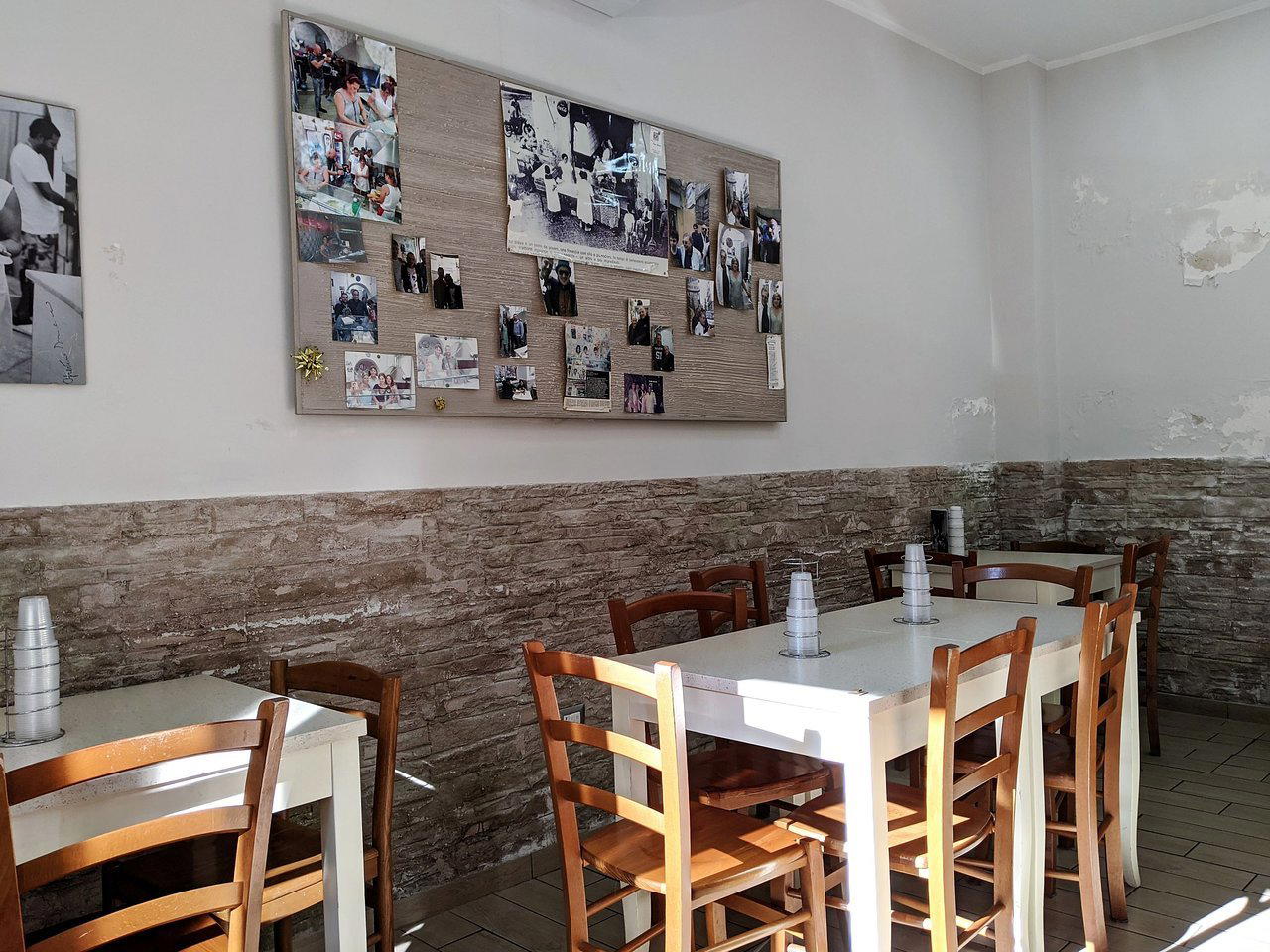
The address on Via Giudecca Vecchia puts it in one of Naples's older residential folds, away from the tourist-facing dining strips near the historic centre. There is no awards positioning or destination-dining framing here, this is a working neighbourhood operation serving the people who live nearby. Expect a functional room, direct service, and a focus squarely on the pizza.
Is Pizzeria De' Figliole connected to a family tradition in Naples?
The name De' Figliole, meaning 'of the daughters' or 'of the children' in the Neapolitan register, points to a family-rooted operation, which in Naples frequently signals continuity across generations rather than a recent concept launch. That lineage matters in a city where pizza-making knowledge passes through families as much as through formal training.
What's the signature dish at Pizzeria De' Figliole?
The margherita is the technical reference point in this tradition, and in a place like this it is the dish against which everything else is measured.
Where do I go for Pizzeria De' Figliole?
Pizzeria De' Figliole is located at Via Giudecca Vecchia, 39, 80139 Napoli NA, Italy, Naples.
How far ahead should I plan for Pizzeria De' Figliole?
Walk in. Neighbourhood pizzerias at this level in Naples do not run reservation systems, the planning required is simply arriving at a reasonable hour. Via Giudecca Vecchia is in central Naples, so the logistics are straightforward once you have the address.
Peers in This Market
Comparable venues nearby, for context on price, style, and recognition.
| Venue | Cuisine | Price | Awards | Notes |
|---|---|---|---|---|
| Pizzeria De' FiglioleThis venue (the venue you are viewing) | Traditional Neapolitan Fried Pizza | $10–20 | Not listed | Not listed |
| Pizzeria Brandi | Authentic Neapolitan Pizza | $20–30 | Not listed | San Ferdinando |
| Antonio & Antonio | Neapolitan Pizza & Seafood | $30–50 | Not listed | San Ferdinando |
| Bro. Ciro e Antonio Tutino Pizzeria | Modern Neapolitan Pizza | $20–30 | 50 Top Pizza Italia #23 | Mercato |
| Vasinikò | Neapolitan Pizza | $20–30 | Not listed | Antignano |
| Pizzeria I Decumani | Authentic Neapolitan Pizza | $10–20 | Not listed | Il Vasto |
Continue exploring
More in Naples
Restaurants in Naples
All restaurants in Naples →
Bars in Naples
All bars in Naples →



Details
- Rustic
- Cozy
- Classic
- Casual Hangout
- Historic Building
- Open Kitchen
- A La Carte
- Vegetarian Friendly
Current opening hours
- Monday
- 10 AM–10:30 PM
- Tuesday
- 10 AM–10:30 PM
- Wednesday
- 10 AM–10:30 PM
- Thursday
- 10 AM–10:30 PM
- Friday
- 10 AM–10:30 PM
- Saturday
- 10 AM–10:30 PM
- Sunday
- Closed
Hours can change for holidays and private events. Hours as of .
Simple, friendly, and authentic atmosphere in a tiny, clean, bright space with open kitchen.