Amdo Momo

Our verdict
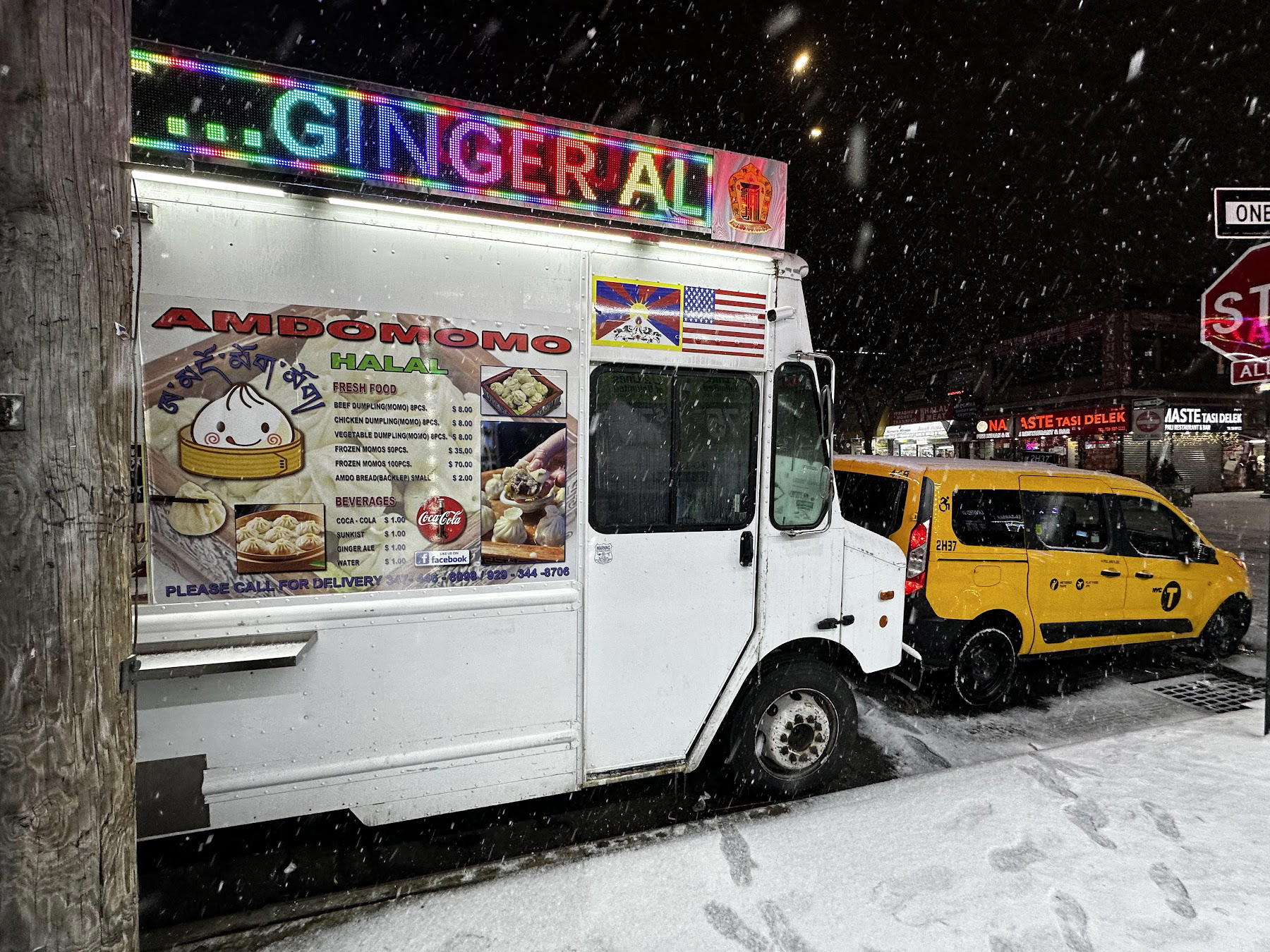
Amdo Momo is a Tibetan food truck in Jackson Heights focused on a narrow, disciplined format: momos served at street-food prices in one of New York City’s deepest immigrant dining corridors. Its reputation rests on beef momos, eight for $8, with swirled pleats, supple skins, hot broth, and the kind of single-dish clarity that turns a corner vendor into a serious dining address.

Pearl is the En Primeur Club membership app, where members save venues, book tables and use the concierge.
The menu
What to order
- Beef momos
- Chicken momos
- Vegetable momos
- Frozen momos (30 pcs)
- Frozen momos (100 pcs)
At the corner of 37th Road and 74th Street, Jackson Heights does not ease anyone into dinner. Trains, buses, grocery runs, phone calls, and competing snack agendas all meet at pavement level. Amdo Momo belongs to that street rhythm rather than apart from it: a Tibetan food truck built around one narrow promise, momos served fast, hot, and cheaply in a neighbourhood where Himalayan cooking is part of daily life rather than novelty.
New York’s Tibetan food culture has long been anchored in Queens, especially around Jackson Heights and nearby Elmhurst, where Tibetan, Nepali, Bhutanese, Indian, Bangladeshi, and Pakistani foodways overlap block by block. In that setting, the momo is not a trend item. It is lunch, late snack, family shorthand, and diaspora comfort, shaped by altitude, migration, and the practical genius of dough wrapped around seasoned filling. The city’s broader restaurant economy often rewards range, tasting-menu ambition, or design expense. Here, discipline works in the opposite direction: do one thing, price it clearly, and let repetition sharpen the format.
Queens Tibetan cooking, reduced to the momo
The appeal is partly cultural and partly architectural. A momo has to resolve several tensions at once: wrapper against filling, steam against structure, broth against bite. Amdo Momo’s reputation has formed around beef momos sold as eight for $8, a price point that places the truck inside New York’s serious cheap-eats category rather than the city’s destination dining economy. The known details are unusually concrete: swirled topknots, supple skins, beef arriving hot from the pot, and broth released inside the dumpling. Those are not decorative flourishes; they are the technical markers that separate a merely filling dumpling from one made with care.
The former Tibetan monk associated with the truck matters as context, not as a sentimental origin story. In a city that often packages immigrant cooking for outside approval, the stronger point is that this format asks for no translation. It is a low-cost, high-specificity expression of Tibetan food culture in the borough where that culture has the room to operate on its own terms. The truck’s narrowness is the argument. No sprawling menu is needed when the craft is concentrated in pleating, steaming, seasoning, and temperature.
That focus also explains why the recognition around Amdo Momo has traveled beyond the immediate neighbourhood. New York has many acclaimed dining rooms, but the city’s food authority has always depended on vendors and counters that compress skill into a few square feet. Awards and critical praise tend to favor the language of rarity; street food earns attention differently, through repeatability under pressure. The momo, served from a truck rather than plated in a dining room, makes that case cleanly.
Why Jackson Heights changes the stakes
Jackson Heights is not a backdrop. It is the reason the experience makes sense. The neighbourhood’s density creates a rare kind of culinary literacy: diners may compare dumpling textures across Tibetan, Nepali, and North Indian contexts in the space of a short walk, while also moving past sari shops, halal butchers, mobile vendors, sweet shops, and momo counters. In Manhattan, a Tibetan dumpling is framed as discovery. In this part of Queens, it is part of a living circuit of errands, commuting, and multilingual appetite.
That distinction matters for how to read the truck. Amdo Momo is not trying to mimic a restaurant. The value lies in immediacy, not ceremony: a corner location, a compact order, and a price that keeps the food in everyday rotation. For travelers accustomed to New York dining as reservations, bar programs, and dining-room theatre, this is a useful correction. Some of the city’s sharpest eating happens without a host stand, a wine list, or a room at all.
Readers building a wider New York itinerary can place this stop alongside other neighbourhood-led dining rather than luxury-only addresses. For another Queens Tibetan reference point, see Phayul. For contrast across the city’s broader restaurant spectrum, EP Club also covers & Sons Ham Bar, 'inoteca, 1 or 8 (Sushi - Japanese), and 12 Chairs (Israeli). The wider city index is here: Our full New York City restaurants guide, with adjacent planning through Our full New York City hotels guide, Our full New York City bars guide, Our full New York City wineries guide, and Our full New York City experiences guide.
How to read the price, the format, and the reputation
The $ category is not incidental. In New York, low price often gets mistaken for low consequence, especially by travelers trained to equate seriousness with dining rooms and advance planning. Amdo Momo shows the opposite. Eight momos for $8 creates a rare ratio of cost to specificity: Tibetan cuisine, a focused truck format, and a dish whose reputation depends on execution rather than menu breadth.
The practical approach is simple: treat it as street food in a high-traffic Queens corridor, not as a conventional restaurant appointment. The address is the corner itself, and the experience is shaped by the pace of the block. Children are not a mismatch for the format, provided the group is comfortable eating from a truck and handling a compact, hot, broth-filled order. For visitors mapping food-led travel beyond New York, the same editorial logic applies to focused specialists such as Jōdo Saké Bar in Los Angeles, Onigiri Time in Pasadena, ¿Por Qué No? in Portland, 'Ai Love Nalo in Waimanalo Beach, 'āina in San Francisco, 'Ama 'Ama in Kapolei, -Grilled beef Sukiyaki- KAMAKURA TANUKIAN 鎌倉 たぬき庵 in Kamakura, and ¡Salud! in Los Angeles.
Editorial verdict is less about rarity than clarity. Amdo Momo belongs in the part of New York dining where a single item can carry the weight of a cuisine, a neighbourhood, and a vendor’s daily discipline. The city has plenty of expensive meals that require explanation. This one makes its case in eight pieces.
Frequently asked questions
How would you describe the cuisine at Amdo Momo?
Amdo Momo serves Tibetan cuisine.
How much does it cost to eat at Amdo Momo?
Pricing at Amdo Momo is listed as $.
Does Amdo Momo have a Michelin star or similar recognition?
Amdo Momo has received recognition including: To do just one thing, and do it brilliantly: Is that not a destiny fulfilled? At this single-minded food truck, a former Tibetan monk makes perfect momos (eight for $8) with swirled topknots, supple skins, beef still seething from the pot a….
Where is Amdo Momo located?
Amdo Momo is located in New York City.
Should I book Amdo Momo in advance?
No booking details are listed for Amdo Momo in New York City. As a $ food truck at the corner of 37th Road and 74th Street, it fits a walk-up format rather than a reserved-table format.
What has Amdo Momo built its reputation on?
Amdo Momo has built its reputation on a single-minded focus: momos. the public record describes eight for $8, with swirled topknots, supple skins, beef from the pot, and hot broth, which is the core of its appeal in New York City. Check the venue's official channels for the latest details.
Is Amdo Momo suitable for children?
For children who eat dumplings, Amdo Momo can work well because the menu centers on momos and the price sits at $ for eight. Its New York City food-truck format keeps the experience informal and direct.
In Context
Comparable venues nearby, for context on price, style, and recognition.
| Venue | Cuisine | Price | Notes |
|---|---|---|---|
| Amdo MomoThis venue (the venue you are viewing) | Traditional Tibetan Momo Food Truck | $1–10 | Not listed |
| Asian Bowl | Casual Burmese & Asian Bowls | $10–20 | Forest Hills, Casual Burmese & Asian Bowls |
| Pierogi Boys | Traditional Polish Pierogi | $10–20 | Downtown Brooklyn, Traditional Polish Pierogi |
| Chinatown Ice Cream Factory | Not listed | $1–10 | Chinatown-Two Bridges, Asian-Inspired Ice Cream |
| Sweatshop Studios LLC | Fort Greene, other | Not listed | Not listed |
| Warung Selasa at Indo Java | Traditional Indonesian | $10–20 | Elmhurst, Traditional Indonesian |
Recognition history
Dated appearances from independent guides and award organizations, with the underlying list record or original source where available.
New York Times Best Restaurants in New York City #62
New York Times
Continue exploring
More in New York City
Restaurants in New York City
All restaurants in New York City →
Bars in New York City
All bars in New York City →





Details
- Solo
- Casual Hangout
- Late Night
- After Work
- Standalone
- Street Scene
- A La Carte
- Counter Dining
- Soft Drinks
- Water
- Halal
Casual street-food truck atmosphere with outdoor sidewalk standing or curbside eating, focused on quick service rather than decor or indoor seating.