Keens



Operating since 1885, Keens is one of Midtown Manhattan's oldest chophouses and a James Beard America's Classic. The dry-aged USDA Prime cuts, broiled on a high-temperature grill, anchor a menu that also features the signature mutton chop and prime rib hash. Ranked #150 in Opinionated About Dining's 2025 Casual North America list, it remains a reference point for old-school New York steakhouse tradition.
Pearl is the En Primeur Club membership app — saves, bookings, and concierge access live there. Same editors, same standards.
- Address
- 72 W 36th St., New York, NY 10018
- Phone
- (212) 947-3636
- Website
- keens.com
- Directions
- Get directions
 Saves & bookings on Pearl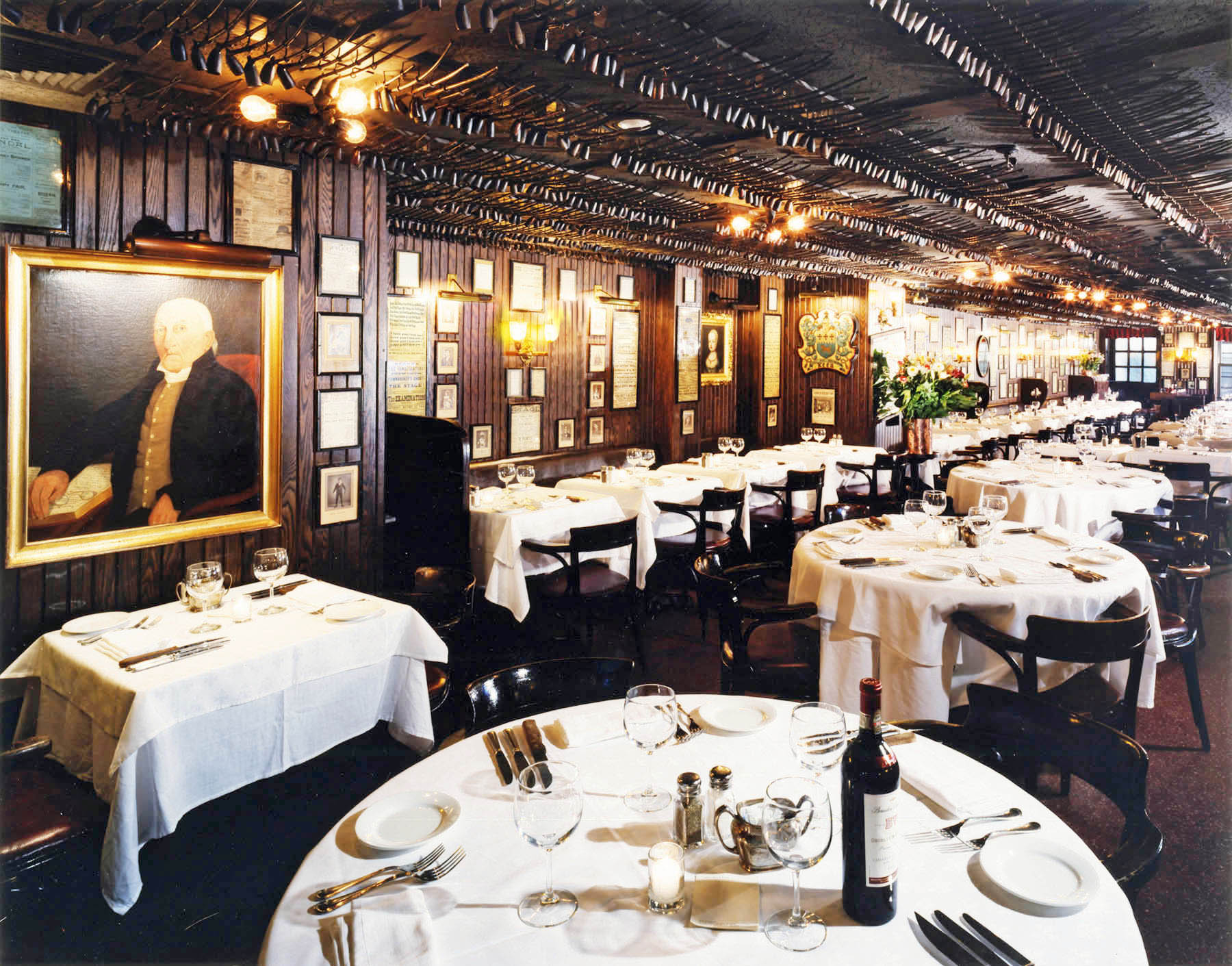
Oak, Pipe Smoke, and the Weight of 140 Years
Before you reach the menu, the room makes its argument. Dark oak paneling runs floor to ceiling. Thousands of churchwarden pipes hang overhead in rows, each one tagged, a ledger of regulars stretching back generations. White tablecloths, vested bartenders, and the low hum of a dining room that has been running at full pitch since 1885. The physical environment at Keens does not ask for your attention; it already has it. In a city where restaurant design cycles through trends every few years, a room that has changed this little over 140 years communicates something specific: the food has always been the reason to return, and the room has never needed to compensate for it.
Keens occupies a particular position in New York's steakhouse hierarchy, not the sleek, expense-account format of newer Midtown entries, and not the white-tablecloth-as-theater approach of the hotel chophouses. It is closer in spirit to the chophouse tradition that predates American steakhouse culture as a category: a place built around a single product, executed with discipline, served without ceremony. The James Beard Foundation recognised this in 2013 with its America's Classic Award. That credential matters here not as decoration but as confirmation of what repeat visitors already know.
USDA Prime, Self-Dry-Aged, Broiled on High Heat
The sourcing argument at Keens starts with a decision most modern steakhouses outsource: the aging. The kitchen operates on a self-dry-aged program using USDA Prime beef, which means the product arriving at the table has been managed in-house rather than purchased pre-aged from a commodity supplier. Dry aging at this grade concentrates flavour through moisture loss and enzyme activity, producing a more pronounced, nutty depth in the meat that wet-aged beef, the dominant commercial format, does not replicate. The difference is structural, not cosmetic.
The cooking method compounds this. A high-temperature broiler drives the Maillard reaction at the surface quickly, producing a crust without overcooking the interior. This is the same logic that makes a wood-fired grill effective, applied through a different tool. The result, on a properly handled porterhouse, is a exterior with real char and an interior that holds its temperature and texture. The porterhouse for the table remains a reliable order, and the restaurant ranked #150 in Opinionated About Dining's 2025 Casual North America list, up from #166 in 2024.
Mutton chop is the other sourcing story worth understanding. American steakhouses rarely feature mutton, lamb, yes, but mutton (from an older animal) has stronger, more complex flavour and requires longer cooking. The saddle cut served at Keens is the dish that most separates it from the standard chophouse format and connects it to a pre-20th-century British-American dining tradition when mutton was a prestige product. That the dish has survived on the menu for over a century while American dining preferences moved decisively toward beef is itself a statement about the kitchen's confidence in its product.
The Supporting Cast Holds Its Position
New York's serious steakhouses have always been tested as much by their sides and bar programs as by the beef itself. The canonical creamed spinach, the shrimp cocktail served cold, the martinis, these are not afterthoughts at Keens. The OAD review describes them as "as they should be."
This matters in context. New York has a range of steakhouse formats across different price tiers and neighbourhoods, from the Italian-American hybrid approach at Bowery Meat Company to the seafood-forward integration at Carne Mare, the compact intimacy of 4 Charles Prime Rib, and the Midtown business-dining register of Benjamin Steak House and Bobby Van's Steakhouse. What distinguishes Keens from most of this peer group is the consistency of its format and product.
Three Rooms, One Address, Different Temperatures
The floor plan at Keens functions as a spectrum of register. The barroom runs at the kind of hale-fellow-well-met volume that made 19th-century chophouses the social infrastructure of commercial Manhattan. The main dining rooms are larger and more formal, suited to groups and extended meals. Between them, the pub room operates at a lower pitch, smaller, more enclosed, closer to the pipe collection and the particular atmosphere that makes Keens a reference point for what New York restaurants looked like before the 20th century redesigned the city. The pub room remains one atmospheric space in the restaurant.
The wine list tracks the red wine logic that steakhouse dining has always followed: Cabernet Sauvignon, Bordeaux, and old-vintage Napa are the anchors. These choices are not accidental. High-tannin, fruit-forward reds cut through fat and amplify the savoury depth of dry-aged beef in a way that lighter styles do not. The list is extensive and weighted toward the same conviction as the food: this is not a room for equivocal choices.
2025: A Change of Ownership, a Continuity of Product
Keens entered 2025 under new ownership, a transition that its regulars are watching closely. The physical space, the menu, and the sourcing program remain in place. What is documentable now is that the kitchen is producing at a level consistent with, or above, its recent ranking trajectory: #146 in 2023, #166 in 2024, #150 in 2025 on the OAD Casual North America list. Chef William Rodgers heads the kitchen.
In the longer American context, Keens belongs to a specific cohort of restaurants that have maintained product integrity across decades. That cohort includes places like Emeril's in New Orleans, long-standing institutions that carry regional identity through periods of trend. It operates in a different register from technically ambitious formats like Alinea in Chicago, Lazy Bear in San Francisco, or The French Laundry in Napa, and from farm-integrated approaches like Single Thread Farm in Healdsburg. The comparison is not competitive; it maps the breadth of serious American dining. Internationally, the premium steakhouse format takes different shapes at places like A Cut in Taipei and Capa in Orlando, while coastal American fine dining follows a different trajectory at Providence in Los Angeles. Keens' position in this landscape is not defined by what it does that others do not, it is defined by how long it has done the same thing, at the same standard, in the same room.
Planning Your Visit
Reputation First
Comparable venues nearby, for context on price, style, and recognition.
| Venue | Cuisine | Price | Awards | Notes |
|---|---|---|---|---|
| KeensThis venue — the venue you are viewing | Classic New York Steakhouse | $$$$ | Not listed | Not listed |
| Wolfgang’s Steakhouse | Classic New York Steakhouse | $$$$ | Not listed | Midtown-Times Square |
| Old Homestead | Classic American Steakhouse | $$$$ | Not listed | Chelsea-Hudson Yards |
| Gallaghers | Classic American Steakhouse | $$$$ | Michelin Plate | Midtown-Times Square |
| Quality Meats | Premium American Steakhouse | $$$ | Not listed | Midtown-Times Square |
| American Cut | Modern American Steakhouse | $$$$ | Not listed | Tribeca-Civic Center |
Recognition history
Dated appearances from independent guides and award organizations, with the underlying list record or original source where available.
New York Times Best Restaurants in New York City #28
New York Times
Opinionated About Dining Casual in North America Highly Recommended
Opinionated About Dining
World's Best Steaks 101 Best Steak Restaurants #68
World's Best Steaks
New York Times Best Restaurants in New York City
New York Times
Opinionated About Dining Casual in North America Ranked #150
Opinionated About Dining
World's Best Steaks 101 Best Steak Restaurants #58
World's Best Steaks
World's Best Steaks 50 Best Steakhouses in North America #29
World's Best Steaks
Opinionated About Dining Casual in North America Ranked #166
Opinionated About Dining
Opinionated About Dining Casual in North America Ranked #146
Opinionated About Dining
Continue exploring
More in New York City
Restaurants in New York City
Browse all →
Bars in New York City
Browse all →
Hotels in New York City
Browse all →




At a Glance
- Classic
- Well Known
- Cozy
- Elegant
- Historic
- Business Dinner
- Special Occasion
- Celebration
- Group Dining
- Historic Building
- Private Dining
- Extensive Wine List
- Craft Cocktails
Current opening hours
- Monday
- 11:45 AM–10:30 PM
- Tuesday
- 11:45 AM–10:30 PM
- Wednesday
- 11:45 AM–10:30 PM
- Thursday
- 11:45 AM–10:30 PM
- Friday
- 11:45 AM–10:30 PM
- Saturday
- 5–10:30 PM
- Sunday
- 5–9:30 PM
Hours can change for holidays and private events. Last verified .
Cozy historic atmosphere with classic steakhouse decor, soft lighting, and distinctive pipe displays creating a charming, story-filled setting.