Kochi



Kochi brings the logic of Korean street skewers into a Michelin-starred tasting format on 10th Avenue. Chef Sungchul Shim threads fine-dining technique through dishes eaten with your hands, from Iberico pork done three ways to raw steelhead trout with pickled cherry tomatoes. Ranked #85 in North America by Opinionated About Dining in 2025, it sits in a narrow tier of New York restaurants where informality and precision operate on the same menu.
Pearl is the En Primeur Club membership app — saves, bookings, and concierge access live there. Same editors, same standards.
- Address
- 652 10th Ave, New York, NY 10036
- Phone
- (646) 478-7308
- Website
- kochinyc.com
- Directions
- Get directions
 Saves & bookings on Pearl
The Counter, the Smoke, and the Skewer
Kochi is a Michelin 1-star Modern Korean Tasting Menu restaurant in New York City, priced at about $145 per person. Hell's Kitchen sits well outside the corridor where most of New York's high-end tasting rooms concentrate. The stretch of 10th Avenue near 46th Street is practical, unglamorous, and, in food terms, still finding its identity. That context matters when you arrive at Kochi, because the room does not announce itself the way a Midtown institution might. The open kitchen is the architectural statement here: a working counter that organises the room around fire and motion rather than tablecloth formality. The team moves quickly. The atmosphere reads less like a special-occasion dining room and more like an izakaya that happens to hold a Michelin star.
That convergence, street-food logic inside a fine-dining frame, is exactly the point. The word kochi is Korean for skewer, which places the menu's reference point firmly in the tradition of Korean pojangmacha stalls and night-market vendors rather than the white-tablecloth Korean fine dining that New York has seen develop at places like Atomix. Where Atomix positions itself within the multi-course kaiseki-influenced tier, Kochi draws from a different origin: the hand-held, smoke-kissed, immediately satisfying food of outdoor markets and late-night stalls.
Street Food Heritage, Fine-Dining Execution
Korean street food has a specificity that gets flattened in most Western-market interpretations. The real canon includes tteokbokki's fermented-gochujang heat, the crisp-tender contrast of hotteok filled with brown sugar and cinnamon, kimbap assembled with economy and precision, and the char of dak-kkochi chicken skewers eaten standing at a pojangmacha counter. These are not rustic accidents, they are technically demanding preparations refined by decades of repetition at stalls that live or die on consistency.
Shim's approach at Kochi uses that night-market discipline as an organising principle rather than a decorative gesture. The tasting format blitzes through a sequence of grilled bites designed to be eaten without cutlery, which is a deliberate structural choice: it preserves the immediacy of street-food consumption while allowing the kitchen to control ingredient quality and preparation at a fine-dining level. The result sits in a specific niche that few New York restaurants have mapped with this degree of commitment.
The menu evidence on record illustrates the method. Iberico pork appears in three preparations, char siu, ssamjang, and skewered with pickled apple, which places it simultaneously in Chinese barbecue tradition, Korean fermented-paste culture, and the acidic brightness that cuts pork fat in cold-weather street eating. A bowl of finely diced raw steelhead trout arrives with pickled cherry tomatoes, cucumber, and a tomato-basil foam, which moves between Korean banchan freshness and European technique without announcing the translation. A blackberry-lime sorbet with Calpico, smoked vanilla oil foam, and mezcal-soaked blackberries closes the meal in the same register: fermented, smoked, and acidic flavors working together the way Korean dessert vendors layer sweet, sour, and char.
Where Kochi Sits in New York's Korean Fine-Dining Tier
New York's Korean restaurant scene has bifurcated over the past decade. One track leads toward multi-course tasting menus with extensive wine pairings, international press, and Michelin recognition at the two- and three-star level. The other track stays closer to the Korean-American neighborhood experience: large-format tabletop grilling, shared banchan, and group dining in Koreatown. Kochi operates in neither camp cleanly, which is what makes its position interesting.
At the $$$$ price tier, it prices against peers like Atomix, which holds two Michelin stars and operates with the rigor and formality of the city's French tasting-room tier, comparable in commitment to places like Le Bernardin, Eleven Madison Park, Per Se, and Masa. But Kochi's format, hand-held bites, open kitchen energy, a pace that doesn't linger, positions it as a different kind of commitment. You're paying for ingredient quality and technical precision, not for ceremony.
Combined with the Michelin one-star recognition, the signal is clear: this is a restaurant that continues to sharpen its proposition.
For context on how this level of sustained critical momentum compares to what's happening at notable American tasting-room restaurants elsewhere, the comparable set includes places like Lazy Bear in San Francisco, Alinea in Chicago, Single Thread Farm in Healdsburg, The French Laundry in Napa, Providence in Los Angeles, and Emeril's in New Orleans. Internationally, the approach of threading a street-food tradition into a fine-dining format also resonates with what places like 8 1/2 Otto e Mezzo Bombana in Hong Kong and Alain Ducasse's Louis XV in Monte Carlo have done with regional culinary traditions: using technique to intensify and clarify, not to obscure.
The Chef's Frame
The tasting-menu format in New York has spent years under scrutiny for its length, its cost, and the performative weight it places on the dining experience. The reaction against that tendency, toward shorter, less theatrical formats, has produced a specific kind of counter-programming, and Kochi sits inside that shift. The format is calibrated against what the food actually requires, not against a conventional idea of what a tasting menu should deliver.
Chef Sungchul Shim's fine-dining background provides the technical foundation, but the editorial interest is in how that training gets applied. The menu's structure, rapid succession of grilled bites, hand-held service, open kitchen visibility, places execution pressure on the team in ways that slower, more formally plated formats do not. Every skewer needs to arrive at the right temperature, with the right char, at pace. The young team visible behind the counter is not decorative; the open kitchen format makes their precision part of the experience.
Planning Your Visit
Kochi operates dinner service only, opening at 5 PM each evening and closing at 9:30 PM Sunday through Thursday, with a slightly later last seating at 10 PM on Friday and Saturday. The 10th Avenue address in Hell's Kitchen is accessible from the A, C, and E lines at Port Authority, and the neighborhood has few competing dinner destinations in its immediate radius, which means the walk from the subway is functional rather than scenic.
Given the Michelin recognition, advance booking is advisable. The $$$$ price designation places it in the same bracket as the city's major tasting-room destinations, though the format's pacing means the time commitment is likely shorter than at heavier multi-course operations.
6 across 966 ratings.
Quick reference: 652 10th Ave, Hell's Kitchen | Dinner nightly from 5 PM | $$$$ | Michelin 1 Star (2024) | OAD #85 North America (2025)
Recognition, Side-by-Side
Comparable venues nearby, for context on price, style, and recognition.
| Venue | Cuisine | Price | Awards | Notes |
|---|---|---|---|---|
| KochiThis venue — the venue you are viewing | Modern Korean Tasting Menu | $$$$ | Michelin 1 Star | Not listed |
| Nōksu | Modern Korean Tasting Counter | $$$$ | Michelin 1 Star | Midtown South-Flatiron-Union Square |
| Jeju Noodle Bar | Modern Korean Noodle Bar | $$$$ | Michelin 1 Star | West Village |
| Oiji Mi | Modern Korean Fine Dining | $$$ | Michelin 1 Star | Midtown South-Flatiron-Union Square |
| Family Meal at Blue Hill | Farm-to-Table Family Style | $$$$ | Michelin 1 Star | Greenwich Village |
| Torien | Traditional Japanese Yakitori Omakase | $$$$ | Michelin 1 Star | Greenwich Village |
Recognition history
Dated appearances from independent guides and award organizations, with the underlying list record or original source where available.
Opinionated About Dining Top Restaurants in North America Ranked #108
Opinionated About Dining
Wine Spectator Award of Excellence
Wine Spectator
Michelin 1 Star
Michelin
Opinionated About Dining Top Restaurants in North America Ranked #85
Opinionated About Dining
Michelin 1 Star
Michelin
Opinionated About Dining Top Restaurants in North America Ranked #87
Opinionated About Dining
Opinionated About Dining Top Restaurants in North America Ranked #95
Opinionated About Dining
Continue exploring
More in New York City
More from Chef Sungchul Shim
Browse all →
Restaurants in New York City
Browse all →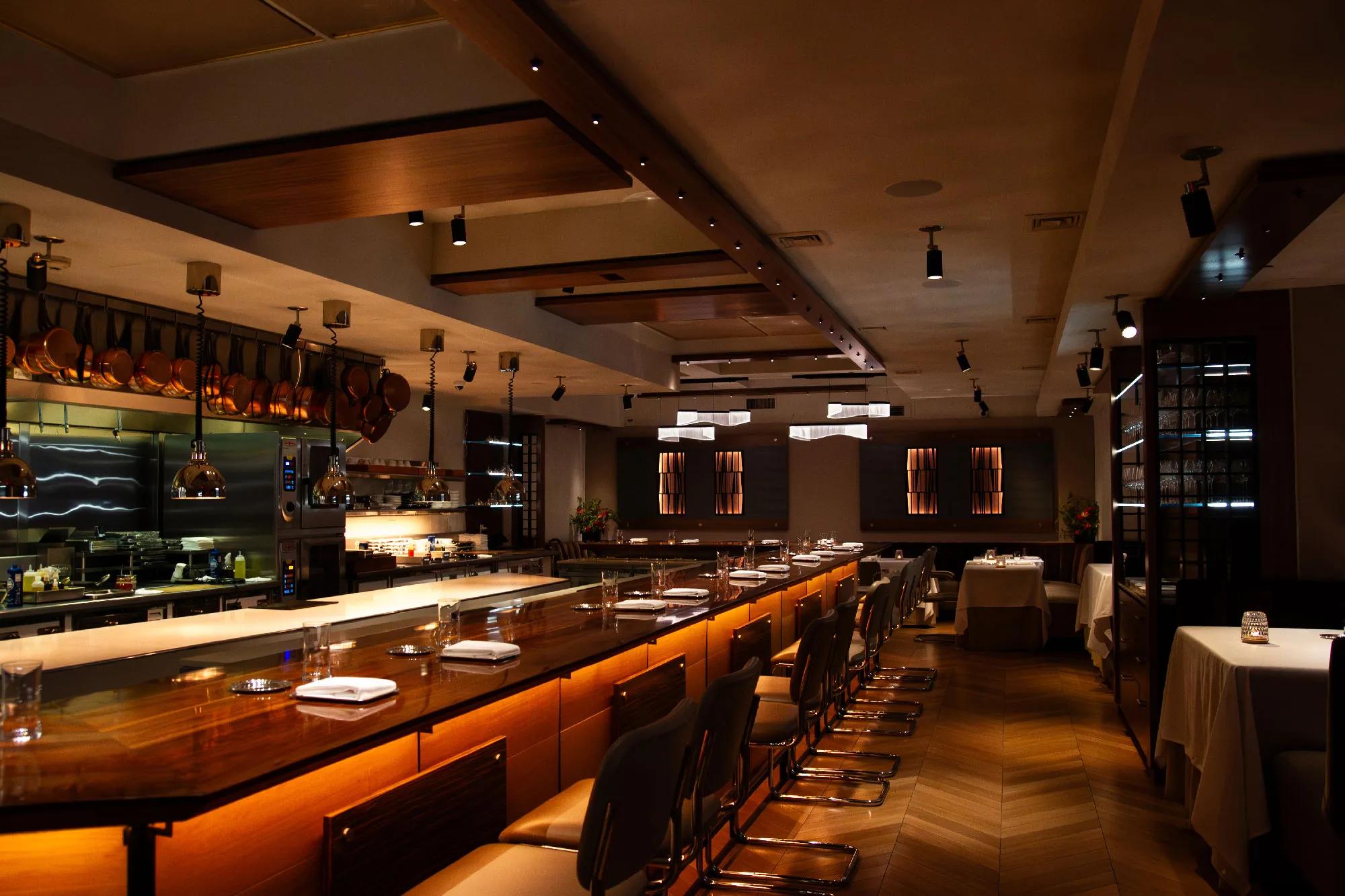
Bars in New York City
Browse all →
Hotels in New York City
Browse all →







At a Glance
- Intimate
- Elegant
- Modern
- Cozy
- Date Night
- Special Occasion
- Chefs Counter
- Open Kitchen
- Sake Program
- Local Sourcing
Current opening hours
- Monday
- 5–9:30 PM
- Tuesday
- 5–9:30 PM
- Wednesday
- 5–9:30 PM
- Thursday
- 5–9:30 PM
- Friday
- 5–10 PM
- Saturday
- 5–10 PM
- Sunday
- 5–9:30 PM
Hours can change for holidays and private events. Last verified .
Small, elegant dining room with open kitchen centerpiece, moderate noise, and intimate atmosphere.