
Tabelog 100 #32
Our verdict
A Burgers Cafe brings Shimabara into Japan’s serious hamburger conversation through a compact takeout format, modest pricing, and repeated Tabelog Hamburger 100 selections in 2022, 2024, and 2026. It is less a long-lunch restaurant than a focused stop for travelers tracking how regional Japan adapts an American form through local appetite, bread culture, and small-city discipline.

Pearl is the En Primeur Club membership app — saves, bookings, and concierge access live there. Same editors, same standards.
- Address
- 4338番地6 Honkojimachi, Shimabara, Nagasaki 855-0073, Japan
- Phone
- +81 957-62-1500
- Hours
- Mon–Tue 11:30 AM–1:30 PMWed–Thu ClosedFri–Sun 11:30 AM–1:30 PM
- Website
- tabelog.com
- Directions
- Get directions
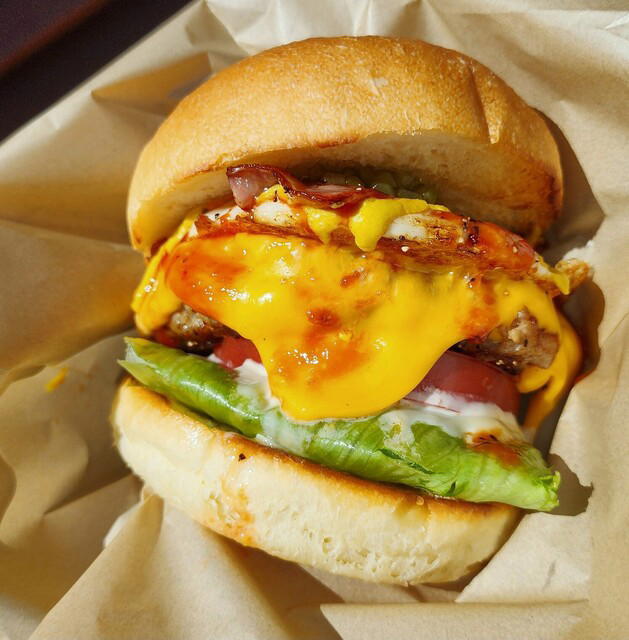
Approaching the Honkojimachi address, the rhythm is not a grand dining room but a small Japanese food stop built around speed, repetition, and a narrow service window. Shimabara is better known for castle streets, spring water channels, and the slow geography of the Ariake Sea, yet its food culture also has compact, specific formats. Here, the hamburger is not novelty. It is a lunch object shaped by the same pressures as ramen, curry, and bakery culture across regional Japan: sourcing, bread, timing, and consistency.
A Burgers Cafe belongs to the Japanese burger specialist category, where format matters more than décor. Its public listing places it under hamburger, cafe, and bread, a useful three-part clue. In Japan, burger credibility often depends as much on bun and construction as patty. A cafe-bread overlap points to a culture where Western forms are absorbed through shokupan, bakery counters, and small-batch lunch trade, not American diner nostalgia alone. For visitors mapping Shimabara dining, this is not the same choice as local Japanese cooking at Houraku or a contemporary regional table such as ペシコ.
A takeout burger in a city shaped by water, bread, and short lunch habits
The ingredient question around Japanese hamburgers usually starts with beef, but structure is more revealing. Regional burger shops must make a handheld lunch feel deliberate without luxury pricing. In Shimabara, where day trips compress meals between transport, sightseeing, and onsen routes, the takeout specialist format is more than convenience. It defines how the food is read.
The price band sits at JPY 1,000 to JPY 1,999, placing the experience in Japan’s serious casual tier rather than the premium counter bracket. That matters in 2026 because Japanese burger culture now spans chain efficiency to chef-led, ingredient-driven shops competing for specialist recognition. The Tabelog Hamburger 100 selection in 2026, following appearances in 2024 and 2022, gives the address a credential that matters within this category. It is not a Michelin-style fine-dining signal; it is narrower and, for this format, more relevant.
That recognition changes how travelers should interpret the stop. A burger in a small Nagasaki city might look like a fallback meal between more obviously local options. Here, the award history suggests specialist craft inside a modest frame. The attraction is not ceremony, but the discipline required to keep a compact menu category compelling enough for national hamburger-focused attention.
Why the sourcing story is a format story
Without a named chef or published signature item anchoring the narrative, the honest reading is category-led. Japanese burger shops that earn attention tend to reveal the supply chain through texture and assembly: bread choice, meat handling, sauce and vegetable balance, and the ability to hold together during takeout. These elements decide whether a burger survives its format.
A Burgers Cafe is listed as a takeout specialty, which puts pressure on construction. A plated burger can rely on the room, cutlery, and sides. A takeout burger has fewer hiding places. The bun must manage heat and moisture, fillings must stay legible, and the whole thing must remain coherent after leaving the counter. Ingredient sourcing becomes practical rather than romantic: bread and produce choices must work under transport conditions, not just in a photograph.
Shimabara adds a regional lens. Nagasaki Prefecture has long absorbed outside foodways, from Chinese and Portuguese influences to postwar Western-style cafes. The hamburger fits that habit of adaptation, but the city scale keeps it grounded. This is not a global luxury burger model of imported beef and heavy branding. It reads closer to Japan’s everyday craft tradition, where a narrow product category is refined through repetition, value, and local lunch demand.
For readers using EP Club to build a route rather than chase one address, separate the broader Shimabara map by mood. The full Shimabara restaurants guide compares casual meals with longer-format dining; the Shimabara hotels guide helps decide whether this is a day stop or overnight base. Drinking and after-hours planning sit in the Shimabara bars guide, and wider Kyushu itineraries can cross-check regional producers through the Shimabara wineries guide and local programming in the Shimabara experiences guide.
How it fits Japan's wider casual specialist circuit
Japan’s casual specialist restaurants reward narrow focus. Curry counters, onigiri shops, bakeries, burger stands, and sake bars can sit below fine-dining prices while attracting travelers who care about craft. That is the useful comparison set for A Burgers Cafe: compact venues where a familiar food becomes a precise object.
Across Japan, that pattern appears in many forms. A traveler might compare the discipline of a burger specialist with the single-product clarity of 1/3 HAMBURGER FACTORY in Kanazawa, the focused casual appeal of [Curry Senmon Ten] Maruyama Kyoju. in Sapporo, or the cafe-led register of.cafe in Osaka. The same logic extends outside Japan, where Jōdo Saké Bar in Los Angeles and Onigiri Time in Pasadena show how Japanese formats travel when the product is tightly defined.
Within Japan, the breadth of casual and specialist dining is the point..know in Kumamoto, (Shoku) Vietnam in Kawasaki, [ki:] in Kyoto, #肉といえば松田 奈良本店 in Kashihara, -Grilled beef Sukiyaki- KAMAKURA TANUKIAN 鎌倉 たぬき庵 in Kamakura, and. 鮪と炭火焼き うお炭 秋葉原店 in Tokyo all sit in different culinary lanes, yet each asks a similar traveler question: is the format clear enough to justify a detour?
For Shimabara, the answer is strongest when the day calls for a short, focused lunch rather than a long sit-down meal. A Burgers Cafe is not trying to represent the whole city. It gives the city a sharp casual marker, backed by repeated Tabelog category recognition and a price point that keeps the decision easy. In a regional itinerary, that combination is more useful than another generic recommendation: a defined product, a defined format, and a reason to take the hamburger seriously in Nagasaki.
Frequently asked questions
Is A Burgers Cafe a family-friendly restaurant?
It suits an easy lunch rather than a formal outing, with takeout service and a lunch window of 11:30 AM to 1:30 PM on most opening days. The address is 4338-6 Honkojimachi, Shimabara, and parking is listed as available with 4 units.
Is A Burgers Cafe formal or casual?
Casual, by format and price: it is a takeout specialty with no official website listed and a price range of JPY 1,000–JPY 1,999. The 2026 Tabelog 100 selection for Hamburger confirms its place in Japan’s specialist burger circuit without turning it into a white-tablecloth stop.
Is A Burgers Cafe expensive?
Pricing at A Burgers Cafe is listed as JPY 1,000 - JPY 1,999 JPY 1,000 - JPY 1,999 View spending breakdown.
What are the opening hours for A Burgers Cafe?
Hours at A Burgers Cafe: Mon: 11:30 AM–1:30 PM; Tue: 11:30 AM–1:30 PM; Wed: Closed; Thu: Closed; Fri: 11:30 AM–1:30 PM; Sat: 11:30 AM–1:30 PM; Sun: 11:30 AM–1:30 PM.
Where do I go for A Burgers Cafe?
A Burgers Cafe is located in Shimabara.
What's the defining dish or idea at A Burgers Cafe?
The defining idea is burgers handled as a focused takeout specialty, not an expansive menu. Tabelog lists the categories as Hamburger, Cafe, and Bread, and the venue was selected for Tabelog 100 - Hamburger - 2026.
Fast Comparison
Comparable venues by cuisine and price in the same metro.
| Venue | Cuisine | Price | Awards | Notes |
|---|---|---|---|---|
| A Burgers CafeThis venue — the venue you are viewing | American Burgers | $10–20 | Tabelog 100 #32 | Not listed |
| Houraku | Homestyle Chinese / Cafeteria | $10–20 | Tabelog 100 #50 | Kakino-ki Town, Shimabara City |
| ペシコ | Sato-hama Gastronomy | $200–300 | Tabelog Silver #104 | Shimabara |
| COCO'S | Japanese Family Restaurant | Not listed | Not listed | 文京町 |
| The BEACH BURGER HOUSE | California-style beach burger & pancake house | Not listed | Not listed | Miyazaki |
| Moose Hills Burger | Gourmet Burger Restaurant | $10–20 | Tabelog 100 #80 | Fujikawaguchiko-machi |
Recognition history
Dated appearances from independent guides and award organizations, with the underlying list record or original source where available.
Tabelog 100 #32 · No. 32
Tabelog · Tabelog 100 - Hamburger - 2026
Continue exploring
More in Shimabara
Restaurants in Shimabara
Browse all →
Bars in Shimabara
Browse all →
Details
- Casual
- Casual Hangout
- Standalone
- A La Carte
Current opening hours
- Monday
- 11:30 AM–1:30 PM
- Tuesday
- 11:30 AM–1:30 PM
- Wednesday
- Closed
- Thursday
- Closed
- Friday
- 11:30 AM–1:30 PM
- Saturday
- 11:30 AM–1:30 PM
- Sunday
- 11:30 AM–1:30 PM
Hours can change for holidays and private events. Last verified .
Casual drive-up spot focused on quick, high-quality takeout burgers