The Asbury Hotel

Michelin Selected · Mr & Mrs Smith Seal of Approval
It’s been a long time since the storied seaside town of Asbury Park was as uncomplicatedly pleasant as it is today, and the Asbury Hotel, a block from the famous boardwalk, aims to weave together the Jersey Shore’s Victorian-era history, its more recent rock-and-roll reputation, and the direct beachy fun that any seaside town aspires to. The building is a distinctive one, a red brick 1950s structure that once housed the Salvation Army. A mid-century modernist-inspired graphic sensibility marks its interiors, from the typical double rooms all the way up to its Quad and Octo floor plans, for families, rock bands, and/or entourages. The comforts are simple but modern and more than adequate, and the artwork throughout is an homage to the 20th-century heyday of the Jersey Shore. Meanwhile the Asbury’s Soundbooth bar also operates as a café and a music venue, and one of its two rooftop lounges doubles as an open-air cinema, and, in the warmer months, look for a beer garden and food trucks. Next door, the Asbury Lanes bowling alley comes complete with its own classic diner, and it probably goes without saying that Asbury Park is home to no end of other dining and drinking options.

Pearl is the En Primeur Club membership app, where members save venues, book tables and use the concierge.
Where Asbury Park's Comeback Reads in the Architecture
Approach The Asbury Hotel from 5th Avenue and the building's industrial bones read clearly against the flat Jersey Shore sky. The structure occupies a stretch of Asbury Park that spent decades in structural and economic limbo, and the hotel's conversion aesthetic makes no attempt to paper over that history. Exposed concrete, raw steel detailing, and a deliberately unpolished materiality place it inside a category of American adaptive-reuse hotels that treat grit as a design asset rather than a problem to solve. Properties like the Chicago Athletic Association in Chicago have followed a comparable logic: take a building with genuine history and let its provenance do the work that marble lobbies and bespoke fragrance programs do elsewhere.
The rooftop is the property's clearest editorial statement. Open-air, with sightlines across the city to the Atlantic, it functions as a social hub in a way that few rooftop amenities in comparably sized American markets manage. The spatial hierarchy is informal: the rooftop invites prolonged occupation rather than a quick drink with a view. That social programming sensibility connects The Asbury to a broader shift in American independent hospitality, away from the transactional check-in model and toward properties that function as active nodes in their neighborhoods.
Asbury Park and What the Hotel's Michelin Selection Signals
The Michelin Selected designation in the 2025 Hotels & Stays guide places The Asbury Hotel in evaluated company that extends well beyond New Jersey's borders. Michelin's hotel selection program operates on different criteria than its restaurant stars, emphasizing character, service consistency, and the quality of the guest experience relative to the property's stated identity. A Michelin Selected listing at a mid-format independent in a secondary coastal market signals that the hotel delivers on its premise with enough reliability to warrant external validation. For comparison, the program also covers properties as different in register as Troutbeck in Amenia and Four Seasons at The Surf Club in Surfside, which illustrates the breadth of the selection rather than a single luxury tier.
Asbury Park's transformation since the early 2000s has been documented thoroughly enough to be treated as fact rather than boosterism. The city moved from sustained disinvestment to a genuine creative district, with the music scene, the LGBTQ+ community, and independent food and bar operators arriving well ahead of the hotel investment. The Asbury Hotel opened into that context and has functioned as a consolidation point for visitors who want access to the boardwalk scene without sacrificing the kind of property credentials that travel editors and Michelin evaluators track. For a full map of where to eat and drink around the hotel, see our full Asbury Park restaurants guide.
The Design Logic and How It Positions the Property
American coastal hotels have historically split between two identities: the grand resort with white-columned grandeur and the weathered motel strip where the beach proximity is the only pitch. The Asbury Hotel operates in neither of those registers. The design vocabulary draws from mid-century industrial retrofits and the warehouse-aesthetic independent hotel movement, which matured in American urban markets before migrating to secondary cities and coastal towns. The result is a property that reads as younger and more culturally attuned than a conventional resort, without the self-conscious irony that can make the genre feel thin.
The Asbury Ocean Club Hotel represents the other dominant option in the same market, offering a more residential tower format and a different price register. The two properties serve the same geographic market but draw from overlapping rather than identical guest profiles.
Interior common spaces lean into the warehouse language: high ceilings, open sightlines, and furniture arrangements that support casual gathering. The lobby functions more like a living room than a check-in hall, a spatial decision that encourages guests to treat the ground floor as a place to spend time rather than a corridor to the elevator. Properties that have made the same structural decision, like 1 Hotel San Francisco in San Francisco, tend to attract guests who are as interested in the property's social atmosphere as in the room itself.
Comparing Registers: Where The Asbury Sits Nationally
Placed in a national context, The Asbury Hotel occupies the mid-to-upper tier of American independent coastal properties without attempting the amenity depth of large-format luxury resorts. That is a deliberate positioning rather than a shortcoming. Properties like Post Ranch Inn in Big Sur, Meadowood Napa Valley in Napa, or Amangiri in Canyon Point operate with a different brief entirely, one driven by landscape isolation, extensive spa programming, or destination dining. The Asbury's brief is urban-adjacent: give guests a well-designed base inside an active city, let the neighborhood supply the programming, and build a rooftop that keeps people on-site when the Atlantic wind cooperates.
For travelers calibrating between beach resort and city-hotel sensibilities, that distinction matters. The Little Palm Island Resort & Spa in Little Torch Key or the Kona Village, A Rosewood Resort in Kailua Kona offer a fundamentally different proposition: seclusion and controlled environment. The Asbury is a property for guests who want Asbury Park's boardwalk, music venues, and food scene to be immediately available, with a hotel that can hold its own once the evening ends.
Travelers arriving from New York have multiple surface and rail options to Asbury Park, with NJ Transit service running from Penn Station. The journey takes roughly 90 minutes to two hours depending on service, making The Asbury a realistic weekend option for the New York market without requiring a car. That rail accessibility is part of what separates Asbury Park from comparable New Jersey shore towns and explains the city's particular demographic draw. For guests oriented toward East Coast design hotels with urban energy, comparable properties in other markets include Raffles Boston in Boston, The Fifth Avenue Hotel in New York City, and Washington School House Hotel in Park City for those extending a westward itinerary.
Planning Notes
The Asbury Hotel sits at 210 5th Ave in Asbury Park, NJ, a short walk from the boardwalk and the Convention Hall. Summer weekends on the Jersey Shore fill quickly, and a Michelin Selected property at this price tier in a market with limited comparable inventory tends to sell well ahead of peak dates. Booking with adequate lead time in June through August is advisable. Shoulder season, particularly May and September, offers easier availability with the full benefit of the rooftop. The hotel's proximity to the Stone Pony and the 5th Avenue arts corridor means that music weekends and arts events can influence availability independently of standard summer peak patterns.
Quick Comparison
Comparable venues nearby, for context on price, style, and recognition.
| Venue | Cuisine | Price | Awards | Notes |
|---|---|---|---|---|
| The Asbury HotelThis venue (the venue you are viewing) | Mid-range boutique hotel housed in a restored 1950s Salvation Army building, positioned as Jersey Shore's first new hotel in 50 years and a cultural gathering space. | $100–200 | Michelin Selected · Mr & Mrs Smith Seal of Approval | Not listed |
| Asbury Ocean Club Hotel | beachfront luxury boutique | Not listed | 1 Michelin Key · Forbes Recommended | Asbury Park Boardwalk |
| Bungalow Hotel | Modern boutique with West Coast cool and surfer chic aesthetic; art-centric design by celebrity designers Courtney and Robert Novogratz. | Not listed | Michelin Selected | Pier Village |
| The James Bradley | Restored Victorian mansion reimagined as a design-forward seaside house. | $200–300 | Michelin Selected | Bradley Beach |
| The George | Modern style with historic bones in a landmark Georgian Inn. | Not listed | Michelin Selected | Montclair |
| The Chateau Grande Hotel | Contemporary chateau-style luxury boutique hotel | $200–300 | Michelin Selected | East Brunswick |
Recognition history
Dated appearances from independent guides and award organizations, with the underlying list record or original source where available.
Michelin Selected
Michelin
Mr & Mrs Smith Seal of Approval
Mr & Mrs Smith
Continue exploring
More in Asbury Park
Hotels in Asbury Park
All hotels in Asbury Park →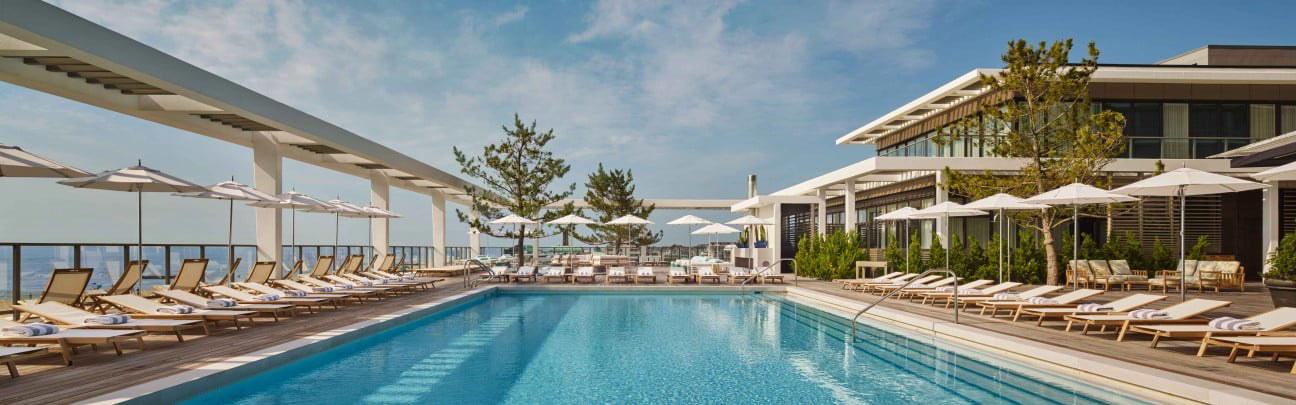
Bars in Asbury Park
All bars in Asbury Park →
Restaurants in Asbury Park
All restaurants in Asbury Park →
Wineries in Asbury Park
Browse all →


Details
- Trendy
- Energetic
- Lively
- Modern
- Weekend Escape
- Celebration
- Group Retreat
- Beachfront
- Rooftop Pool
- Historic Building
- Design Destination
- Live Music
- Wi Fi
- Pool
- Fitness Center
- Waterfront
- Wheelchair Accessible
- Elevator
- Accessible Restroom
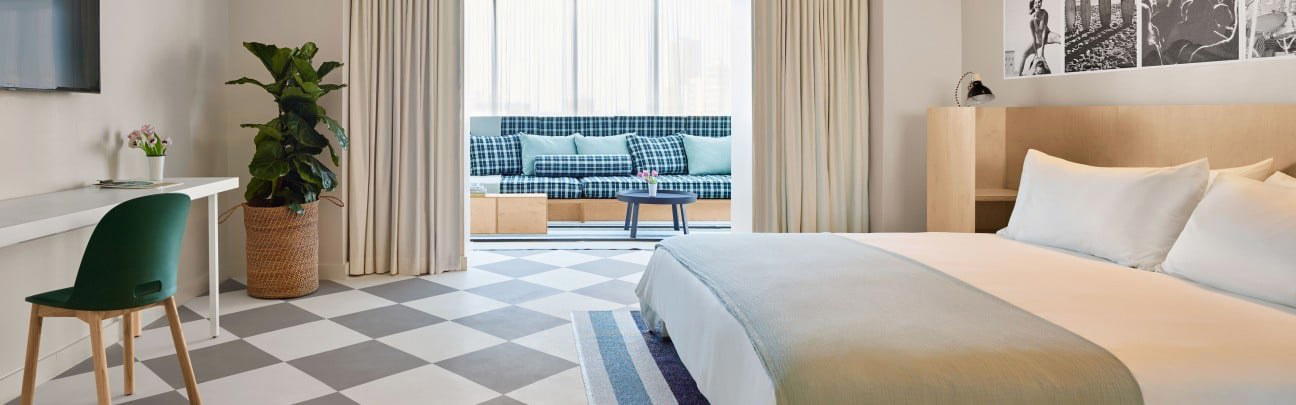
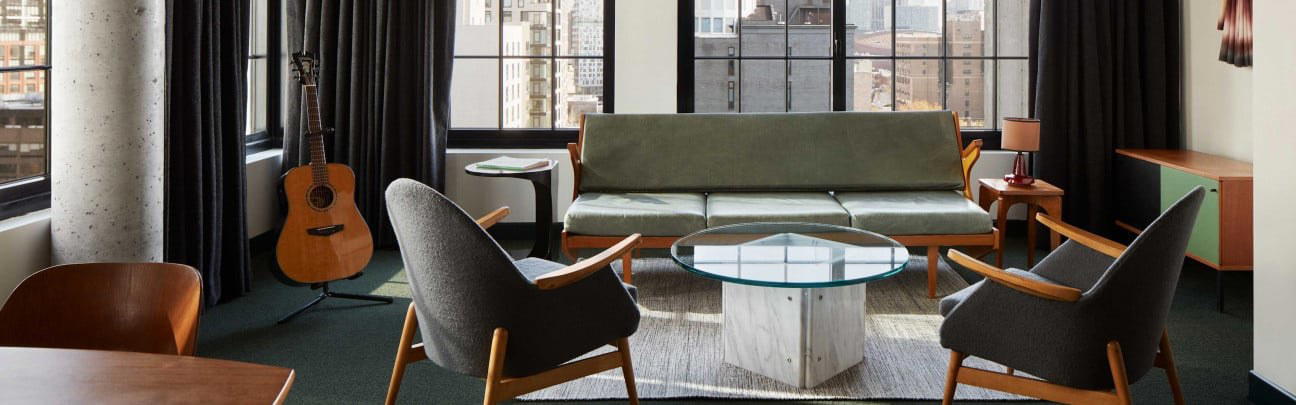
Light-filled, pared-down Scandinavian-inspired rooms with bold geometric patterns and black-and-white photos of musical greats; buzzy, energetic lobby bar and social spaces with live music, retro touches, and lively atmosphere.