Soi Hanok Stay (소이 한옥스테이)
Soi Hanok Stay occupies Gyeongju's expanding tier of architecturally considered hanok accommodation, where traditional Korean timber-frame construction meets considered modern hospitality. The property sits within South Korea's most historically concentrated city — a UNESCO World Heritage designation anchors the entire region — and positions itself for travellers who want proximity to Silla-era heritage without trading structural authenticity for comfort.
 Discover on Pearl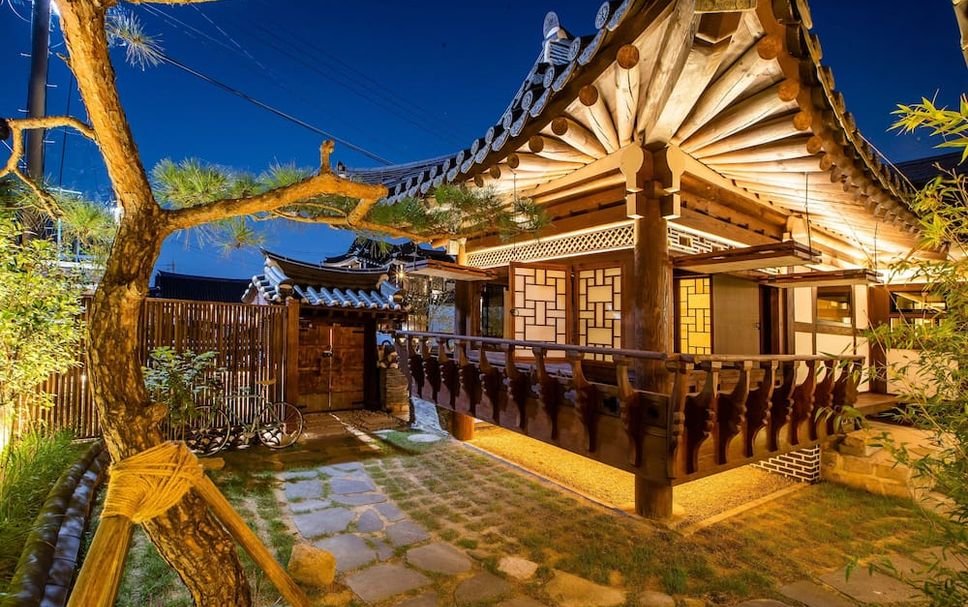
Timber, Tile, and the Weight of Gyeongju
Approaching a hanok in Gyeongju carries a different quality of anticipation than checking into almost any other form of accommodation in South Korea. The city itself operates as a kind of open-air archive: burial mounds interrupt the urban grid, stone pagodas appear at the end of ordinary streets, and the surrounding Gyeongbuk region holds a density of UNESCO-listed heritage that few cities anywhere can match. Against that backdrop, the choice of a hanok stay is not aesthetic preference alone — it is a decision about what kind of relationship with place you want during your time here.
Soi Hanok Stay (소이 한옥스테이) positions itself within Gyeongju's growing category of design-attentive traditional accommodation. Hanok as a building typology is architecturally specific: curved clay-tile roofs, timber post-and-beam construction, and interior courtyard arrangements that regulate light, airflow, and the relationship between indoors and outside. These are not arbitrary decorative choices. They represent a building logic developed across centuries of Korean domestic architecture, and properties that preserve that logic without collapsing it into theme-park reproduction occupy a distinct tier in the market for heritage travel.
The shortlist, unlocked.
Hard-to-book tables, cellar releases, and concierge-planned trips.
Get Exclusive Access →What Hanok Architecture Actually Means for the Guest
The structural vocabulary of a hanok shapes daily life in ways that a conventional hotel room does not. Ondol floor heating — the traditional Korean radiant system in which heat circulates beneath stone or wood floors , means that the warmth in a hanok comes from below, not from a wall unit. Guests typically sleep closer to the floor, on bedding laid directly on the heated surface, which changes the spatial grammar of the room entirely. The courtyard, where one exists, functions as a pressure valve between interior and exterior: a place to sit in the morning before the city fully activates, or to observe the way light moves across a tiled roof as the afternoon passes.
Across South Korea's premium hanok accommodation sector, properties have split into two broad types. The first preserves the physical structure of historic buildings with minimal intervention, accepting the limitations that come with centuries-old construction. The second uses traditional architectural forms as a design framework while incorporating contemporary infrastructure , plumbing, insulation, climate control , at a standard that meets modern expectations. The second approach dominates Gyeongju's newer hanok stays, because the city draws a wide visitor profile: domestic travellers on cultural weekends, international visitors with UNESCO itineraries, and an increasing number of guests specifically seeking accommodation that complements the heritage experience rather than existing in parallel to it.
Gyeongju as a Setting
Gyeongju's claim on the traveller's attention rests on a concentration of Silla dynasty (57 BCE to 935 CE) heritage that has no direct equivalent elsewhere on the peninsula. Tumuli Park, with its grass-covered royal burial mounds rising from the city centre, sits within walking distance of active commercial streets. Bulguksa Temple , a UNESCO World Heritage Site since 1995 , requires a short trip southeast into the mountains, where it shares a designation with the nearby Seokguram Grotto. The Gyeongju Historic Areas as a whole received UNESCO listing in 2000, covering five distinct zones of concentrated monuments and sites.
For a hanok property in this context, location within the city matters considerably. Gyeongju's historic core clusters around the tumuli and the old city grid, while the Bulguksa and Seokguram sites require transport. Travellers weighing accommodation options should clarify proximity to the zones they plan to spend most time in, since Gyeongju rewards slow, walking-paced exploration more than itinerary-dense day-tripping.
For a broader sense of South Korea's accommodation range across different city profiles, Ananti at Busan Cove in Busan represents the large-footprint coastal resort approach, while Kensington Hotel Seorak in Sokcho-si offers a reference point for mountain-adjacent leisure stays. Gyeongju's hanok tier occupies a different register entirely: smaller, more architecturally specific, and tied to a particular kind of cultural proximity that neither resort model replicates.
Planning Your Stay
Gyeongju draws its heaviest visitor numbers during spring cherry blossom season (typically late March to mid-April) and autumn foliage (October to early November), when the tumuli and temple grounds photograph at their most atmospheric and accommodation across the city books out well in advance. Shoulder months , May, June, and September , offer more availability and cooler conditions than the humid Korean summer. Winter stays have their own logic: the landscape quiets, Bulguksa under snow is a different experience entirely, and ondol heating in a hanok room becomes a genuine argument for the format over conventional alternatives.
Direct access to Gyeongju from Seoul is possible by KTX high-speed rail to Singyeongju Station, with journey times from Seoul Station running approximately two hours. The station sits outside the historic city centre, so local transport or a taxi is needed to reach central accommodation. From Busan, travel time drops to under thirty minutes on the same line, making Gyeongju a viable day-trip destination from the coast, though the heritage depth of the city rewards at least an overnight stay.
For context on other considered property formats across South Korea, Camptong Forest in Gapyeong and Gangwon-do in Hongcheon illustrate how the nature-immersion category has developed in the northern provinces, while Grand Hyatt Jeju in Jeju-si and JW Marriott Jeju Resort & Spa in Seogwipo anchor the island's international-brand tier. Seoul's upper bracket, for reference, runs from [Four Seasons Hotel Seoul] through [Josun Palace, a Luxury Collection Hotel] to the [JW Marriott Hotel Seoul] , all operating in a price and service register well above Gyeongju's hanok category. See our full 경주시 restaurants guide for dining context in the city.
For international comparisons in design-led small-property accommodation, Castello di Reschio in Lisciano Niccone operates on a similar philosophy of architectural heritage as the primary guest experience, as does Aman Venice in Venice in its relationship between historic structure and contemporary hospitality infrastructure. The common thread across these properties is that the building itself carries meaning that a purpose-built hotel cannot replicate.
Frequently Asked Questions
- Is Soi Hanok Stay more formal or casual?
- Hanok accommodation in Gyeongju sits firmly on the casual end of the formality scale. The format is intimate by definition , small key counts, courtyard settings, and floor-based sleeping arrangements lend themselves to relaxed, self-directed stays rather than structured hotel service. Gyeongju as a city is oriented around cultural site visits rather than dining or nightlife, which reinforces the low-formality character of properties like Soi Hanok Stay. Dress code is not a consideration here.
- Which room offers the leading experience at Soi Hanok Stay?
- Without confirmed room-category data, a general principle applies across Gyeongju's hanok tier: rooms with direct courtyard access or refined garden views typically justify any price premium over standard rooms. In hanok architecture, the relationship between the interior and the courtyard is structurally central, and rooms that preserve that connection deliver the most coherent architectural experience. Confirming room configurations directly with the property before booking is advisable.
- What is Soi Hanok Stay known for?
- Soi Hanok Stay sits within Gyeongju's category of traditional Korean hanok accommodation, positioning itself for travellers who want the physical experience of timber-frame, tile-roof construction in South Korea's most heritage-dense city. Gyeongju's UNESCO World Heritage designation across five site zones gives any hanok property in the city a locational argument that properties in less historically concentrated cities cannot make. The combination of architectural format and cultural proximity to Silla-era monuments defines what this kind of stay offers.
- Can I walk in to Soi Hanok Stay?
- Walk-in availability at Gyeongju hanok properties is structurally limited by their small scale. Properties in this category typically have low key counts, and during Gyeongju's peak seasons (spring and autumn) they book out well ahead. Advance reservation is the reliable approach. Contact details and booking channels are leading confirmed through current listings, as smaller independent properties in this category sometimes update their booking infrastructure more frequently than larger hotels.
- Is Gyeongju hanok accommodation suitable for first-time visitors to South Korea?
- Gyeongju hanok stays work well for first-time visitors specifically because the city's heritage concentration provides immediate, walkable cultural context , the architecture of the accommodation and the monuments outside reinforce each other. That said, travellers accustomed to international hotel infrastructure should note that hanok formats involve different spatial arrangements (floor sleeping, courtyard orientation, ondol heating) that reward openness to the format. Gyeongju is approximately two hours from Seoul by KTX rail, making it a practical addition to a first itinerary rather than a detour.
Side-by-Side Snapshot
These are the closest comparables we have in our database for quick context.
Preferential Rates?
Our members enjoy concierge-led booking support and priority upgrades at the world's finest hotels.
Get Exclusive AccessThe shortlist, unlocked.
Hard-to-book tables, cellar releases, and concierge-planned trips.
Get Exclusive Access →