



Six Senses Shaharut occupies a cliff edge in Israel's Negev Desert, its structure engineered to disappear into the rock rather than dominate it. The resort earned LEED Certification — the first hotel in Israel to do so — and a 90-point score on La Liste's 2026 Top Hotels ranking. Access from Tel Aviv takes three and a half hours by road, or under an hour by air to Eilat followed by a 45-minute transfer.
Pearl is the En Primeur Club membership app — saves, bookings, and concierge access live there. Same editors, same standards.
- Address
- Hevel-Eilot, Negev Desert, Israel 8886500, Shaharut, 8886500
- Phone
- +972 8-615-0055
- Website
- sixsenses.com
- Directions
- Get directions
 Saves & bookings on Pearl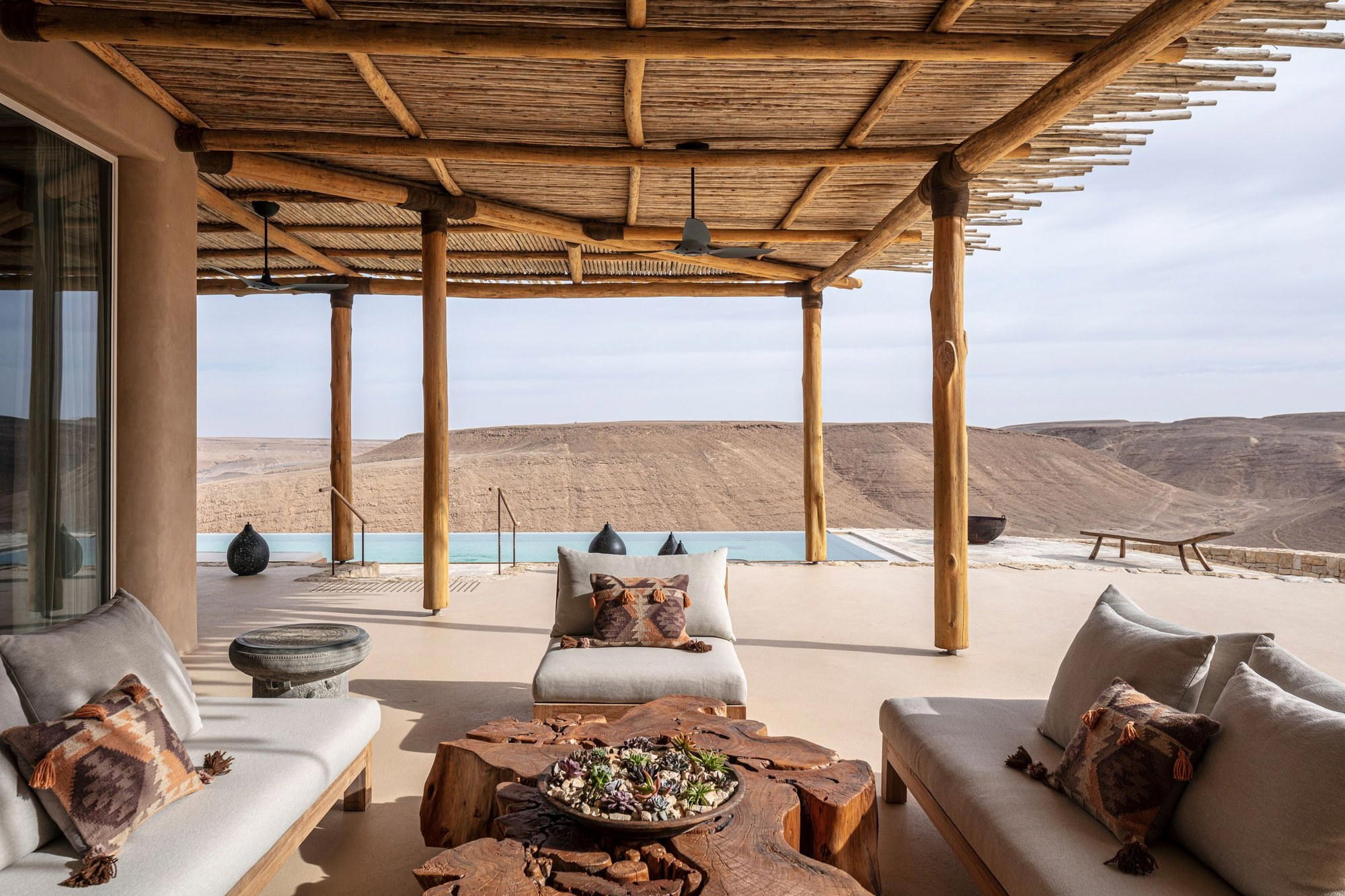
Built Into the Rock, Not On top of It
The Negev Desert presents a particular design challenge: any structure placed against its ancient cliff faces either submits to the geology or fights it. Six Senses Shaharut, positioned at altitude in the Hevel-Eilot region of Israel's southern Negev, belongs to the first camp. The resort's architecture reads less as construction than as excavation — volumes that follow the cliff's natural grain, materials drawn from the same palette as the surrounding sandstone, and massing kept low enough that the horizon remains the dominant visual event. Approaching at dusk, when the dunes shift from burnt orange to deep amber before the sky turns to black, the property barely registers as man-made. That is the precise effect the design team was aiming for.
This approach to desert architecture has a specific precedent in the region. The ancient Nabataean civilisations that shaped the Negev's trade routes built into cliff faces rather than across open ground, minimising exposure to wind, heat, and the psychological weight of the open desert. Six Senses Shaharut draws on that sensibility, consciously or not, producing a property that feels like it belongs to a long continuum of human presence in this landscape rather than an interruption of it.
LEED Certification and What It Actually Means Here
Six Senses Shaharut holds the distinction of being the first hotel in Israel to receive LEED Certification from the U.S. Green Building Council — a credential that carries specific, measurable implications rather than serving as a vague sustainability badge. The rating reflects a 25 percent reduction in energy consumption relative to a standard build of comparable scale, achieved through high-efficiency mechanical and electrical systems and occupancy-sensor lighting throughout the property. In a desert environment where cooling loads are extreme and grid infrastructure is remote, that figure represents a meaningful engineering commitment.
The sustainability architecture extends beyond energy. Water is bottled on-site in glass using a BevGuard filtration system, eliminating plastic entirely. Food waste feeds an organic garden on the property. Used cooking oil from the kitchen is donated to a local biodiesel programme. A palm grove on-site absorbs 100 percent of treated wastewater, meaning the property discharges zero liquid into the surrounding environment. These are not isolated gestures but components of a closed-loop system that the resort makes legible to guests through its Earth Lab, an interactive facility where local community members lead workshops on desert craftsmanship and sustainability practice. For properties in this tier, the Earth Lab format is unusual: it externalises the sustainability story rather than keeping it operational-only, which shifts it from credential to genuine programme.
La Liste's 2026 Leading Hotels ranking placed Six Senses Shaharut at 90 points, a score that situates it in the upper band of globally recognised desert and wilderness properties, comparable in positioning to desert-format peers in the American Southwest or Wadi Rum. Within Israel's accommodation market, the comparison set is smaller. Properties such as Beresheet in Mizpe Ramon and the Beresheet Hotel in Beersheba occupy adjacent desert territory, but Six Senses Shaharut operates at a different architectural and programmatic register, closer in spirit to Amangiri in Canyon Point, a property similarly built around the idea that the landscape is the primary amenity and the hotel's job is not to compete with it.
The Journey as Part of the Stay
Getting to Shaharut is not incidental to the experience; it is the opening act. From Tel Aviv or Jerusalem, the drive south takes three and a half hours through terrain that changes character steadily as the Mediterranean coastal zone gives way to the Judean foothills and then to the open Negev. For guests preferring air travel, the route from Tel Aviv to Eilat takes approximately 50 minutes by domestic flight, followed by a 45-minute transfer to the property, a total door-to-door time comparable to many urban airport connections. From Petra, the transfer runs roughly three hours, which positions the property as a logical extension of a Jordan circuit for travellers combining both countries. The geography of arrival matters here because the desert's scale becomes legible only in transit; by the time the property appears on the cliff edge, the context for understanding it has already been established.
The resort operates on a quiet-haven model and currently welcomes guests aged 12 and older, a policy that shapes the atmosphere considerably. This is not a property organised around children's programming or high-volume family facilities. The tone skews toward adults seeking the specific quality of silence that southern Israel's desert belt can provide, a silence that is not merely the absence of noise but a positive characteristic of the landscape, something the Nabataean cities of the Negev, now a UNESCO World Heritage Site, were built to accommodate.
Positioning Within Israel's Premium Accommodation Market
Israel's upper accommodation market spans a wide geographic and stylistic range. Urban properties like the David Citadel Hotel in Jerusalem and design-forward city hotels like Brown TLV Urban Hotel in Tel Aviv operate on a different logic entirely, built around cultural access, walkable neighbourhoods, and urban programming. The Efendi Hotel in Acre represents a third mode: heritage architecture in a historically layered city. Six Senses Shaharut belongs to none of these categories. It is a wilderness property first, with its value proposition rooted in landscape immersion, design restraint, and the kind of structured solitude that very few properties in the region can credibly offer. For readers comparing the Israeli desert experience against international wilderness benchmarks, the La Liste score and the LEED credential together provide the clearest signal: this property operates at a tier where peer properties in the American Southwest, the Jordanian desert, or the Moroccan High Atlas would be the relevant reference points. For more on what Israel's broader property scene offers, our full Shaharut restaurants and hotels guide covers the surrounding region in detail.
Globally, the category of high-design desert wilderness hotels has grown significantly over the past decade, with properties like Castello di Reschio in Italy and Hotel Esencia in Tulum demonstrating that guests in the leading accommodation tier are increasingly drawn to properties that place landscape at the centre of the offer rather than treating it as backdrop. Six Senses Shaharut fits within that broader shift, adding the specific credential of first-in-country LEED status and a La Liste score that confirms its standing within the international peer group.
Planning a Visit
Advance planning matters for a property of this type. Desert wellness retreats with limited capacity and a focused guest profile tend to book well ahead of arrival, particularly during the Negev's cooler months from October through March, when daytime temperatures are navigable and the night sky, at this altitude, with minimal light pollution, reaches full clarity. The journey from Tel Aviv by road or the Eilat air connection are both practical entry points. Guests incorporating a Petra visit can approach from the north via Jordan in approximately three hours. For context on how this property compares to other landmark desert and landscape-led hotels, properties like Elma Arts Complex in Hadera offer a different register of Israeli hospitality, while international comparators such as Cheval Blanc Paris, Aman Venice, and Mandarin Oriental Bangkok illustrate the global tier within which Six Senses Shaharut now operates.
Recognition history
Dated appearances from independent guides and award organizations, with the underlying list record or original source where available.
La Liste Top Hotels
La Liste
Virtuoso Luxury Hotel Partner
Virtuoso
Michelin Selected
Michelin
World Spa Awards Middle East's Best Wellness Retreat 2025 Nominee
World Spa Awards
World Spa Awards Israel's Best Wellness Retreat 2025 Winner #1
World Spa Awards
Continue exploring
More in Shaharut
Hotels in Shaharut
Browse all →
At a Glance
- Quiet
- Scenic
- Elegant
- Minimalist
- Sophisticated
- Rustic
- Honeymoon
- Romantic Getaway
- Wellness Retreat
- Weekend Escape
- Infinity Pool
- Private Villa
- Destination Spa
- Panoramic View
- Wi Fi
- Pool
- Spa
- Fitness Center
- Room Service
- Concierge
- Sauna
- Mountain
- Wi Fi
- Pool
- Spa
- Fitness Center
- Room Service
- Concierge
- Sauna
Tranquil desert serenity with natural light through floor-to-ceiling windows, earthy tones, raw stone walls, and a sense of calm oasis-like retreat.
Know Before You Go
- Getting there
- Hevel-Eilot, Negev Desert, Israel 8886500, Shaharut, 8886500