Wadi Rum Night Luxury Camp sits inside Jordan's protected desert reserve, where accommodation structures are designed to dissolve into the red sandstone surroundings rather than impose upon them. The camp occupies a tier of desert hospitality that prioritises spatial drama over conventional hotel amenities, placing guests directly inside one of the Middle East's most geologically compelling landscapes. Advance planning and direct inquiry are essential given the remote location and limited capacity.

Pearl is the En Primeur Club membership app, where members save venues, book tables and use the concierge.
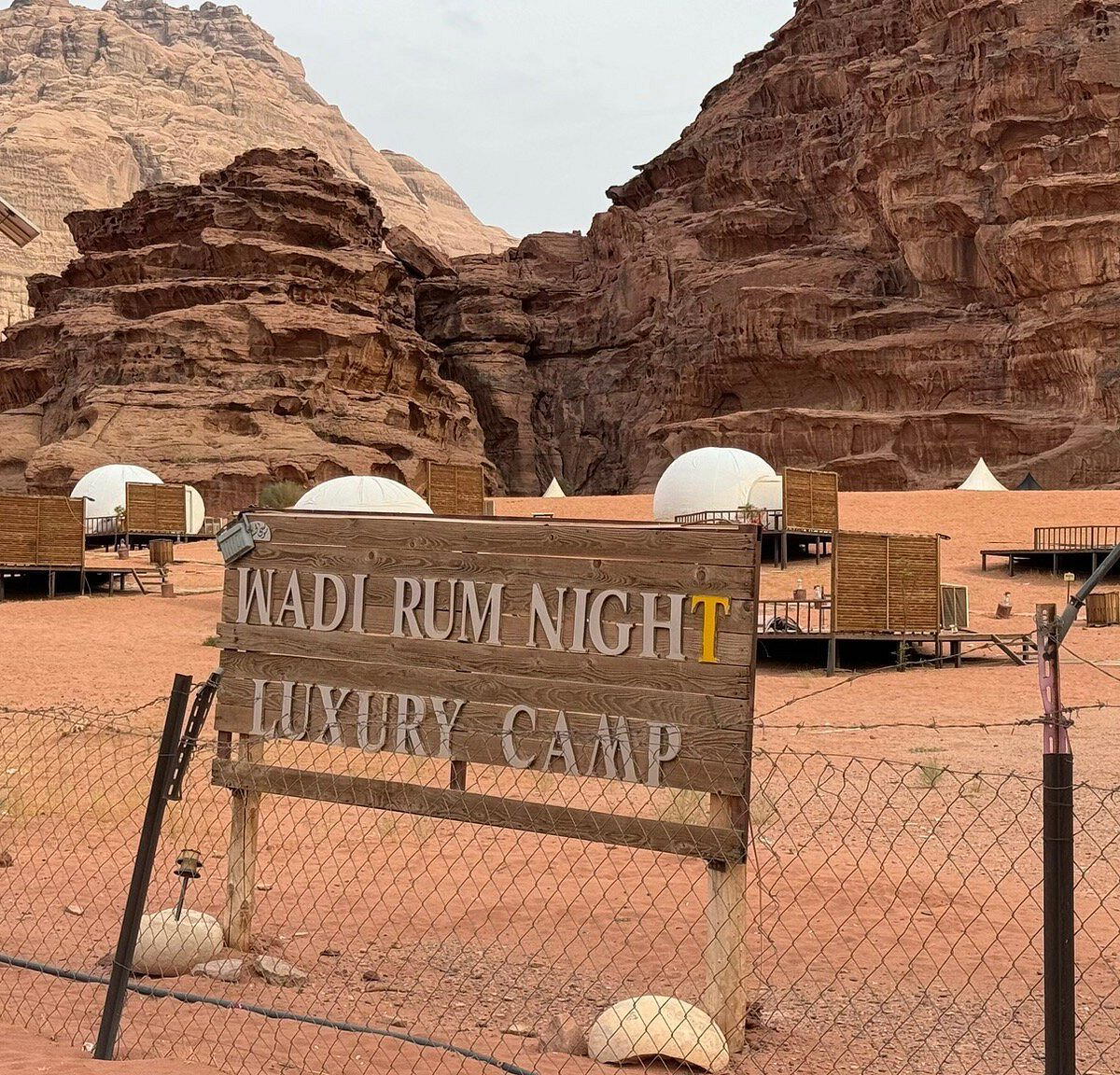
Where the Architecture Is the Desert Itself
There is a particular category of desert accommodation that refuses the logic of the conventional hotel: no lobby chandelier, no marble corridor, no curated art collection hung at eye level. Instead, the structure defers entirely to the landscape outside it, and the landscape in Wadi Rum is severe enough to make that deference feel rational. The protected reserve covering roughly 720 square kilometres of southern Jordan contains some of the most recognisable rock formations in the Middle East: Precambrian sandstone towers, iron-oxide plains that shift between orange, crimson, and deep burgundy depending on the hour, and a silence that is not emptiness but geological weight. Wadi Rum Night Luxury Camp occupies this reserve as a design premise, situating its accommodation within that context rather than against it.
The broader approach taken by camps in this tier of Wadi Rum hospitality involves tent and dome structures engineered to provide thermal comfort in a desert that can swing from intense afternoon heat to cold nights, particularly from October through March. The design challenge in this environment is a specific one: how to give a structure a sense of permanence and enclosure without disconnecting it from the 360-degree spectacle outside. Transparent or semi-transparent domed structures, which have become the architectural shorthand for premium desert accommodation globally, address this by treating the ceiling as a picture window. In Wadi Rum, where the Milky Way is visible on clear nights without light pollution from any significant urban source, that ceiling view becomes the amenity that justifies the category.
The Camp Within the Reserve: Physical Context
Wadi Rum Village serves as the entry point for the protected area, and from there access is restricted to licensed operators using four-wheel-drive vehicles or camels along tracks that cut through the sandstone. This access model is not incidental to the experience; it is structurally enforced by the reserve's conservation status, which limits what can be built, where, and at what density. The result is that premium camps in the area operate at low capacity by necessity, which in turn shapes the ratio of space to guest that higher-tier properties can offer.
That spatial ratio is one of the defining characteristics of the Wadi Rum luxury camp category. Properties operating at low capacity in a 720-square-kilometre reserve are, by geometric logic, offering something that scaled resort infrastructure cannot replicate: the reasonable prospect of sitting outside your structure and seeing no other structure. For travellers who have experienced large-format desert resorts elsewhere in the region, the difference in atmosphere is significant.
The camp sits in this geography not as an outpost of international hotel culture but as a structure that draws its logic from the terrain. Where properties like Amangiri in Canyon Point embed their architecture into American canyon geology using poured concrete designed to echo desert colours, the Wadi Rum camp category works with a lighter material palette, typically fabric, steel, and in some cases curved polycarbonate panels for dome formats. The restraint is partly regulatory, partly practical, and partly an aesthetic position that has become the defining visual language of this accommodation tier globally.
Comparable Frameworks for Premium Desert Accommodation
The conversation around what constitutes appropriate luxury in extreme natural environments has shifted considerably in the last decade. International precedents, from the tent camps of Botswana's Okavango to the desert lodges of Namibia's Namib-Naukluft, established an early framework: premium accommodation in protected wilderness should leave a light footprint and provide comfort without erecting the infrastructure of a conventional hotel. Jordan's Wadi Rum camps belong to this lineage, adapted for a desert environment with its own regulatory architecture and Bedouin cultural context.
That Bedouin context is not decorative. The reserve's cultural history is documented in rock inscriptions, some dating back thousands of years, and the tradition of desert hospitality encoded in Bedouin practice, including the offering of tea, the orientation of gathering spaces toward the open horizon, and the reliance on fire as a social anchor, shapes how experiences at camps like this are structured. Zarb, a slow-cooked underground method of preparing meat and vegetables that is specific to Bedouin tradition in this region, appears consistently in camp dining formats, though the specific menu and format at Wadi Rum Night Luxury Camp should be confirmed directly with the property.
For travellers calibrating their Jordan itinerary, the camp sits within a wider regional context. The Dead Sea resorts, including Hilton Dead Sea Resort & Spa in Sweimeh and Holiday Inn Resort Dead Sea by IHG, represent the scaled resort end of Jordanian accommodation, and Kempinski Hotel Ishtar Dead Sea operates at a higher tier within that format. Wadi Rum camps occupy an entirely different structural position: remote, low-capacity, experience-oriented, and dependent on the surrounding protected landscape as their primary amenity. The Mujib Chalets in the Mujib Biosphere Reserve represent a lower-infrastructure iteration of the same protected-landscape hospitality model. Bedouin Garden Village in Aqaba offers a coastal alternative for those building a southern Jordan itinerary that combines the desert with the Red Sea.
Planning and Practical Considerations
The remoteness of Wadi Rum Night Luxury Camp is not a variable that softens with advance planning; it is a fixed condition of the location. The reserve sits approximately 300 kilometres south of Amman, making it a logical pairing with Petra, which lies around 100 kilometres to the north. Most itineraries position Wadi Rum as a one- or two-night stay within a broader Jordan circuit, though the case for a longer stay is strong if the objective is to move through the reserve at different times of day, when the light and colour of the sandstone change materially. Sunrise and sunset are the architecturally significant hours here: the formations shift colour across a spectrum that cannot be experienced from a single observation point at a single time.
Given limited availability at low-capacity camps in a reserve where new construction is tightly controlled, bookings for peak periods, particularly the cooler months from October through April when daytime temperatures are manageable and night skies are clearest, should be made as far in advance as possible. Visitors should contact the camp directly for current availability, rates, and transfer arrangements from Wadi Rum Village, as no third-party booking policy or pricing is confirmed in publicly available data. See our full Village restaurants guide for broader context on the area.
A Quick Peer Check
| Venue | Price | Awards |
|---|---|---|
| Wadi Rum Night Luxury CampThis venue (the venue you are viewing) | $200–300 | Not listed |
| Fairmont Amman | $200–300 | 1 Michelin Key · Forbes Recommended |
| Four Seasons Hotel Amman | Not listed | 1 Michelin Key · La Liste Top Hotels |
| The Ritz-Carlton, Amman | $300–500 | 1 Michelin Key · Forbes 4-Star |
| The St. Regis Amman | $300–500 | 1 Michelin Key · Forbes 4-Star |
| W Amman | $100–200 | Michelin Selected · Forbes Recommended |
Continue exploring
More in Village
Details
- Romantic
- Scenic
- Rustic
- Cozy
- Intimate
- Romantic Getaway
- Honeymoon
- Weekend Escape
- Panoramic View
- Terrace
- Wi Fi
- Room Service
- Mountain
Cozy atmosphere with romantic lantern light, bonfires, and magical desert nights under twinkling stars.