


Rebuilt on the bones of the historic Hotel de la Paix, Park Hyatt Siem Reap sits at the walkable centre of town on Sivutha Boulevard, a few hundred feet from the Old Market and the royal residence. Its 107 rooms and suites wrap a Khmer-inflected courtyard, and the three-storey Spa Indochine gives the property a genuine retreat dimension that most of its city-centre competitors cannot match. Rates from $367 per night.
 Discover on Pearl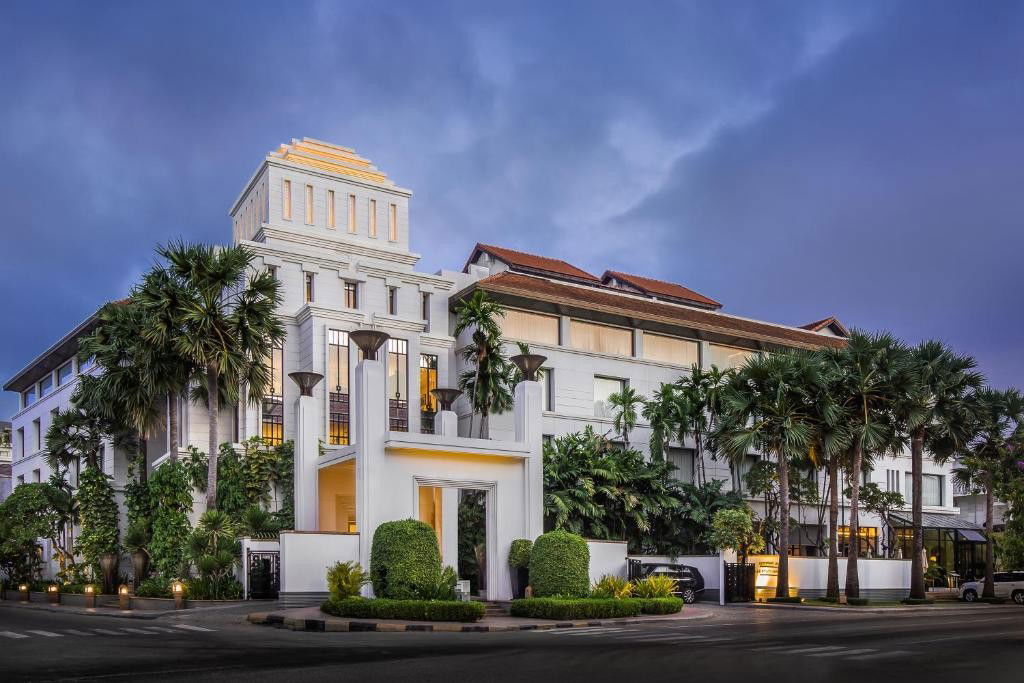
A Courtyard City at the Centre of Siem Reap
Siem Reap's luxury hotel tier has long been divided between two distinct spatial models: riverside properties that trade on proximity to the Siem Reap River and its colonial promenade, and centrally positioned hotels that prioritise walkability over water views. Park Hyatt Siem Reap belongs firmly to the second category, and for many travellers that distinction resolves the booking decision before they reach the amenities list. Sivutha Boulevard places the hotel within a few hundred feet of the Old Market, the royal residence, and the cluster of streets that form the social core of the city. That central positioning is measurable in time saved rather than in abstract lifestyle appeal.
The property itself was rebuilt from the Hotel de la Paix, a structure with Art Deco origins that gave the architects a clear visual language to work with. The result draws from two directions simultaneously: Khmer design flourishes, expressed through carved motifs, warm tropical wood, and local art, sit alongside white multi-tiered ceilings, colonial-style ceiling fans, and century-old framed French blueprints for Angkor. The rooms do not try to resolve that tension so much as hold it as a deliberate aesthetic position. Across 107 rooms and suites, the core palette runs to warm yellows and sea blues against dark furniture, with Italian marble bathrooms throughout, each including both a soaking tub and a separate shower.
The Retreat Dimension: Spa Indochine and the Logic of Stillness
In Southeast Asian luxury, wellness programming has split into two broad approaches. The first treats the spa as an amenity annexed to a hotel — a room list with treatments. The second builds the spa as a structural element of the property, with enough physical presence and programming depth to function as a reason for choosing the hotel rather than a benefit discovered after arrival. Spa Indochine, spread across three storeys, falls into the latter group. Its footprint within the overall hotel architecture gives it a weight that single-floor hotel spas rarely achieve.
The wellness argument for Park Hyatt Siem Reap extends beyond the treatment menu. The saltwater pool on the first floor, framed by a series of white angular arches and finished in green tiles, is designed for extended use rather than a quick lap and exit. Private corners are integrated into the layout, giving the pool a retreat quality that the ground-floor lap pool, functional as it is, does not replicate. Complimentary cold water and sunscreen at poolside are operational signals: the property assumes guests will spend real time there, not just pass through. For a traveller whose Angkor temple itinerary involves pre-dawn starts and significant physical exposure to heat and humidity, that assumption matters more than it might in a less demanding destination.
Room selection shapes the retreat experience materially. Courtyard-facing rooms deliver greener views and significantly less traffic noise than their street-facing counterparts, a distinction that becomes relevant in a city centre location where ambient sound cannot be managed through geography alone. At the higher end of the room hierarchy, suites offer a choice between private plunge pools or rooftop gardens. The 1,859-square-foot Pool Suite extends the retreat logic furthest: two bedrooms each with its own bathroom, two living areas with glass doors opening directly to a private plunge pool. That format functions as a self-contained unit within the hotel rather than simply a larger version of a standard room.
Cultural Programming as Active Wellness
The most interesting aspect of Park Hyatt Siem Reap's programming is its approach to local culture as something woven into the stay rather than offered as an optional excursion. Every Monday, Wednesday, Friday, and Sunday, the hotel presents a dinner show in The Dining Room courtyard combining apsara dancing with bokator martial arts. Apsara is the classical Khmer dance tradition with roots in Angkor-era temple iconography; bokator is a centuries-old Cambodian combat art that was nearly lost during the Khmer Rouge period and has since been revived. Presenting both in the same setting draws a connection between Cambodia's refined artistic traditions and its more physical heritage, and does so on a regular schedule rather than as an occasional feature.
The Num Bahn Chok Tour, led by the hotel's chef and focused on Cambodia's rice noodle dish, belongs to the same logic. Farm-to-table formats have become familiar in luxury hospitality globally, but the specific context here, a dish that functions as daily breakfast food for much of Cambodia, gives the experience a grounded quality that generic market tours often lack. It places the guest inside a local food tradition at its most ordinary and routine rather than at its most festive or performative. For guests using Siem Reap as a base for Angkor visits, these in-hotel programmes provide cultural access that requires no independent research or logistics.
Where Park Hyatt Siem Reap Sits in the City's Competitive Set
Siem Reap's luxury hotel options span a wide range of formats and scales. Amansara operates as an ultra-exclusive all-suite enclave, with its small key count and inclusion pricing placing it in a different tier entirely. Raffles Grand Hotel d'Angkor carries more colonial-era heritage than any property in the city but sits at a remove from the immediate centre. Anantara Angkor Resort and Sofitel Angkor Phokeethra Golf & Spa Resort both offer comprehensive resort formats with more extensive grounds than a city-centre footprint allows. Shinta Mani Angkor and Bensley Collection Pool Villas positions itself around design provenance and social enterprise credentials. Angkor Village Hotel and FCC Angkor by Avani operate at lower price points with different architectural characters. Sala Lodges occupies the boutique end with a village-within-a-garden format.
Park Hyatt Siem Reap's position in that field is defined by two factors: the combination of Hyatt brand infrastructure and service consistency at 107 keys, and a central location that none of its larger-scale competitors match. Rates starting at $367 per night place it in the upper-mid tier of city options, above the Avani-bracket properties and below Amansara's all-inclusive pricing. The Google rating of 4.6 from 779 reviews suggests the service delivery holds across a substantial sample rather than appearing only in curated coverage.
Travellers considering Cambodia more broadly will find comparable levels of heritage-inflected luxury at Raffles Hotel Le Royal in Phnom Penh and different terrain altogether at Shinta Mani Wild in Prey Praseth Village or Six Senses Krabey Island in Sihanoukville. Jaya House River Park Hotel offers a smaller, more intimate alternative within Siem Reap itself. For wider reading on the city, the EP Club Siem Reap hotels guide covers the full competitive set, alongside guides to restaurants, bars, wineries, and experiences.
Planning Your Stay
The hotel is at Sivutha Boulevard, Krong Siem Reap, in the navigable centre of the city. Rates begin at $367 per night. When booking, a courtyard-facing room is worth specifying directly: the difference in ambient noise and garden outlook is material, and it is not always the default assignment. The Pool Suite at 1,859 square feet is the suite format with the most complete in-room retreat infrastructure if that is the primary goal. For pool use, the first-floor lagoon pool rewards a longer, quieter stay over the ground-floor lap pool, which suits morning exercise more than afternoon recovery. The hotel's cultural dinner programming runs four evenings per week; confirming the schedule at check-in and reserving a table in the courtyard is the most efficient way to access it without last-minute coordination.
Guests planning Angkor temple visits should note that the site's most popular access window is pre-dawn to mid-morning, making the hotel's proximity to transport links as relevant as its proximity to the Old Market. The concierge's Num Bahn Chok Tour warrants advance notice rather than a same-day request. For context on comparable wellness-led luxury properties at the international level, properties such as Amangiri in Canyon Point, Aman New York, and Aman Venice demonstrate what the Aman model does with retreat-first programming at different scales. In Europe, Casa Maria Luigia in Modena and Castello di Reschio in Lisciano Niccone show a different, estate-based approach to the same retreat instinct. Badrutt's Palace Hotel in St. Moritz and Bvlgari Hotel Tokyo offer further reference points for how brand-affiliated luxury performs at this scale. Within New York, The Fifth Avenue Hotel handles the central-location, high-amenity combination in a very different urban context.
Frequently Asked Questions
Recognition, Side-by-Side
A fast peer set for context, pulled from similar venues in our database.
| Venue | Awards | Cuisine | Notes |
|---|---|---|---|
| Park Hyatt Siem Reap | Park Hyatt Siem Reap exudes peace, withits tranquil pools, Khmer design flourish… | This venue | |
| Amansara | |||
| Anantara Angkor Resort | |||
| Sofitel Angkor Phokeethra Golf & Spa Resort | |||
| Shinta Mani Angkor and Bensley Collection Pool Villas | |||
| Angkor Village Hotel |
Preferential Rates?
Our members enjoy concierge-led booking support and priority upgrades at the world's finest hotels.
Get Exclusive Access