
Among Siem Reap's larger resort properties, Sofitel Angkor Phokeethra occupies a specific tier: 238 rooms across colonial-style low-rise buildings, a golf course, and a design philosophy that threads French hospitality conventions through Khmer cultural traditions. Open since 2000, it holds a Google rating of 4.8 across more than 1,500 reviews and draws travellers combining Angkor temple access with structured resort amenities.
 Discover on Pearl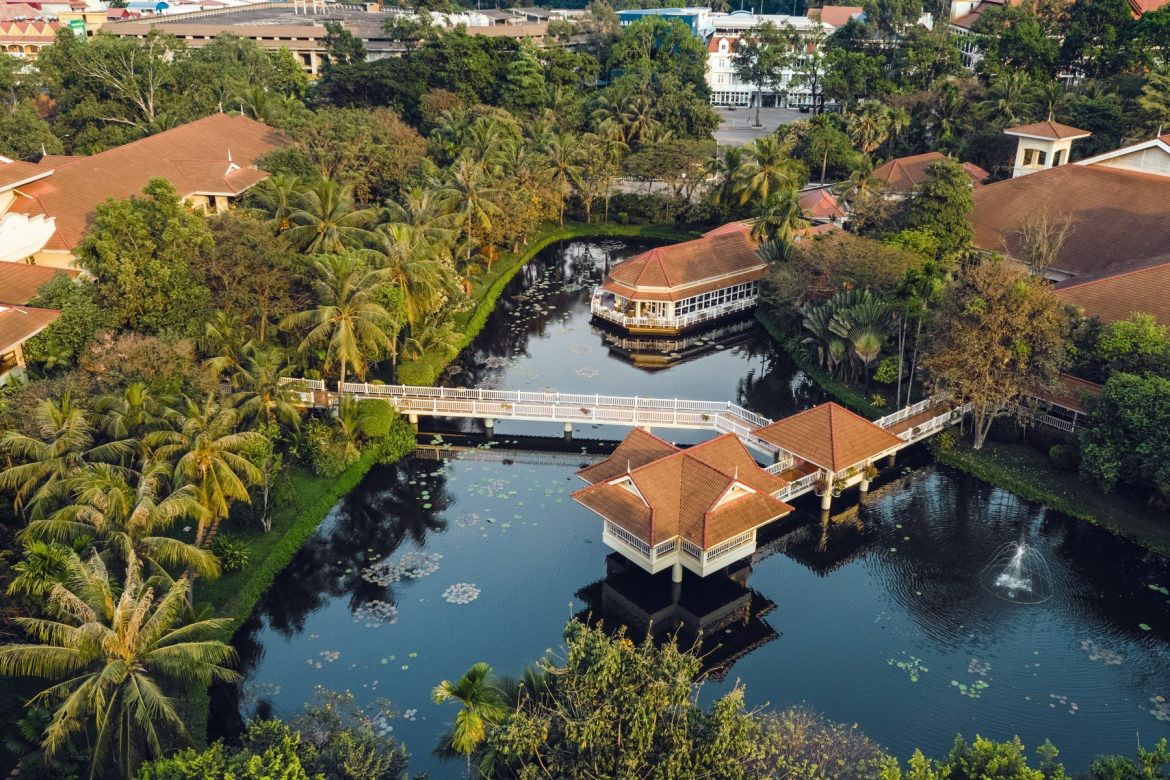
Colonial Atmosphere and the Franco-Khmer Tradition in Siem Reap
Luxury hospitality in Siem Reap has always carried the weight of French Indochina, and no district of Cambodia makes that history more tangible than this city, which grew up in the shadow of both Angkor's temples and French colonial administration. The properties that occupy the upper tier of Siem Reap's accommodation market each handle that inheritance differently. Raffles Grand Hotel d'Angkor leans into formal colonial revival, while Amansara strips the history back to modernist restraint. Sofitel Angkor Phokeethra, part of Accor's Sofitel line, takes a third position: the colonial aesthetic is present and deliberate, but it's organised around a stated philosophy of genuine exchange between French hospitality traditions and Cambodian cultural practice, rather than surface nostalgia.
That framework, which the property calls its French Zest approach, shapes details that might otherwise read as incidental. Staff greet arrivals with both Cambodian heartfelt hospitality and a spoken "Bonjour," a small gesture that points to the hotel's intent to hold both cultures in the same frame rather than subordinate one to the other. In a city where the tension between colonial legacy and contemporary Khmer identity is not abstract, that positioning has editorial weight.
The Grounds: Twenty-Four Years of Tropical Growth
Opened in 2000 on the northern outskirts of Siem Reap along Vithei Preah Sihanouk Avenue, the resort has had more than two decades for its landscaping to mature, and that time shows. The grounds are dense with tropical foliage: palm trees, flowering hedgerows, and garden paths that slow the pace of movement through the property in a way that recently built resorts cannot replicate through design alone. The 238 rooms and suites are distributed across low-rise, colonial-style buildings that keep the property's profile horizontal, allowing the garden environment to dominate rather than recede.
The walkways carry an additional layer of interest: small plaques along the paths mark props donated by film crews who have stayed here, a record of the property's decades-long role as a base for production teams drawn to Angkor's proximity. It's an unusual form of institutional memory for a hotel, and it adds texture to a stroll that might otherwise be purely horticultural.
Inspectors note that rooms facing the gardens and pool reward the specific request, while entry-level accommodations offer direct pool access, a practical advantage for guests travelling without the need for private balcony space. Couples or those prioritising separation from shared areas will find the balcony-equipped options more suited to extended stays.
Mouhot's Dream and the Chef's Table Format
Siem Reap's dining scene has expanded considerably since 2000, with the city now supporting a range of Khmer, French-inflected, and international restaurants serving the temple circuit's international visitor base. Within the resort, the primary dining venue is Mouhot's Dream, and the format that draws the most specific attention from the property's inspectors is the Chef's Table arrangement inside the restaurant: a seating configuration with a direct window onto the kitchen and views across a lakeside setting. This is a format that works precisely when the technical theatre of a working kitchen has something to show, and it warrants advance reservation rather than walk-in assumption.
The wider Siem Reap dining context for guests staying here is worth understanding. The hotel's northern outskirts location places it at some remove from the concentrated restaurant cluster around the old market, Pub Street, and the riverfront. For Siem Reap's full restaurant range, guests should plan for transport into the city centre rather than assuming walkability. The resort functions leading as a base with its own internal dining logic rather than as a property you leave each night for the city's independent restaurant scene.
The Explorer's Tales Bar and Atmospheric Continuity
Bar programming in luxury hotels often defaults to either the generic international cocktail list or the aggressively themed heritage experience. The Explorer's Tales bar at the Phokeethra works within the second category but carries an Old World atmosphere that inspectors credit as genuinely established rather than recently curated. For guests arriving from, say, FCC Angkor by Avani, where the bar atmosphere is weighted toward journalistic colonial history, the Explorer's Tales offers a comparison point: both trade in the aesthetics of the early-twentieth-century traveller, but the Phokeethra's version has the benefit of two decades of actual use layered into it. For Siem Reap's broader bar scene, the property's own bar functions as a reliable anchor rather than an afterthought.
Golf, Spa, and the Dry-Season Timing Question
The golf component positions the Phokeethra in a specific travel category that separates it from properties like Anantara Angkor Resort, Park Hyatt Siem Reap, or Shinta Mani Angkor, none of which pair temple access with on-site golf facilities at this scale. Golf-and-stay packages are available through the hotel's website and represent the clearest argument for choosing the Phokeethra over comparably priced alternatives for guests who want to combine Angkor temple visits with course time.
Timing the stay to the dry season, November through March, opens a specific programme: apsara dance performances at the Royal Court, held under open sky. The apsara tradition is central to Cambodian classical culture, directly connected to the temple carvings at Angkor itself where the celestial dancer figures appear across kilometres of bas-relief, and a live performance watched in this context carries historical resonance that a standard cultural show in an air-conditioned theatre does not. It is, in practical terms, one of the stronger seasonal arguments for timing a Siem Reap stay within the dry window.
The spa rounds out the amenity structure in a way that aligns the Phokeethra with the broader regional resort format, where wellness programming has become a standard expectation at this tier. Specific treatments are available on the hotel's website. Comparable properties at the smaller, more intimate end of Siem Reap's luxury market, including Sala Lodges and Angkor Village Hotel, offer wellness in formats that feel less resort-scale; the Phokeethra's offering is more in keeping with a full-facility property.
Practical Planning
The resort sits on the northern outskirts of Siem Reap along Vithei Preah Sihanouk Avenue, placing it conveniently for the Angkor temple complex while requiring transport for access to the city's central dining and bar districts. With a Google rating of 4.8 across 1,507 reviews, the property has a documented track record with international guests. Reservations for the Chef's Table inside Mouhot's Dream should be made in advance, particularly during the dry-season peak of November through March when occupancy across Siem Reap's upper-tier properties tends to be highest. Golf package details are managed through the hotel's official website. For context on how the Phokeethra fits within Siem Reap's full accommodation range, see our full Siem Reap hotels guide.
Travellers considering Cambodia more broadly might also reference Raffles Hotel Le Royal in Phnom Penh for the capital's comparable French colonial tier, or Shinta Mani Wild in Prey Praseth Village for a contrast in wilderness-focused luxury within the same country. For those building a broader regional itinerary, Six Senses Krabey Island in Sihanoukville represents the coastal alternative. Internationally, guests who favour the Sofitel's Franco-colonial register may also respond to the historical atmosphere found at Badrutt's Palace Hotel in St. Moritz, where a different European grand-hotel tradition carries similar institutional weight. See also our full Siem Reap experiences guide and our full Siem Reap wineries guide for broader city planning.
Frequently Asked Questions
A Lean Comparison
These are the closest comparables we have in our database for quick context.
Preferential Rates?
Our members enjoy concierge-led booking support and priority upgrades at the world's finest hotels.
Get Exclusive Access