

Positioned above Chengdu's IFS subway station in the city's commercial and cultural centre, Niccolo Chengdu earned 92.5 points in the 2026 La Liste Top Hotels ranking. The property anchors its identity in commissioned artwork, a dedicated tea sommelier, and dining that takes Sichuan spice seriously across two restaurants and a cocktail bar. Afternoon tea and Sunday brunch both draw a local following strong enough to warrant advance reservations.
 Discover on Pearl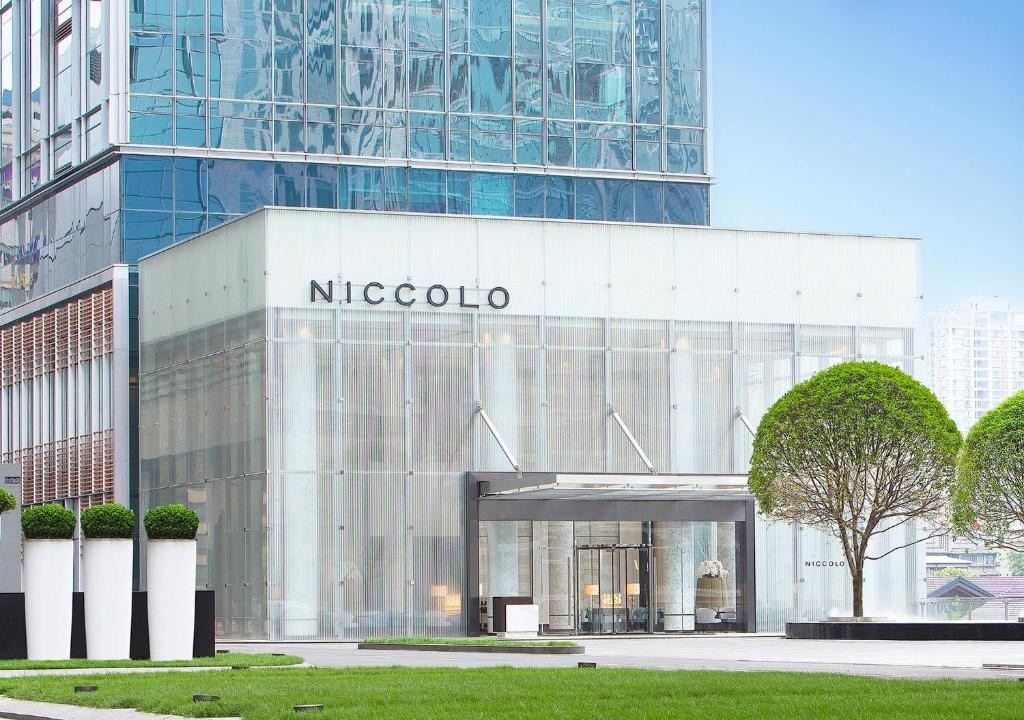
Where the City Announces Itself
Arriving at Niccolo Chengdu, the experience is shaped before you reach the check-in desk. The lobby is dominated by Zhang Xiang Ming's Beijing Girl, a large-scale work whose deep, considered gaze stops most guests mid-step. It is a deliberate choice: rather than deploying art as ambient decoration, the property positions it as the first point of contact, the threshold between Chengdu's kinetic street-level energy and the contained atmosphere above. That calibration, art as orientation rather than ornament, runs through the entire property and distinguishes it from the broader tier of international luxury hotels operating in this city.
The address itself carries weight. Tower 4 of Chengdu IFS places the hotel directly above the IFS subway station in the Jinjiang District, which means the city is immediately accessible without a transfer or a taxi queue. For a city of Chengdu's scale, that kind of central positioning matters operationally. It also places the hotel within the IFS complex that includes the now-famous giant panda sculpture scaled across one of the adjacent buildings, a detail that has become an informal landmark in the Chengdu shopping district. The outdoor garden area between the IFS mall and the hotel provides the cleaner vantage point for it.
The shortlist, unlocked.
Hard-to-book tables, cellar releases, and concierge-planned trips.
Get Exclusive Access →The Art of Anticipation: How the Hotel Meets Guests
Chengdu's luxury hotel tier has grown considerably in the past decade. Properties including The Ritz-Carlton, Chengdu, The St. Regis Chengdu, and Waldorf Astoria Chengdu occupy the same broad premium tier, and each has staked a different position. What separates Niccolo Chengdu within that field is a service philosophy oriented around anticipatory detail: the tea sommelier available in The Tea Lounge to guide herb selection rather than simply pour, the iPad Minis pre-loaded in standard rooms and full-sized iPads in suites, the yoga mats placed in every room for guests who want them without having to request them.
These are not grand gestures. They reflect a considered assumption about what a guest might need before the guest asks. That operational posture, more consultative than transactional, is increasingly what separates one well-appointed hotel from another in a city where the hardware difference between properties in this price tier is often marginal. Niccolo Chengdu's 92.5-point score in the 2026 La Liste Leading Hotels ranking reflects that positioning. La Liste's methodology weights guest experience and culinary provision alongside facility standards, and that score places the property solidly within the upper band of recognized luxury hotels across mainland China.
Tea, Spice, and the Question of Where to Eat
The hotel's dining configuration reflects Chengdu's culinary identity more directly than most international luxury properties manage. Sichuan cuisine, built on the interaction between málà (numbing heat) and fermented depth, is one of China's most technically demanding regional styles and one of its most globally recognised. The hotel deploys that local authority across two distinct venues: Yue Hin, oriented toward Cantonese and Sichuan traditions, and Niccolo Kitchen, which runs the popular Sunday brunch that draws both hotel guests and Chengdu residents.
That local footfall is a meaningful signal. When city residents return consistently to a hotel restaurant, it usually indicates either a format or a price point that competes with the broader dining market, rather than one that subsists on captive hotel traffic. Sunday brunch at Niccolo Kitchen carries enough demand that reservations are advised before arrival. The same applies to afternoon tea at The Tea Lounge, where a dedicated in-house tea sommelier handles herb and blend selection underneath what the property describes as a prominent art installation. The glass-walled space serves as one of the hotel's better demonstrations of its design logic: an interior environment composed around both the view out and the objects within.
The hotel bar extends the Sichuan thread into cocktails, incorporating local spice profiles into the drinks program. For visitors unfamiliar with Chengdu's food culture, that provides a lower-stakes entry point into the flavour registers that define the city's cuisine before committing to a full Sichuan meal. For those who have already spent time eating their way through the broader city, our full Chengdu restaurants guide maps the wider dining scene in more detail.
Room Logic and What Each Category Offers
The room design follows a contemporary framework built on natural light and earth tones, with blackout curtains automated for those whose schedules or time zones demand the option. The 500-thread-count linen specification sits at the standard for this tier, and the soaking tub is present in every category, which is worth noting given that some competitors in Chengdu restrict larger bath formats to upper room grades.
What changes meaningfully between standard rooms and suites is not primarily material finish but vantage and technology. Several rooms offer a direct sight line over a shopping district that has developed around an old Chinese temple, a juxtaposition that represents Chengdu's broader character more accurately than most curated lobby experiences manage. Suites carry full-sized iPads rather than the iPad Minis provided in standard rooms, a minor but deliberately signalled distinction. The 24-hour fitness facility delivers city views from the cardio equipment, and the lap pool, described as intimate in scale, functions as a genuinely low-traffic space by the standard of urban luxury hotels.
Guests focused on room category should note that views vary significantly by floor and orientation within the tower. Confirming the specific vantage point at the time of booking is advisable rather than assuming from the room tier alone.
Where Niccolo Chengdu Sits in the Wider Context
Chengdu's luxury accommodation tier now spans a range of formats, from design-led heritage conversions like The Temple House to the more architecturally singular Guanyin Yiyuntai Hotel, and further out, the retreat model represented by Six Senses Qing Cheng Mountain. Also worth consideration is Upper House Chengdu and InterContinental Century City Chengdu for guests weighing central options across different brand cultures. Niccolo Chengdu occupies the position of a full-service city hotel with a strong arts identity and a dining program that engages with local culinary tradition more actively than its peer set typically does.
For those mapping a broader China itinerary, the same editorial approach to luxury can be found at properties like Mandarin Oriental Qianmen in Beijing or Amanfayun in Hangzhou, each of which uses local cultural context as a structural element rather than an afterthought. At the international end of the same ownership tier, Aman Venice and Aman New York offer instructive comparisons in how art-forward luxury hotels manage the balance between spectacle and function. Other China properties in the EP Club index worth considering include Xiamen Yunding Resort, 1 Hotel Haitang Bay in Sanya, and Altira Macau. Further afield, Amandayan in Lijiang represents the southwest China regional tradition in a different register entirely.
Planning Your Stay
The hotel is accessible directly from the IFS subway station beneath the complex, making it one of the more transport-efficient luxury addresses in Chengdu. Reservations for The Tea Lounge and Sunday brunch at Niccolo Kitchen should be made before arrival given consistent local demand. Room rates and booking are available through the property directly. Guests with an interest in art should allow time in the lobby and public areas, where the commissioned works change the nature of what is typically transient hotel space.
Frequently Asked Questions
- What room category do guests prefer at Niccolo Chengdu?
- Standard rooms at Niccolo Chengdu come with natural light, city views, 500-thread-count linens, automated blackout curtains, and soaking tubs, making the entry category a considered choice rather than a fallback. Suites add full-sized iPads and, depending on orientation, sight lines over the temple-adjacent shopping district. Guests prioritising views should confirm the specific floor and aspect at booking, as vantage varies meaningfully across the tower. The hotel's 92.5-point La Liste score applies to the property as a whole rather than any single room tier.
- What should I know about Niccolo Chengdu before I go?
- The hotel sits directly above the IFS subway station in Jinjiang District, giving immediate access to the broader city without ground-level transit. Two restaurants, Yue Hin and Niccolo Kitchen, reflect Sichuan culinary tradition alongside international formats, and the hotel bar incorporates local spice profiles into its cocktail program. Afternoon tea in The Tea Lounge and Sunday brunch both attract a local Chengdu following, so reservations for both are advisable rather than optional. The property's 2026 La Liste Leading Hotels score of 92.5 places it in the recognized upper tier of China's luxury hotel market.
- Should I book Niccolo Chengdu in advance?
- If your dates are fixed, booking the room early is direct given the hotel's position in Chengdu's central business and retail district, where occupancy runs consistently through both business travel and leisure periods. More critically, advance reservations for The Tea Lounge and Sunday brunch at Niccolo Kitchen are necessary: both draw a strong local audience that fills available capacity on popular days regardless of whether hotel rooms are at capacity. The hotel's La Liste recognition and central IFS location make it a default consideration for corporate visitors and inbound leisure travelers alike.
- Is Niccolo Chengdu better for first-timers or repeat visitors?
- First-time visitors to Chengdu benefit from the property's central IFS position, subway access, and in-house introduction to Sichuan cuisine across the restaurant and bar formats, a practical entry point into a food culture that can feel opaque from the outside. Repeat visitors tend to find sustained value in the tea sommelier service, the art program across public spaces, and the Sunday brunch's local character, elements that reward familiarity rather than novelty. The hotel's 92.5-point La Liste score reflects a consistency that makes it relevant to both audiences.
- Does Niccolo Chengdu have a meaningful connection to local Sichuan food culture beyond its restaurants?
- The property's tea program at The Tea Lounge goes beyond a standard hotel amenity: an in-house tea sommelier guides herb and blend selection, engaging with Sichuan's deep tea culture rather than offering a generic service. The hotel bar extends local influence into its cocktail program through spice-forward recipes that reference the peppery heat that defines the region's cuisine. Together with Yue Hin and Niccolo Kitchen, the property creates multiple points of engagement with Sichuan's culinary tradition across different times of day and levels of formality.
Cuisine Context
These are the closest comparables we have in our database for quick context.
| Venue | Cuisine | Awards | Notes |
|---|---|---|---|
| Niccolo Chengdu | This venue | ||
| Waldorf Astoria Chengdu | |||
| The Ritz-Carlton, Chengdu | |||
| The St. Regis Chengdu | |||
| The Temple House | |||
| Guanyin Yiyuntai Hotel |
Preferential Rates?
Our members enjoy concierge-led booking support and priority upgrades at the world's finest hotels.
Get Exclusive AccessThe shortlist, unlocked.
Hard-to-book tables, cellar releases, and concierge-planned trips.
Get Exclusive Access →