
Magna Pars, l' Hotel à Parfum transforms a historic Martone family perfume factory into Milan's most innovative luxury hotel, where 39 fragrance-inspired suites overlook aromatic gardens in the fashionable Navigli district. This world-first 'Hotel à Parfum' features an on-site perfume laboratory, Michelin-quality dining, and intimate spa treatments that celebrate Italy's olfactory heritage.
 Discover on Pearl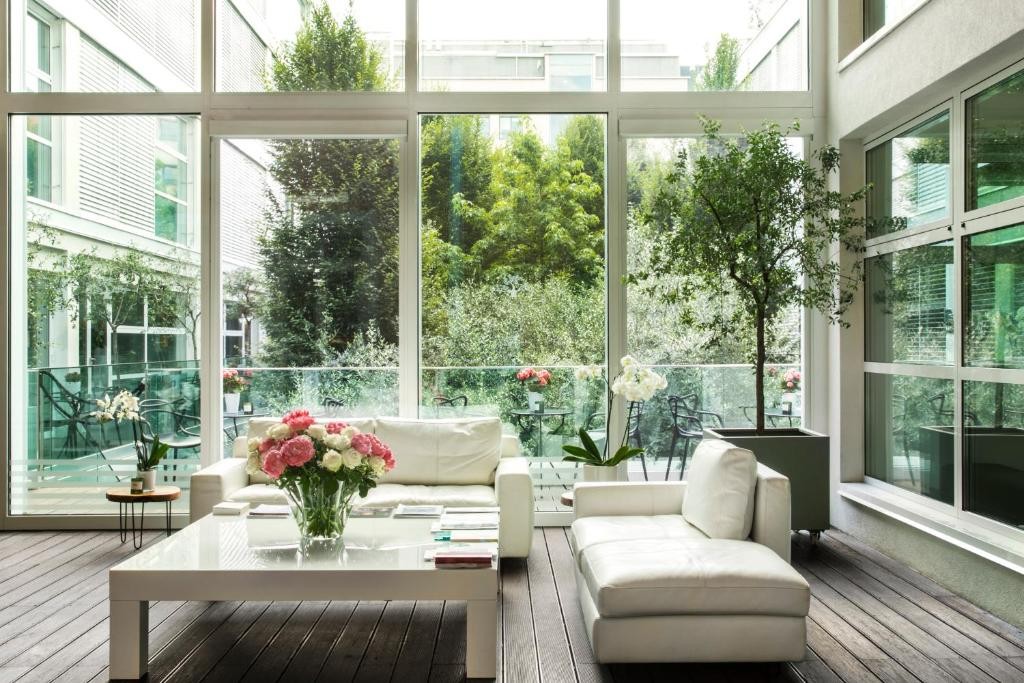
Where a Former Perfume Factory Becomes the Premise
Via Vincenzo Forcella sits just off the energy of Via Tortona and within walking distance of Porta Genova Station, but the street itself reads as a deliberate pause. The Navigli and Tortona districts have become Milan's design-industry nucleus over the past two decades, drawing studios, showrooms, and the hotels that serve the people who work in them. Within that context, Magna Pars, l'Hotel à Parfum occupies a building with a specific past: a perfume factory whose industrial bones, original walls and production history now form the conceptual spine of the entire property. In a city where adaptive reuse has become a genuine design philosophy rather than a renovation trend, this conversion carries more weight than most.
The architectural team of Luciano Maria Colombo, Paola Benelli, and Roberto Murgia approached the transformation as a dialogue between periods rather than an erasure of one by the other. Factory walls remain in conversation with polished steel, aluminum, and glass. The result places Magna Pars in a peer group that includes design-led boutique properties elsewhere in Italy, such as Corte della Maestà in Civita di Bagnoregio and Castello di Reschio in Lisciano Niccone, where existing structures are treated as the primary material rather than an obstacle to a clean build. Among Milan's hotel set, which includes larger-footprint properties like Bvlgari Hotel Milan (Michelin 2 Keys) and Mandarin Oriental Milan (Michelin 1 Key), Magna Pars operates in a smaller, more idiosyncratic register.
The Scent Premise and Its Environmental Logic
The hotel's defining concept is olfactory: every element of the guest experience connects back to fragrance, from the naming conventions of the suites to the courtyard plantings to the on-site perfume laboratory, LabSolue. This is not incidental theming. The original factory produced perfume, and the Martone family, who own the property, have anchored the hotel's identity in that production history. The olfactory focus carries a sustainability dimension that is easy to overlook. The courtyard garden, which all suites face, contains maples, magnolia, azaleas, roses, and three liquidambar trees. This is a living, maintained ecosystem rather than a decorative installation. In autumn the liquidambar trees shift to amber and gold; in spring the roses and azaleas release the floral notes that inform the hotel's internal atmosphere. The garden serves simultaneously as a scent source, a light source for the suites, a thermal buffer, and a maintained biodiverse space within an urban setting.
LabSolue, the in-house perfume laboratory, extends this logic. The property's history as a production site is kept alive through the ability to craft tailor-made fragrances on-site. The Aqua Adornationis amenities kit, designed for the hotel by Giorgia Martone and available at LabSolue, represents a closed-loop approach to hospitality amenities: products conceived within the property's own fragrance lineage and available for guests to purchase and take forward rather than consumed as disposable miniatures. This model, connecting product origin to place of production to guest experience, is more coherent from a sustainability standpoint than the industry standard of branded third-party bathroom provisions.
Suite Design and the Grammar of the Rooms
The suites at Magna Pars are named after fragrances from the Martone family's olfactory library, a naming system that ties each room to the property's core premise rather than to generic numbering or directional identifiers. All suites face the internal garden, which means the views and the light are consistent across the property, oriented inward rather than outward to the street. This inward orientation is also an acoustic decision: the courtyard insulates the rooms from the street-level noise of a neighborhood that includes active rail infrastructure at Porta Genova.
Inside, the rooms combine brushed oak wood floors with leather furniture and original paintings commissioned from young artists at Milan's Brera Academy. The Brera Academy connection is a substantive curatorial choice. Brera is among the most referenced fine arts institutions in Italy, and sourcing emerging work from its students puts original, attributed art in the rooms rather than decorative reproduction prints. Each suite includes a living room area with Italian furniture and a spacious bathroom with a tub. The whitewashed walls and natural material palette read as a coherent internal environment across the property.
The Library Hall, Spa, and the Question of Scale
The Library Hall functions as a common space anchored by books: authentic literary works spanning the 18th through 20th centuries. The scent of orange blossom is introduced here, linking the reading environment to the property's wider olfactory program. In boutique hotel design, common spaces of this kind operate as the informal social infrastructure that larger properties achieve through lobby volume. At Magna Pars, the library and the courtyard garden perform that function in a more compressed and deliberate format.
The spa is small by design, with capacity for two guests only. The programming includes aromatherapy treatments and Ayurvedic massage, consistent with the hotel's scent premise and its wellness positioning. The spa booking policy deserves specific attention: it is accessible exclusively to hotel guests and requires advance reservation at least one month ahead. Guests who fail to plan this element before arrival will find the spa unavailable on short notice. A qualified yoga instructor is also available on request. For context on how this scale and intimacy compares to other Italian property spas, Borgo Santandrea on the Amalfi Coast and Il San Pietro di Positano offer a comparable emphasis on integration with the natural environment rather than spa scale.
Milan's Boutique Hotel Tier and Where Magna Pars Sits
Milan's premium hotel market has historically concentrated around the Quadrilatero della Moda and the Duomo axis, where properties like Grand Hotel et de Milan, Hotel Principe di Savoia, and Armani Hotel set the reference points for high-end accommodation. The Tortona and Navigli areas represent a different axis, one defined by the design and fashion industry's southwestward shift during the Salone del Mobile era. Portrait Milano, Vico Milano, and Casa Baglioni Milan occupy different positions within Milan's wider offer. Magna Pars operates as a family-owned, all-suites property with a conceptual identity that is genuinely specific to its location, history, and the Martone family's olfactory focus.
Google reviews hold a 4.5 rating across 1,080 reviews, which, at that sample size, functions as a reliable signal rather than a curated average. For guests whose visits to Italy extend beyond Milan, the broader Italian property set is worth mapping in advance. Aman Venice, Casa Maria Luigia in Modena, and Four Seasons Hotel Firenze each represent distinct points in the Italian luxury accommodation range. Outside Italy, comparable design-led boutique formats can be found at properties like Aman New York, The Fifth Avenue Hotel, or Amangiri in Canyon Point for those building broader itineraries.
Magna Pars is on Via Vincenzo Forcella, 6, in the 20144 postal zone. The property's position relative to Porta Genova makes it accessible from both the Navigli canal system and the Tortona design district on foot. During Salone del Mobile and Milan Fashion Week, the surrounding area absorbs significant visitor volume, and booking well ahead of those periods is advisable. For a full orientation to what the city offers beyond this property, the EP Club Milan hotels guide, Milan restaurants guide, Milan bars guide, Milan wineries guide, and Milan experiences guide map the wider landscape.
Frequently Asked Questions
Comparison Snapshot
A fast peer set for context, pulled from similar venues in our database.
| Venue | Cuisine | Price | Awards | Notes |
|---|---|---|---|---|
| Magna Pars, l’ Hotel à Parfum | Scents reignitememories. They bring long-gone feelings back to life and are effo… | This venue | ||
| Bvlgari Hotel Milan | Michelin 2 Key | Michelin 2 Keys | ||
| Mandarin Oriental Milan | Michelin 1 Key | Michelin 1 Key | ||
| Excelsior Hotel Gallia, A Luxury Collection Hotel | ||||
| Four Seasons Hotel Milano | ||||
| Park Hyatt Milan |
Preferential Rates?
Our members enjoy concierge-led booking support and priority upgrades at the world's finest hotels.
Get Exclusive Access