


Housed in a former 15th-century Milanese convent on Via Gesù, Four Seasons Hotel Milano occupies one of the Quadrilatero d'Oro's most architecturally significant addresses. Renaissance frescoes, ogival vaults, and ancient fireplaces coexist with interiors refreshed by Patricia Urquiola and Pierre-Yves Rochon. With 118 rooms, an 800-square-metre spa, and a cloister garden that muffles the city entirely, it positions itself at the upper tier of Milan's luxury hotel market.
 Discover on Pearl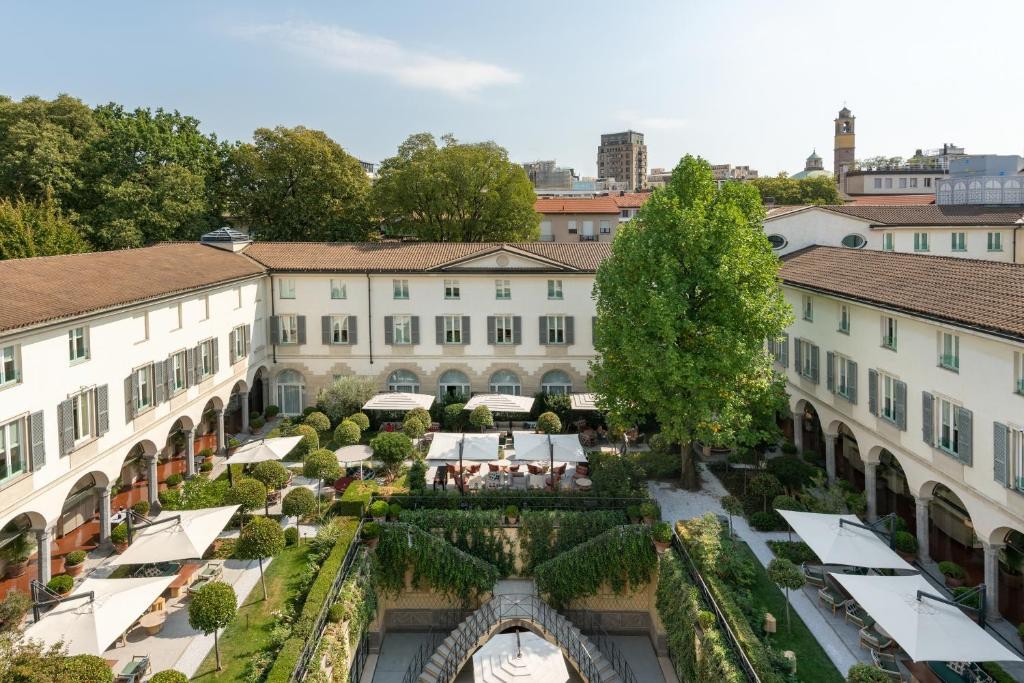
A Convent in the Fashion District
Milan's Quadrilatero d'Oro operates on a particular kind of tension: the city's most forward-looking commercial energy concentrated into a few narrow, pedestrian-only streets, wrapped around buildings that predate the republic by centuries. Via Gesù, one of the quietest lanes in that district, is where that tension resolves most completely. The street fronts flagship houses from Versace, Armani, Prada, and Fendi within a short walk, yet the moment you pass through the entrance of Four Seasons Hotel Milano, the reference point shifts entirely. What was once a 15th-century Augustinian convent now functions as one of Milan's most architecturally layered hotels, and the cloister at its centre — planted with mature trees, seasonal flowers, and the particular stillness of a monastic courtyard — is the most reliable antidote to the district's pace that the neighbourhood offers.
For context on how Milan's luxury hotel tier is structured, compare this property against peers like Bvlgari Hotel Milan (Michelin 2 Keys), Mandarin Oriental Milan (Michelin 1 Key), and Portrait Milano (Michelin 2 Keys). The Four Seasons sits within the same competitive band, distinguished primarily by the depth of its historical fabric and the scale of its wellness offering. Other Quadrilatero-adjacent options worth weighing include Armani Hotel, Grand Hotel et de Milan, Hotel Principe di Savoia, Dorchester Collection, Vico Milano, and Casa Baglioni Milan.
Heritage Architecture as Operational Infrastructure
The decision to convert a convent into a hotel is not a cosmetic one , the building's structure determines the experience at every level. The 118 rooms and suites are arranged partly around the cloister garden, which means that a meaningful portion of the accommodation looks inward rather than onto the street. That orientation is deliberate. Rooms facing the cloister receive a quality of light and quiet that is difficult to engineer in a purpose-built urban hotel. Several suites retain original frescoes in varying states of preservation; the Cloister Suite, as the name indicates, features original vaulted ceilings that no renovation brief could reasonably reproduce.
The common areas were redesigned by architect and designer Patricia Urquiola in 2021, a renovation that refreshed the hotel's shared spaces without erasing their monastic bones. The ogival vaults, ancient fireplaces, and arched brick ceilings remained structural; Urquiola's intervention worked around them. In 2025, the rooms themselves were reinterpreted by Pierre-Yves Rochon, a designer whose hospitality portfolio extends across multiple continents and who brought a refined, cosmopolitan register to spaces that could easily have tipped toward period pastiche. The Frette linens and Fortuny fabrics referenced in the room specification are consistent with the positioning: materials with their own historical lineage, placed inside a building that earns them.
The Foyer Bar and the Stilla Bar: Two Distinct Aperitivo Registers
Milan's aperitivo culture is one of the city's most durable rituals, and the hotel accommodates it through two venues that operate in different registers. The Foyer Bar occupies the former convent church and runs live piano music during pre-dinner hours, making it one of the more theatrically freighted spots in the district for the early-evening ritual. The setting alone , vaulted church architecture repurposed for Campari and conversation , places it in a different category from the hotel bar formats common across Milan's luxury tier.
The Stilla Bar operates in the cloister during the summer months, accompanied by daily DJ sets. The shift in format between the two venues maps onto a broader pattern visible across premium Italian hotels: a covered, architecturally weighty interior option for cooler months or guests seeking a quieter register, paired with an outdoor social format that activates the property's courtyard asset when the weather permits. The Zelo restaurant similarly extends into the cloister in summer, using the garden setting as a seasonal dining room rather than a decorative backdrop. See our full Milan bars guide and full Milan restaurants guide for how these options compare across the city's wider scene.
The Spa: Scale Within a Monastic Cellar
The wellness offering is housed in the ancient vaulted cellars beneath the monastery , a setting that gives the spa a spatial quality rare in urban hotels. At 800 square metres, it is one of the larger spa footprints available in a Milan city-centre property, including a sizeable indoor pool positioned beneath the arched brick ceiling, seven treatment rooms, sauna, hammam, and gym with cardio equipment, weights, personal training, and yoga sessions. The Rossano Ferretti hair salon operates within the property as a full-service offering, Ferretti being among the more credentialed names in European luxury haircare.
For guests accustomed to resort-scale wellness infrastructure, the cellar spa at Four Seasons Milano is the closest urban equivalent the city offers. Properties of comparable standing in Italy that invest similarly in wellness at scale include Four Seasons Hotel Firenze in Florence and Aman Venice, though neither operates within equivalent historical architecture.
Neighbourhood Context: What the Quadrilatero Actually Delivers
The Quadrilatero d'Oro is Milan's most internationally legible neighbourhood, and its streets function as a navigable index of Italian design and fashion at the highest commercial level. Within walking distance of Via Gesù sit the Museo Bagatti Valsecchi, a mansion housing Renaissance art objects in a period-appropriate context, and the Museo di Milano, an 18th-century palazzo documenting the city's urban history. Both are low-key by the standards of major Italian museum culture, which is precisely their value: they offer access to material history without the volume of visitors that characterises Milan's larger institutions. The hotel is positioned to make both genuinely walkable, which adds a cultural layer to what might otherwise read as a purely commercial district stay.
For readers planning broader Italy itineraries, Four Seasons Milano sits within a logical northern anchor. Properties that work well as regional pairings include Casa Maria Luigia in Modena, Castello di Reschio in Lisciano Niccone, Borgo Santandrea on the Amalfi Coast, Il San Pietro di Positano, JK Place Capri, Rosewood Castiglion Del Bosco in Montalcino, and Corte della Maestà in Civita di Bagnoregio. For international comparisons within the Four Seasons group and comparable independent luxury, see The Fifth Avenue Hotel in New York City, Aman New York, and Amangiri in Canyon Point.
Planning Your Stay
The hotel is at Via Gesù 6/8, 20121 Milan, within the Quadrilatero d'Oro and a short distance from the Montenapoleone metro stop. Published rates start at approximately $1,632 per night, positioning it at the upper end of Milan's luxury hotel tier and consistent with the pricing of its closest peers. The 118-room inventory means availability is relatively constrained during Milan Fashion Week and major trade fair periods, when the city's premium hotel supply tightens considerably , booking well in advance during those windows is advisable. The cloister-facing rooms carry a premium over street-facing options and represent the most architecturally distinctive accommodation the property offers. See our full Milan hotels guide, full Milan wineries guide, and full Milan experiences guide for further planning resources across the city.
Frequently Asked Questions
- What is the leading suite at Four Seasons Hotel Milano?
- The Cloister Suite is the property's most architecturally distinctive accommodation, retaining original vaulted ceilings from the 15th-century convent. Several suites in the building also feature preserved Renaissance frescoes. Following the 2025 room renovation led by Pierre-Yves Rochon, all suites were reinterpreted in a refined, cosmopolitan style while the historical fabric remained intact. Published rates for the hotel start at approximately $1,632 per night; suite pricing sits above that figure.
- What is Four Seasons Hotel Milano leading at?
- The property's clearest differentiator within Milan's luxury hotel tier is the combination of genuine historical architecture and a large-scale urban spa. The 15th-century convent structure, the cloister garden, and the 800-square-metre basement spa give it a spatial and atmospheric depth that purpose-built competitors in the same price bracket cannot replicate. Its Quadrilatero d'Oro address also makes it the most fashion-district-proximate of the city's major luxury hotels.
- Can I walk in to Four Seasons Hotel Milano without a reservation?
- Walk-in access to the public areas, including the Foyer Bar and Stilla Bar, is generally possible, though the hotel's 118-room inventory and high-demand calendar (particularly during Milan Fashion Week and Salone del Mobile) mean that food and beverage spaces can be full without notice. For room stays, the property's constrained room count and premium positioning make advance booking advisable, especially during any major Milan trade or fashion calendar event. The hotel is at Via Gesù 6/8 in the Quadrilatero d'Oro.
- What is Four Seasons Hotel Milano a strong choice for?
- It is a strong choice for guests who want a fashion-district address combined with architectural depth and serious wellness infrastructure. The 800-square-metre spa, the cloister garden, and the historically layered room options give it a profile that extends beyond location convenience. At rates starting around $1,632 per night, it is priced at the upper end of Milan's market and performs leading for guests to whom the historical setting is a primary consideration rather than a background detail.
- Does Four Seasons Hotel Milano have a meaningful cultural offering beyond the spa and rooms?
- The hotel sits within walking distance of two museums that are easy to underestimate: the Museo Bagatti Valsecchi, a Renaissance art collection housed in a period mansion, and the Museo di Milano, which documents the city's history inside an 18th-century palazzo. Neither draws the volumes of the Pinacoteca di Brera or the Duomo complex, which makes them genuinely accessible on a tight schedule. Combined with the Foyer Bar's live piano programme in the former convent church, the property has a cultural texture that goes beyond the standard luxury hotel amenity list.
Cuisine and Recognition
A short peer set to help you calibrate price, style, and recognition.
| Venue | Cuisine | Awards | Notes |
|---|---|---|---|
| Four Seasons Hotel Milano | In the center of Italy’s fashion capital sits the stylish Four Seasons Hotel Mil… | This venue | |
| Bvlgari Hotel Milan | Michelin 2 Key | Michelin 2 Keys | |
| Mandarin Oriental Milan | Michelin 1 Key | Michelin 1 Key | |
| Excelsior Hotel Gallia, A Luxury Collection Hotel | |||
| Park Hyatt Milan | |||
| Portrait Milano | Michelin 2 Key | Michelin 2 Keys |
Preferential Rates?
Our members enjoy concierge-led booking support and priority upgrades at the world's finest hotels.
Get Exclusive Access