


Virtuoso Luxury Hotel Partner · Forbes Recommended · Leading Hotels of World Member
Occupying floors 86 to 98 of the 632-meter Shanghai Tower, J Hotel opened in 2021 as a Leading Hotels of the World member with 165 rooms, including 34 suites, seven restaurants and bars, and a Guinness-verified restaurant at 556 meters. The art program draws on Chinese cultural heritage across every floor, from lacquerware to wire sculpture, while a 24-hour personal butler service personalises each stay.

Pearl is the En Primeur Club membership app — saves, bookings, and concierge access live there. Same editors, same standards.
- Address
- Shanghai Tower, No. 126 Dong Tai Road, Lujiazui Pudong New District
- Phone
- +86 21 3886 8888
- Website
- jhotel-shanghai.com
- Directions
- Get directions
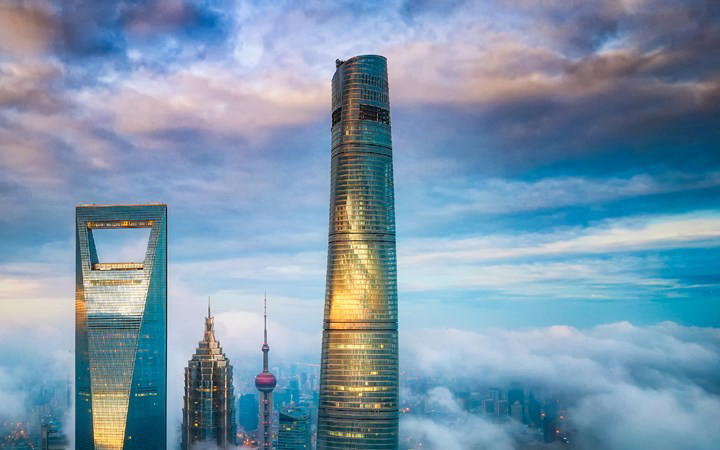
The View That Earns Return Visits
There is a particular habit among J Hotel's repeat guests: they book the same floor, at the same time of year, and request the same butler. That kind of loyalty rarely attaches to a building for its own sake. It attaches to a set of conditions that prove difficult to replicate elsewhere in the city. At J Hotel Shanghai Tower, those conditions begin with altitude and compound from there.
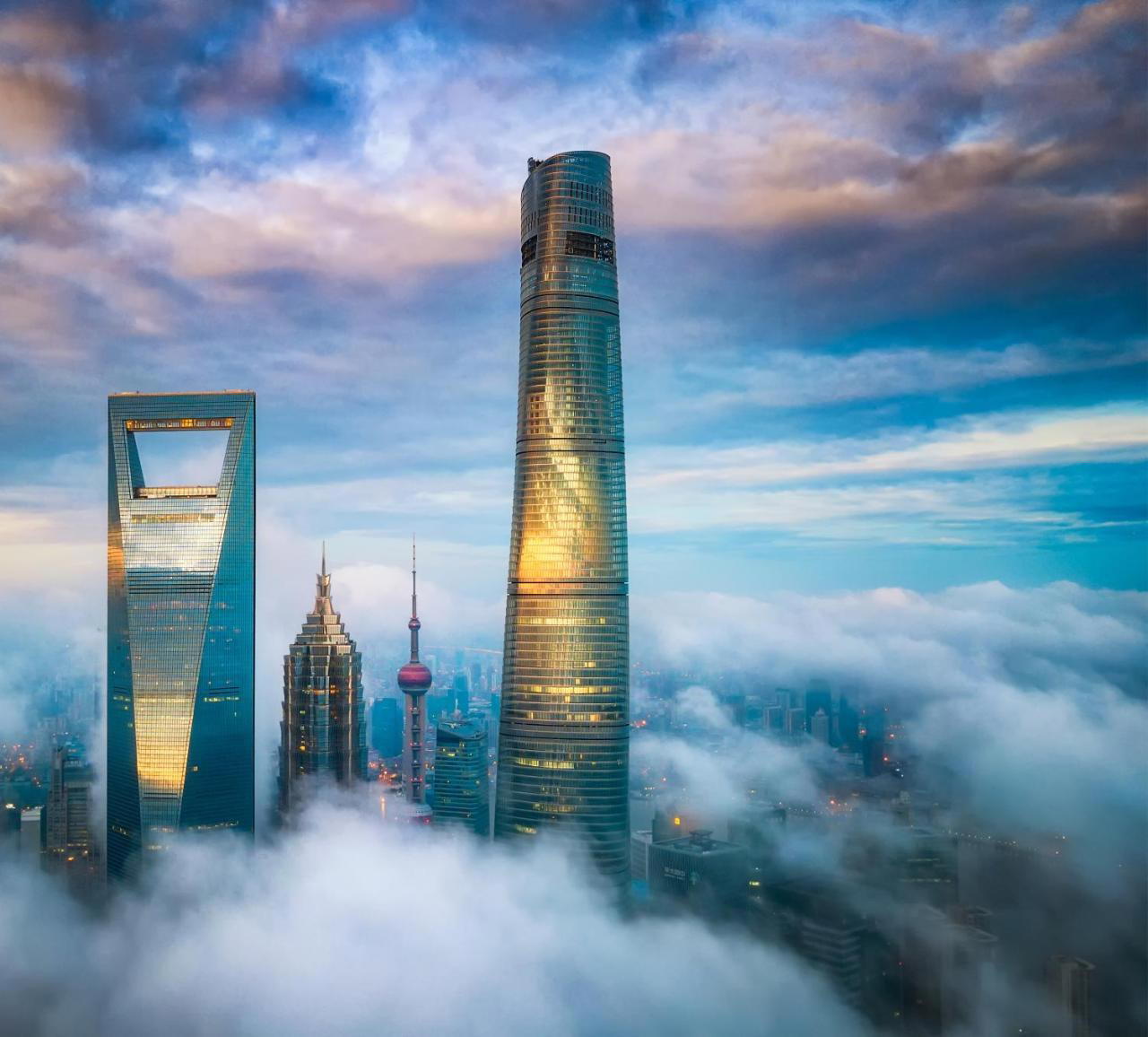
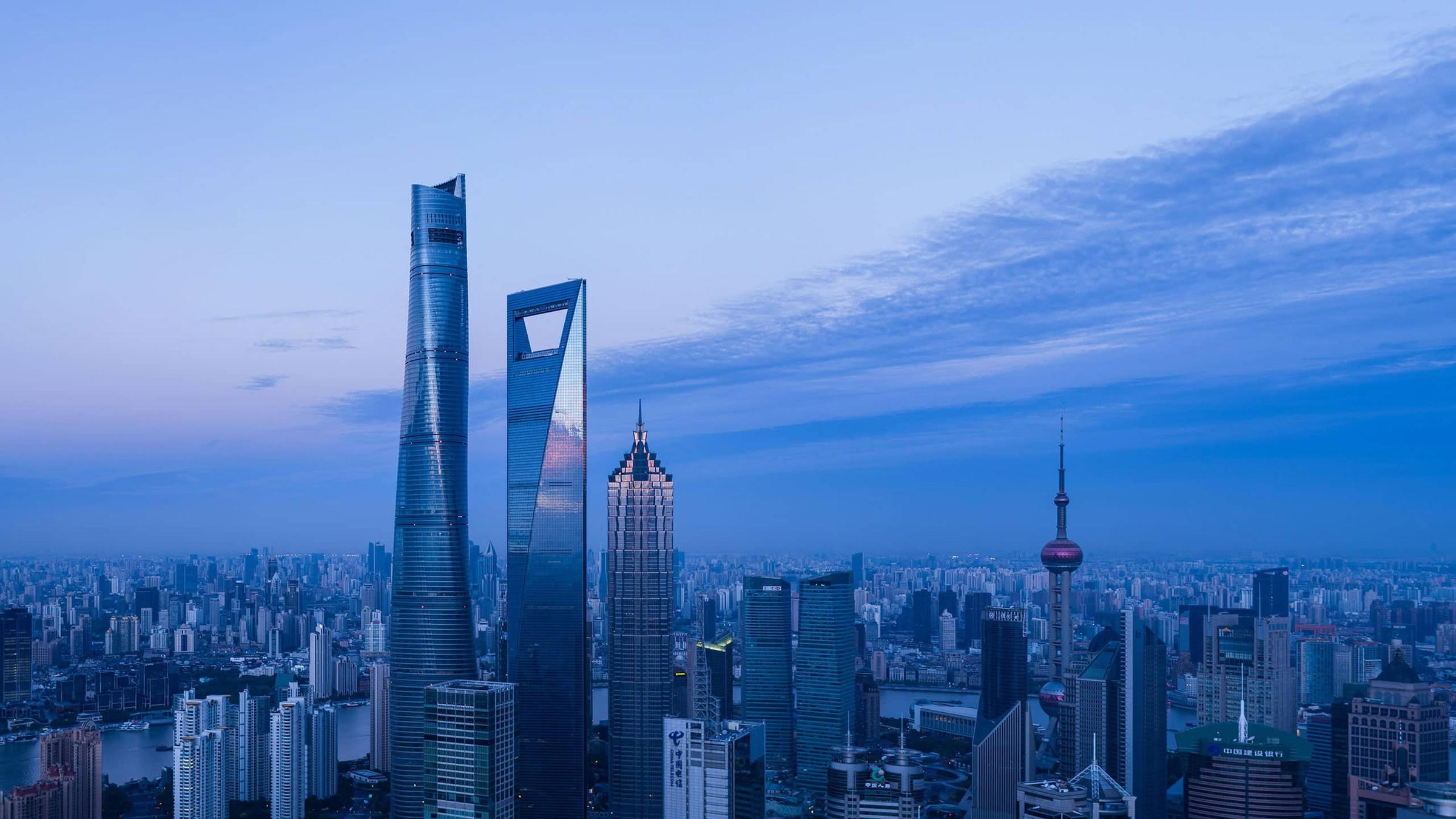
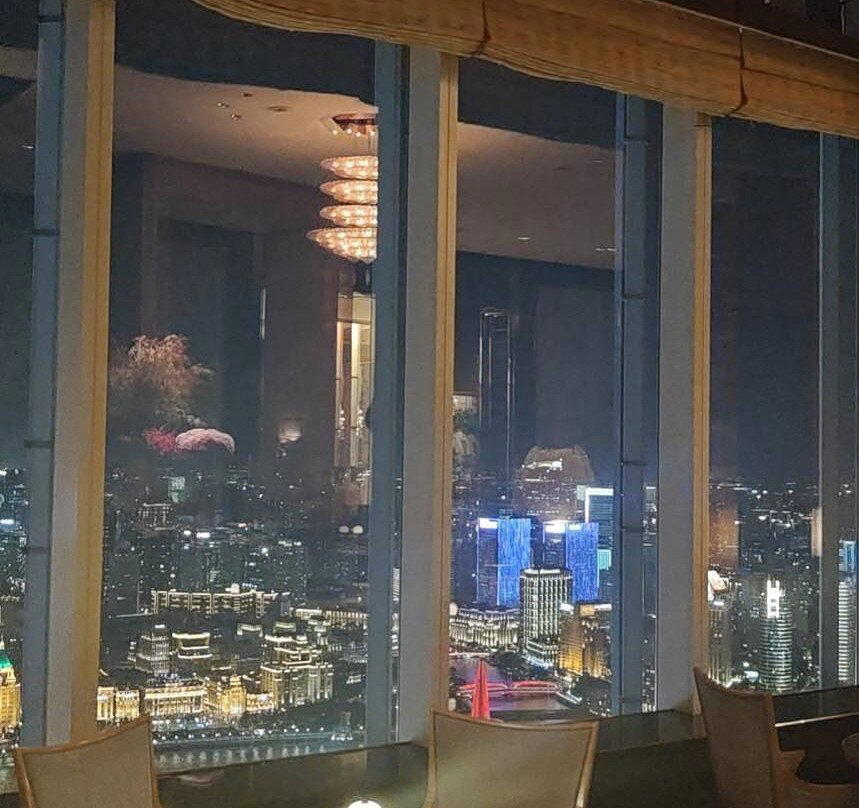
The hotel opened in 2021 across floors 86 to 98 of the 632-meter Shanghai Tower, the tallest building in China and the third-tallest structure on earth. Lujiazui, the financial district that frames it, is already a skyline of considered ambition: the Oriental Pearl Tower, the Jin Mao, the World Financial Center all cluster within a short radius. But from the upper floors of J Hotel, guests look across those buildings rather than up at them. That positional shift is not incidental. It is the organizing principle of the property.
A Property Built Around Altitude as Experience, Not Spectacle
Shanghai's premium hotel market has sorted itself into two broad cohorts over the past decade. The first trades on location and brand recognition: Bund-facing rooms, heritage-building conversions, internationally recognisable flags. Properties like Capella Shanghai, Jian Ye Li and Bvlgari Hotel Shanghai operate in this register, converting address prestige into room rate. The second cohort builds its case around a singular physical proposition. J Hotel belongs firmly to the second group, and its proposition is altitude made liveable rather than merely photographable.
The 165 rooms and 34 suites span floors 86 to 98, ranging from 62 to 380 square meters. Even the entry-level Stateroom and Skyline rooms, at 645 and 656 square feet respectively, are configured with separate living rooms and walk-in closets, a spatial generosity that positions them closer to suite product at comparable properties. The 84th and 85th floors hold the spa, fitness facilities, and a swimming pool with a 1,400-square-foot viewing deck beneath a silvery hammered-metal ceiling. The pool floor is as much an observation platform as a swimming venue, and guests who have stayed more than once tend to schedule their laps at dusk, when the city shifts from white to amber below.
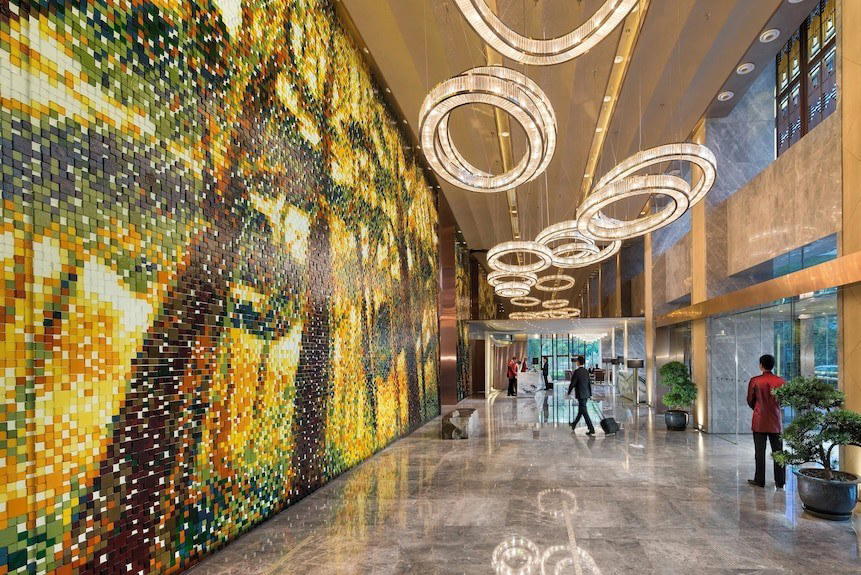
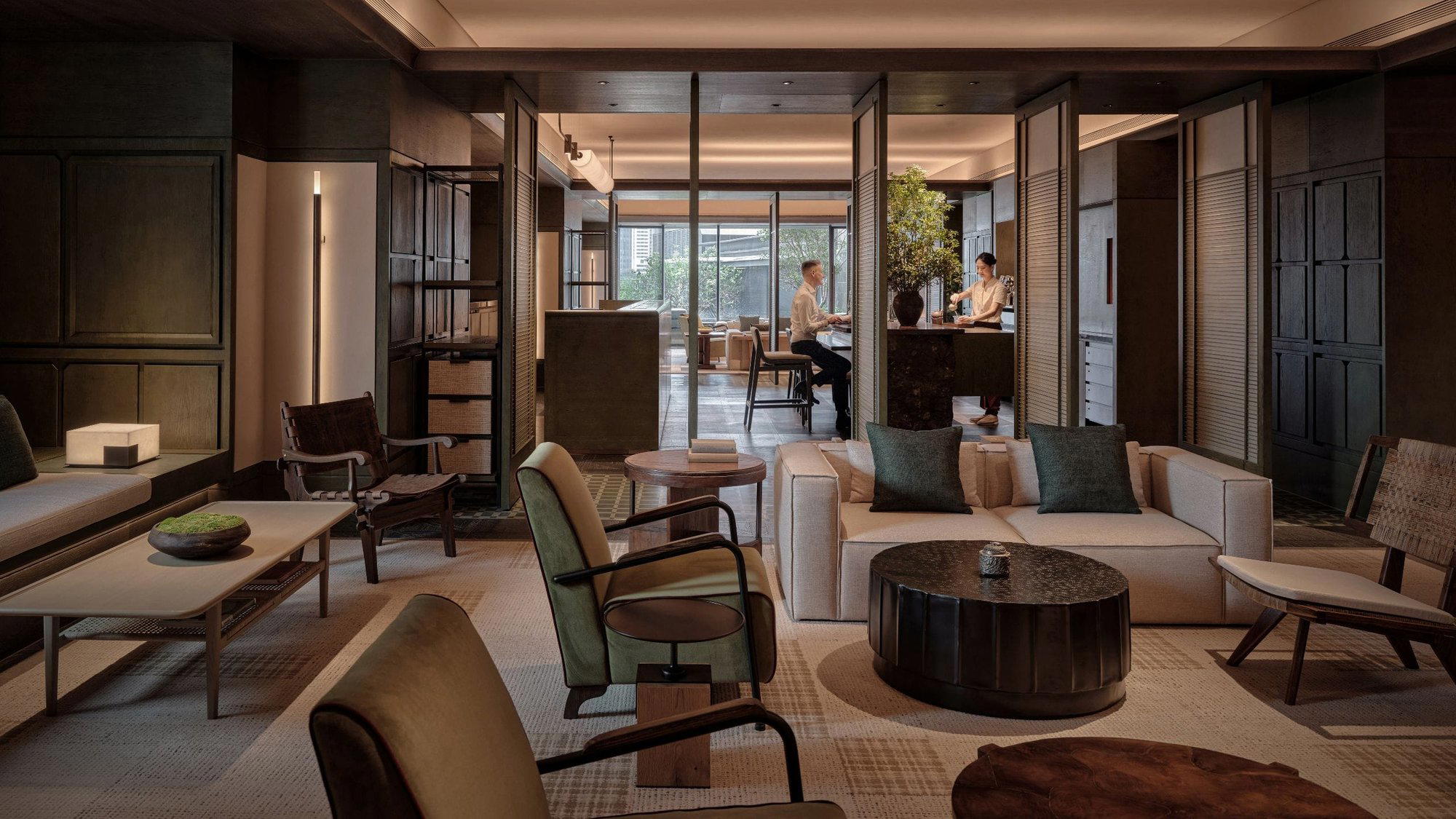
What keeps regulars returning to this specific property, beyond the altitude, is the art program. J Hotel treats its collection not as lobby decoration but as spatial argument. Wire sculptures move through the sky lobby. Mosaic murals cover full walls. Glowing red corridors give way to crystal installations and traditional Chinese landscape paintings. The effect is cumulative: a guest moving between floors encounters a consistently evolving visual register, one grounded in Chinese cultural reference but never reverting to pastiche.
Seven Floors of Eating and Drinking, One of Them Record-Holding
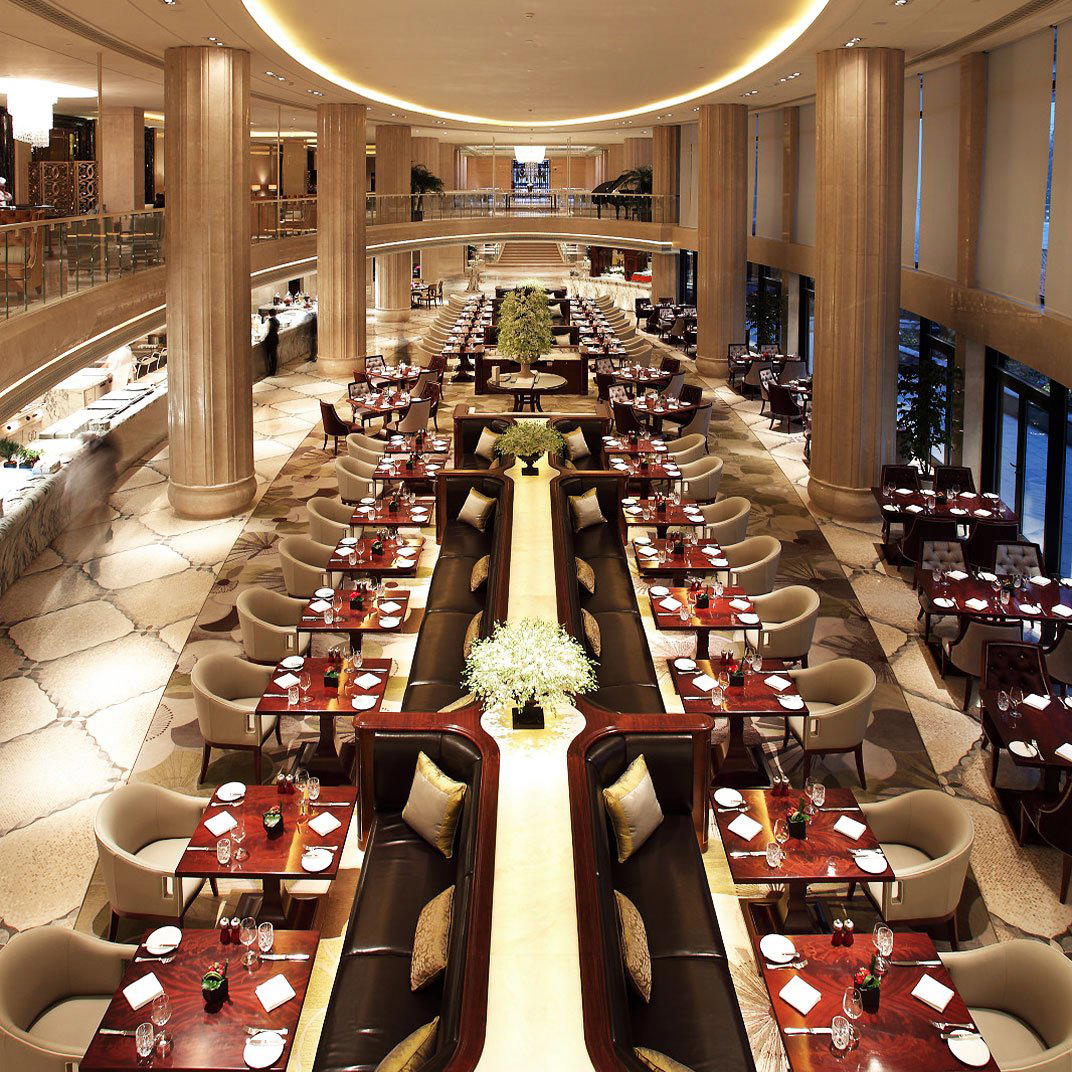
The premium hotel dining landscape in China has shifted significantly since 2015. Hotels that once anchored their food and beverage programs around a single all-day restaurant and a bar have increasingly invested in differentiated, destination-worthy concepts. J Hotel's seven restaurants and bars represent this more ambitious model.
The most discussed is Heavenly Jin on the 120th floor, at 556 meters. It holds the Guinness World Record for highest restaurant within a building, a verifiable credential that functions as a draw in its own right. But the record is the entry point, not the reason regulars return. The kitchen produces Huaiyang cuisine, one of China's four historic culinary traditions, known for knife technique, delicate seasoning, and seasonal precision. Tasting menus here are framed by a massive Silk Road mosaic mural and an open kitchen. The altitude changes how guests read the food: slowly, deliberately, in a room where the horizon is above eye level.
One floor below, at the 101st, Centouno focuses on southern Italian and Mediterranean fine dining through both set menus and à la carte. The restaurant's wire-mesh installation by Italian artist Edoardo Tresoldi gives the room a visual coherence that connects it to the broader art program without overwhelming the dining experience. Housemade pasta and freshly baked bread are the practical anchors of a menu that, at this elevation, benefits from the contrast of Italian produce traditions and Chinese industrial-scale skyline.
Kinnjyou Inaka handles Japanese cuisine across three formats: kaiseki tasting menus, teppanyaki at a live station, and sushi at a circular counter. The three-format structure is a considered choice: it positions the restaurant for different booking occasions rather than committing to a single guest type. Ten private rooms, mirrored partitions, and three 24-karat gold Japanese fan installations complete a room that regular guests tend to book for business entertainment rather than leisure dining.
Jin Yan, the Cantonese fine-dining option, is entered through a hallway covered in crimson glaze that leads to a crystal dragon-and-pearl installation. The eight private rooms feature moon doors hand-painted by artist Zhou Xikang. The programming here aligns with Shanghai's significant Cantonese dining tradition, serving a clientele that arrives knowing the cuisine well and expecting precision.
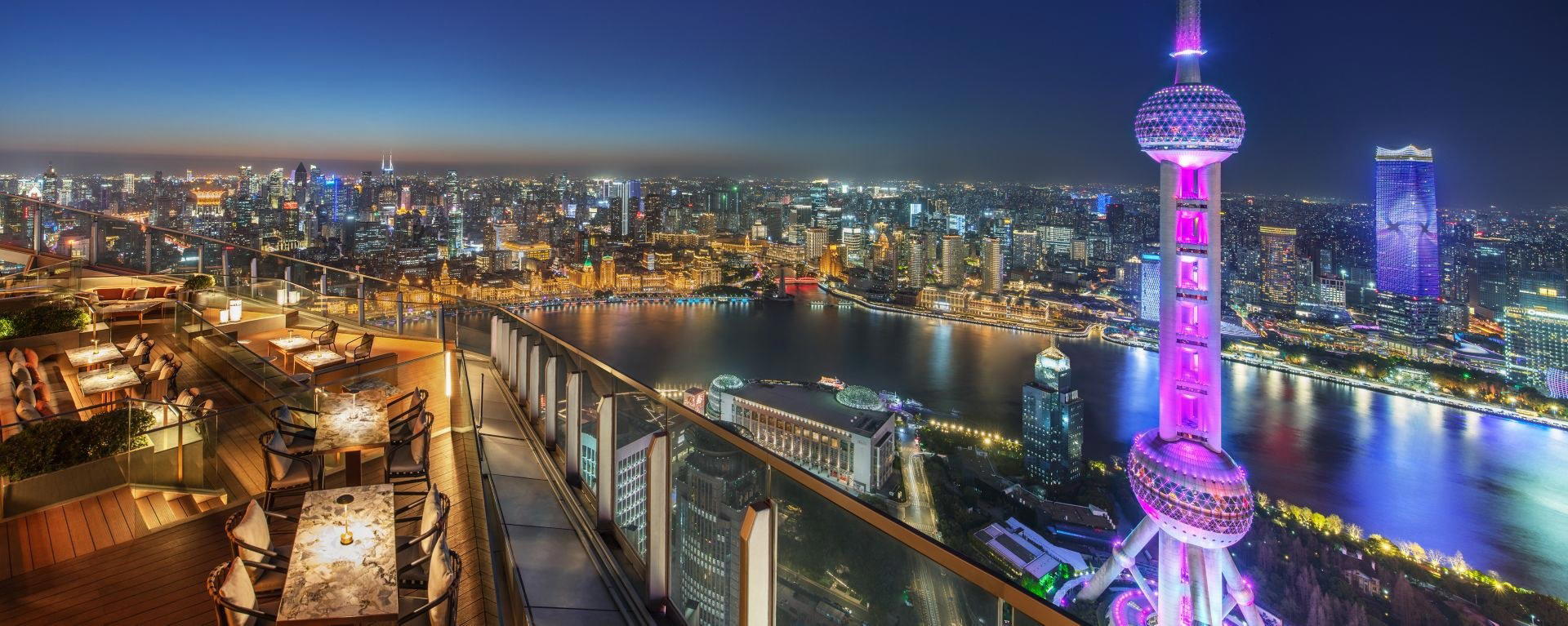
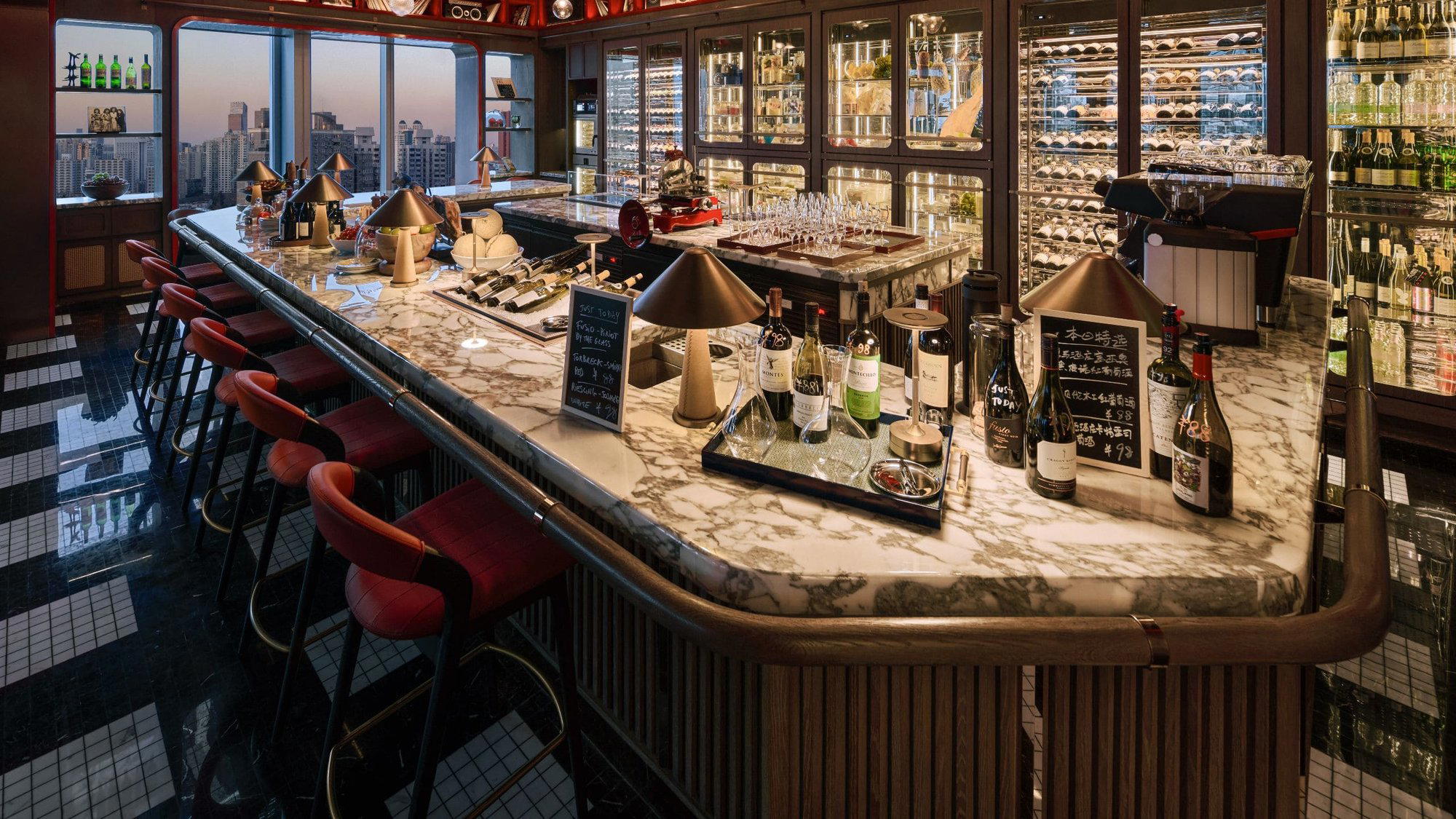
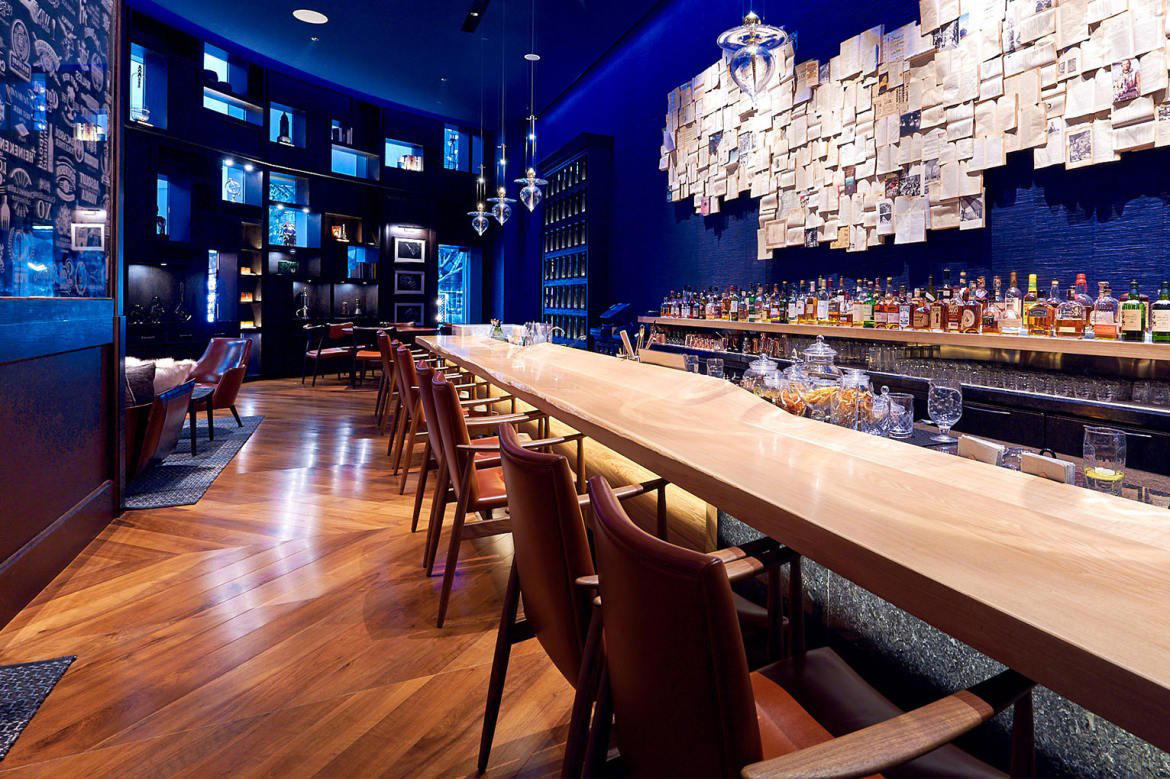
Yi Lounge operates at a different register, designed for the hours between late afternoon and midnight. Afternoon tea transitions to live jazz, with a drinks list covering handcrafted cocktails, champagne, and single-malt whiskies. For guests who have spent the day in meetings in Lujiazui's financial towers, Yi Lounge at sunset functions as decompression chamber and orientation point simultaneously.
The Suite That Functions as an Apartment
Regulars who bring guests to Shanghai for extended stays tend to anchor at the 98th-floor Shanghai Suite, which claims over 4,000 square feet across a parlor, bedroom, dressing room, study, kitchen, and physiotherapy area. The suite's entrance features a Chinese phoenix and peony embroidered on golden calfskin, setting a register that continues through crystal chandeliers, silk and leather accents, and Hermès and Diptyque toiletries. At that scale, the suite competes less with other hotel suites in Shanghai and more with short-term luxury apartment rentals, which it outpoints on service infrastructure and altitude.
Across the property, every guest receives a dedicated J Hotel Personal Butler, available around the clock. The butler program is not presented as premium add-on but as standard provision, which aligns the hotel with a tier of Chinese luxury hospitality where service personalisation is table stakes rather than differentiator. Comparable peer properties in the city, including Amanyangyun and Andaz Xintiandi, Shanghai, offer their own versions of personalised service, though none combine that provision with this altitude.
The Wellness Program at Cloud Level
J Hotel's wellness positioning reflects a broader trend in Chinese luxury hospitality toward specialist treatment modalities rather than generic spa menus. The Reiki Spa on the 85th floor focuses on reiki, the Japanese energy-transfer therapy, as its primary offering rather than treating it as an ancillary option. The 84th floor holds the pool and fitness center. For guests arriving jet-lagged from long-haul flights through Pudong International Airport, the combination of altitude, natural light across the viewing deck, and treatment-focused wellness makes for a recovery environment calibrated to extended international travel.
Planning a Stay
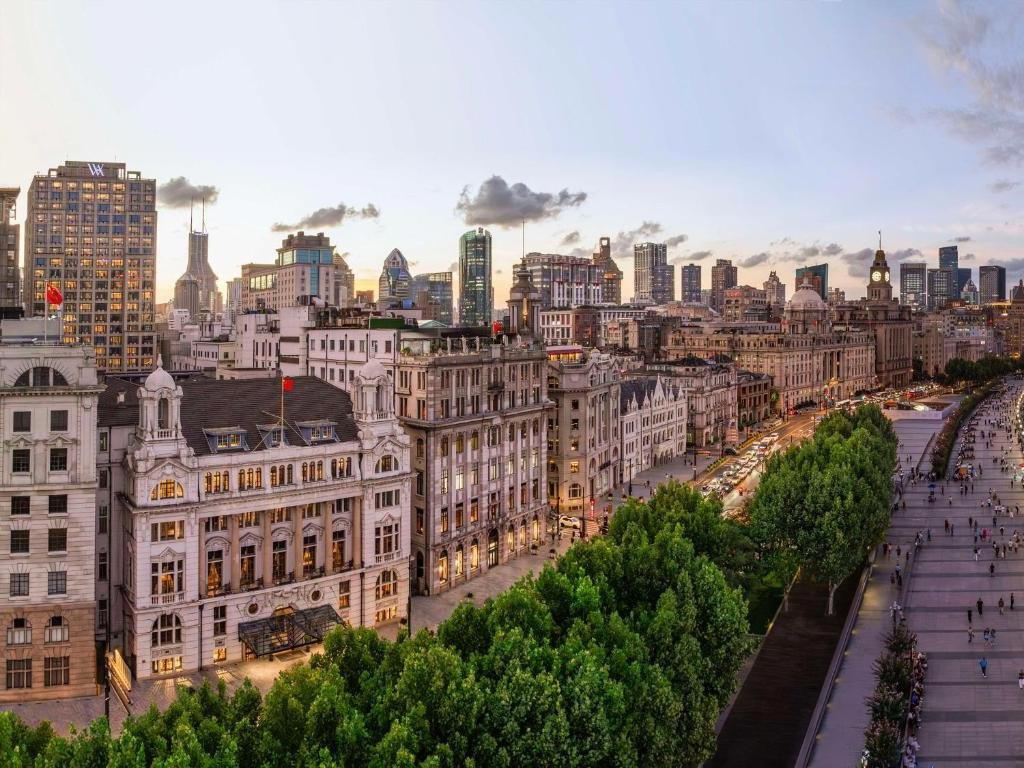
The hotel's address in the Shanghai Tower at No. 126 Dong Tai Road, Lujiazui Pudong New District, puts it in immediate proximity to the Oriental Pearl Tower and the Huangpu River waterfront. The Bund is accessible across the river. For guests planning the broader Shanghai itinerary, our full Shanghai restaurants guide maps the dining landscape across districts. Those comparing properties across China may find useful reference points in Mandarin Oriental Qianmen in Beijing or, for resort alternatives, 1 Hotel Haitang Bay, Sanya.
The hotel accommodates guests across 165 rooms spanning 12 floors, with room categories beginning at 62 square meters. Dining reservations for Heavenly Jin, given the record status and view premium, book ahead; guests staying in-house have the advantage of butler-assisted reservation management. The spa operates on the 85th floor with reiki as its primary modality.
How J Hotel Fits Shanghai's Luxury Hotel Conversation
Properties like Bellagio Shanghai, Artyzen NEW BUND 31 Shanghai, and Cachet Boutique Shanghai each make a distinct spatial argument for why their address should anchor a visit. J Hotel's argument is the most literal: no other hotel in China occupies this altitude, and no other property in Shanghai packages that altitude with seven dining concepts, a Guinness-verified restaurant, and an art program of this scope. For the guest who has already done Shanghai at ground level, the property offers a different orientation to the same city.
Frequently Asked Questions
What is the signature room at J Hotel Shanghai Tower?
The Shanghai Suite on the 98th floor covers over 4,000 square feet and includes a parlor, bedroom, dressing room, study, kitchen, and physiotherapy area. The entrance features Chinese phoenix and peony embroidery on golden calfskin, with crystal chandeliers, silk and leather accents, and Hermès and Diptyque toiletries throughout. At that size and altitude, it is among the most spatially generous suite products in Shanghai. The hotel is a Leading Hotels of the World member (2025), which provides an additional quality benchmark for the room tier.
What should I know about J Hotel Shanghai Tower before I go?
The hotel occupies floors 86 to 98 of Shanghai Tower in Lujiazui, the city's financial district, with the Oriental Pearl Tower and the Bund within easy reach. It opened in 2021 and joined Leading Hotels of the World in 2025. Every guest receives a 24-hour personal butler as standard. The hotel has seven restaurants and bars: Heavenly Jin holds the Guinness World Record for highest restaurant within a building at 556 meters and serves Huaiyang cuisine tasting menus. Entry-level rooms begin at 62 square meters with separate living areas. The Reiki Spa operates on the 85th floor. For broader city context and additional dining options, our full Shanghai restaurants guide covers the city by district.
Comparable Spots
| Venue | Price | Awards |
|---|---|---|
| J Hotel Shanghai TowerThis venue — the venue you are viewing | $300–500 | Virtuoso Luxury Hotel Partner · Forbes Recommended |
| Amanyangyun | Not listed | 2 Michelin Keys · Vogue 2026 Vogue Best Hotels in Shanghai |
| Andaz Xintiandi, Shanghai | $100–200 | Michelin Selected · Forbes Recommended |
| Bvlgari Hotel Shanghai | $750–1,000 | 2 Michelin Keys · La Liste Top Hotels |
| Capella Shanghai, Jian Ye Li | Not listed | 2 Michelin Keys · Michelin Guide New Hotels New Hotel |
| Fairmont Peace Hotel | $200–300 | Michelin Selected · La Liste Top Hotels |
Recognition history
Dated appearances from independent guides and award organizations, with the underlying list record or original source where available.
Forbes Recommended
Forbes
Virtuoso Luxury Hotel Partner
Virtuoso
Leading Hotels of World Member
Leading Hotels of World
Full recognition history (4 entries)
Forbes Recommended
Forbes
Details
- Modern
- Elegant
- Sophisticated
- Well Known
- Ornate
- Business Trip
- Romantic Getaway
- Celebration
- Panoramic View
- Rooftop Pool
- Pool
- Spa
- Fitness Center
- Room Service
- Concierge
- Wi Fi
- Restaurant
- Skyline
- Waterfront
- Wheelchair Accessible
- Elevator
Luxurious and serene high-altitude atmosphere with soundproofed rooms, elegant furnishings, and far-reaching city vistas.