INTO Hotel Chibi

Small Luxury Hotels of the World Member
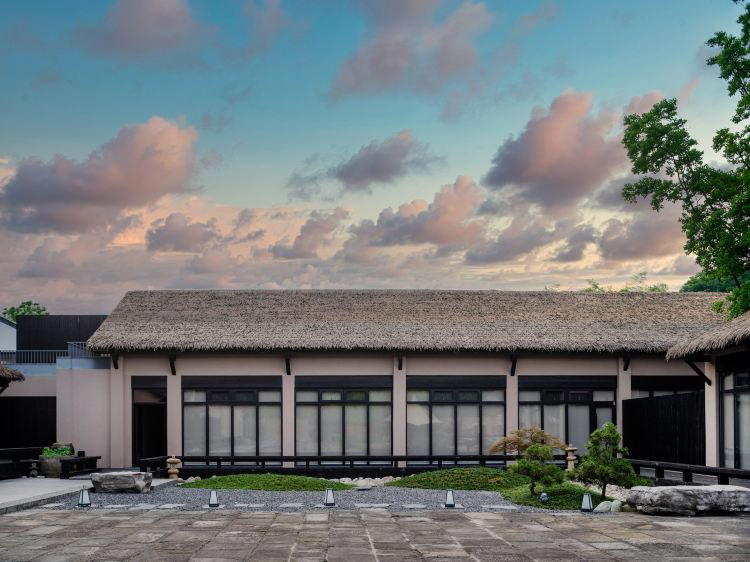
Set against the bamboo forests and Jiangnan gardens of Hubei's Chibi region, INTO Hotel Chibi positions itself within China's growing tier of nature-immersive retreat properties. The design draws from the landscape's historical and pastoral character, balancing traditional architectural heritage with contemporary comfort. For travellers seeking distance from urban China without sacrificing considered hospitality, it represents a deliberate kind of quietness.

Pearl is the En Primeur Club membership app, where members save venues, book tables and use the concierge.
Where the Chibi Countryside Sets the Design Agenda
China's premium retreat market has been sorting itself into two distinct categories for the better part of a decade. On one side sit the polished urban properties with sky-level amenities and business-district addresses, see the Mandarin Oriental Qianmen in Beijing or the JW Marriott Hotel Shanghai at Tomorrow Square. On the other sit a smaller cohort of countryside and nature-embedded properties that treat the surrounding environment as an architectural collaborator rather than a backdrop. INTO Hotel Chibi belongs firmly in the second group.
Positioned at the edge of Chibi City in southern Hubei province, the hotel sits adjacent to the Chibi Ancient Battlefield Scenic Area, a site that carries considerable historical weight in Chinese cultural memory as the location of the famous Battle of Red Cliffs (208 AD). The proximity to that landscape is not incidental to the hotel's design logic: the bamboo forests and Jiangnan-style gardens that frame the property are part of the spatial argument the building is making. Tranquillity here is architectural in intent, not just a marketing word.
The Design Conversation Between Heritage and Contemporary Form
Jiangnan garden aesthetics, the classical southern Chinese tradition of enclosed courtyard landscapes with water features, moon gates, layered rock formations, and considered plantings, form the visual grammar that INTO Hotel Chibi works within. This is a tradition that prizes compression and revelation: spaces that feel intimate before opening onto something larger, views that are framed rather than panoramic. When a hotel commits to this language seriously, the result is a kind of spatial pacing that is hard to replicate through contemporary design alone.
The property's stated philosophy of balancing traditional heritage with contemporary execution places it in a peer conversation with properties like Amanfayun in Hangzhou, which sits within a UNESCO-listed tea village and holds restored heritage structures at its centre, and Amandayan in Lijiang, which works with the vernacular architecture of the Naxi minority tradition. What all of these properties share is the decision to let local material culture carry the design load, rather than imposing a house aesthetic from outside. INTO Hotel Chibi's use of bamboo-forest setting and Jiangnan garden form reads as a version of this same commitment, applied to the specific character of Hubei's countryside.
Hubei sits in central China, a province perhaps better known internationally for Wuhan than for its rural south. Chibi City, in Xianning prefecture, occupies a greener and considerably quieter register than the provincial capital, the Mufu Mountain area and the broader Xianning region are associated with hot springs, bamboo landscapes, and a slower seasonal rhythm. That regional character informs what INTO Hotel Chibi is offering at a structural level: an argument that Hubei's interior has its own credible claim on the luxury retreat conversation.
The Wider Context of Nature-Embedded Hospitality in China
China's nature-retreat tier has expanded significantly as domestic luxury travel has matured. Properties like the Xiamen Yunding Resort, Banyan Tree Chongqing Beibei, and Conrad Jiuzhaigou each anchor themselves in natural spectacle of different kinds, coastal elevation, river-gorge scenery, and the colour-lake range of Sichuan respectively. The common thread is a design strategy that prioritises visual and sensory dialogue with the environment over the branded-interior sameness that characterised earlier phases of Chinese luxury hospitality.
INTO Hotel Chibi operates at a smaller regional scale than several of those properties, which is part of its editorial interest. It is not trying to compete with the grand-gesture resort formats found further south in Sanya (see 1 Hotel Haitang Bay) or in the commercially dense markets of Shenzhen (see Andaz Shenzhen Bay). Instead, it is oriented toward a traveller who specifically wants the Hubei countryside, the bamboo groves, the garden enclosures, the relative obscurity of a historically rich but under-toured region.
That positioning carries its own logic. Properties in under-visited Chinese regions often face a credibility gap with first-time visitors unsure of what the surrounding area offers. Chibi's Ancient Battlefield Scenic Area addresses that gap directly: the Red Cliffs site is a named cultural destination with an established visiting pattern, which means the hotel sits within an existing reason-to-visit rather than needing to create one from scratch. For travellers with an interest in Chinese history and landscape simultaneously, the combination is efficient.
Booking and Access Considerations
Chibi City is accessible from Wuhan, Hubei's provincial capital, which has direct high-speed rail connections to major Chinese cities including Beijing, Shanghai, Guangzhou, and Chengdu. The Wuhan to Chibi corridor is served by regional rail and road, making this a feasible short-break destination from the eastern seaboard. The hotel's location near the battlefield scenic area means that coordination with site visits is direct by local standards.
For travellers building a broader China itinerary that combines urban properties with countryside retreats, INTO Hotel Chibi fits naturally as a contrast segment. Pairing it with a Wuhan city stay, or extending into Hunan province to the south, are itinerary patterns that make geographic sense. For those exploring China's less-trafficked interior, properties like Vanke Lake Songhua Yunlu Hotel in Jilin and Mohe Youran Mountain Residence in Da Hinggan Ling offer points of comparison from China's northern extremes, though the climatic and cultural register is very different. See our full Chibi City guide for broader orientation on the area's dining and cultural options.
Specific room categories, pricing tiers, and booking channels for INTO Hotel Chibi were not available at the time of publication. Rates at properties of this type in Hubei's countryside tier tend to sit below comparable nature-retreat formats in Sichuan or Yunnan, though verification from the property directly is advised before planning. Seasonal considerations apply: central China's summers are humid and warm, while spring and autumn offer the most comfortable conditions for exploring the bamboo-forest setting and outdoor garden spaces.
Within the Aman-adjacent or design-led Chinese retreat category, INTO Hotel Chibi does not carry the same brand recognition as properties like Banyan Tree Ringha in or Elite Spring Villas in Anxi. What it offers instead is a specific place argument: Hubei's Chibi region, the Red Cliffs association, bamboo countryside, and a Jiangnan garden aesthetic applied in a context that most international travellers have not yet encountered. That specificity of place is increasingly what differentiates the more interesting entries in China's luxury retreat tier from the ones that could be anywhere.
For a broader view of how design-led hotels are operating across China's major markets, the EP Club portfolio covers properties from Green Lake Hotel Kunming to Altira Macau and Hyatt Place Nanjing Xuanwu, with international reference points including Aman Venice and Aman New York for travellers calibrating expectations across markets.
Side-by-Side Snapshot
Comparable venues nearby, for context on price, style, and recognition.
| Venue | Cuisine | Price | Awards | Notes |
|---|---|---|---|---|
| INTO Hotel ChibiThis venue (the venue you are viewing) | Boutique mountainside retreat channeling peace and tranquillity of Hubei's countryside. | $100–200 | Small Luxury Hotels of the World Member | Not listed |
| 百萬石温泉飯店 Hyakumangoku Onsen Hotel | Contemporary Japanese luxury resort with wabi-sabi design philosophy and Eastern Zen aesthetics, featuring eight architectural pavilions integrated with natural forest and snow elements. | Not listed | 5-Star | 浦东 |
| InterContinental One Thousand Island Lake Resort | Nature-inspired luxury resort | Not listed | Michelin Selected | Chun'an County |
| DongFengYun Hotel Mi’Le - MGallery | Artistic luxury boutique in vineyard setting with post-modern red brick architecture | $100–200 | Michelin Selected | Dongfengyun Art Town |
| Regent Chongqing | Blends modern elegance with traditional Chinese elements inspired by courtyards and cultural heritage. | Not listed | 1 Michelin Key | Jiangbeizui |
| ME Guangzhou | Lifestyle luxury hotel positioned as a cultural hub within Guangzhou’s emerging second CBD. | Not listed | Not listed | Guangzhou International Financial City–Huangpu Bay Business Circle |
Recognition history
Dated appearances from independent guides and award organizations, with the underlying list record or original source where available.
Small Luxury Hotels of the World Member
Small Luxury Hotels of the World
Details
- Quiet
- Modern
- Minimalist
- Scenic
- Elegant
- Romantic Getaway
- Wellness Retreat
- Weekend Escape
- Panoramic View
- Garden
- Terrace
- Wi Fi
- Pool
- Massage
- Restaurant
- Room Service
- Concierge
- Garden
- Mountain
- Step Free Entrance
- Wheelchair Accessible
Calming neutrals and natural materials create a serene, tranquil atmosphere amid bamboo forests and gardens, praised for its peaceful escape.