
Set within Fès's historic royal gardens district, Fes Marriott Jnan Palace has earned three award distinctions — Regional Winner for Luxury Lifestyle Hotel, Country Winner for Luxury Design Hotel, and Continent Winner for Luxury Culinary Hotel — placing it at the upper tier of Morocco's competitive luxury hospitality market. The property's architecture and culinary programming together form a case study in how large-format hotels in the medina's orbit can compete on design and food credentials, not just scale.
 Discover on Pearl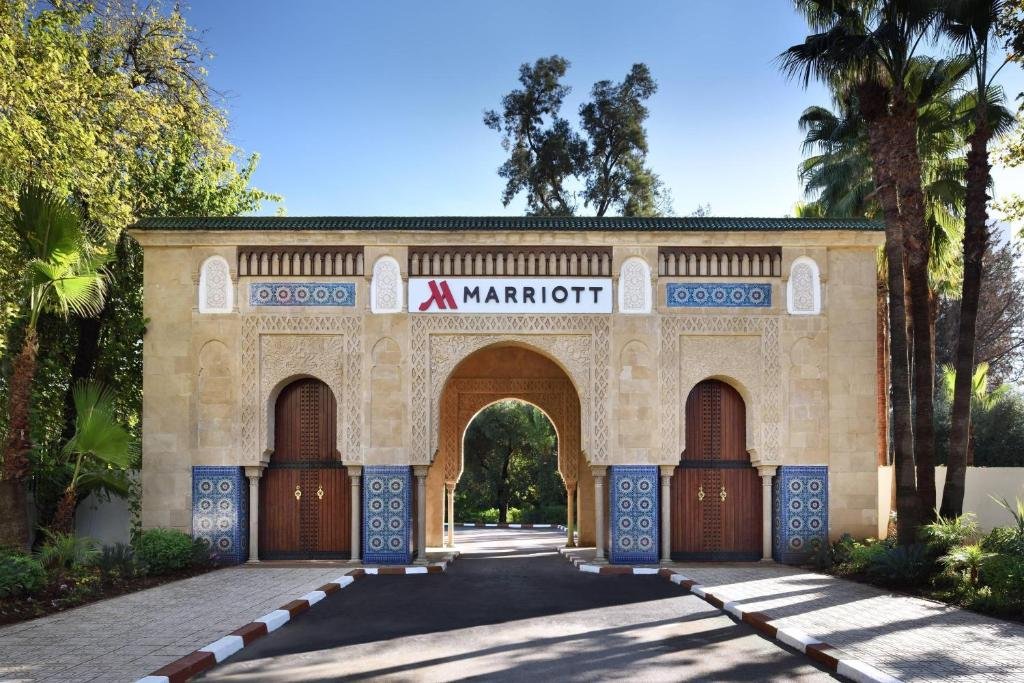
Where Andalusian Design Meets the Fès Medina Circuit
Arriving at Jnan Palace Avenue, the geometry changes before you step through the entrance. Fès operates architecturally in two registers: the dense, inward-facing logic of the medina — blind walls, hidden courtyards, light arriving from above — and the broad, garden-fronted formality of the Ville Nouvelle perimeter, where royal and diplomatic properties were traditionally sited. Fes Marriott Jnan Palace occupies this second register, at 8 Avenue Ahmed Chaouki, positioned adjacent to the royal gardens that give the neighbourhood its name. The physical approach signals a different scale of hospitality than the riad model that dominates Fès's boutique accommodation tier.
Morocco's large luxury hotels have historically been measured against one another on garden scale and water-feature ambition rather than design intelligence. That equation has shifted over the past decade, and the award record at Jnan Palace reflects the shift. The property holds three separate recognition categories: Regional Winner for Luxury Lifestyle Hotel, Country Winner for Luxury Design Hotel, and Continent Winner for Luxury Culinary Hotel. Winning across lifestyle, design, and culinary categories simultaneously positions the property outside the single-axis competition that defines most large-format hotels in the country. Compare this multi-category profile against, say, the more contained boutique logic of Riad Fès or the medina-immersed intimacy of Karawan Riad and Riad Laaroussa, and you see that the Marriott is competing in an entirely different tier , one defined by programmatic breadth rather than architectural compression.
The shortlist, unlocked.
Hard-to-book tables, cellar releases, and concierge-planned trips.
Get Exclusive Access →The Architecture as Editorial Statement
Moroccan hotel design in this bracket tends toward one of two vocabularies: Arabesque maximalism, with zellige tilework and cedar-carved ceilings deployed at overwhelming density, or a more tempered hybrid that borrows the geometry of Islamic ornament without saturating every surface. Jnan Palace's Country Winner recognition for Luxury Design Hotel suggests the property has arrived at something considered rather than simply decorative. In the Fès context, that matters: the medina's craftsmanship traditions set an almost impossible benchmark for interior ornament, and properties that merely replicate it at hotel scale tend to read as theatrical rather than authentic.
The garden setting provides the framework that interior design alone rarely can. Jnan translates from Arabic as garden or orchard, and the grounds function as a spatial argument for the property's identity , a proposition that luxury in Fès need not be compressed into a riad courtyard but can breathe across landscaped hectares in the manner of the city's historic royal estates. This positions Jnan Palace within a lineage of Moroccan garden-hotel properties that includes Jnane Tamsna in Marrakech and, at greater scale, La Mamounia, where garden architecture carries as much prestige weight as the built fabric of the hotel itself.
Culinary Programming at Continental Scale
The Continent Winner recognition for Luxury Culinary Hotel is the most consequential of the three awards, because culinary programming is where large-format hotels in Morocco most frequently underperform. The category implies a food and beverage operation evaluated across the whole African continent, which is a different competitive set than the domestic or regional market. Within Morocco, the culinary hotels that operate at this level of recognition tend to run multiple dining formats , Moroccan, international, and seasonal , rather than a single signature restaurant appended to a hotel lobby.
Fès's own culinary tradition is widely regarded as Morocco's most complex: bastilla here is a benchmark dish, the spice vocabulary draws from Andalusian and sub-Saharan influences in proportions specific to the region, and the city's historic role as a religious and scholarly centre shaped a kitchen culture built around refinement and technique rather than rustic simplicity. A hotel that wins at continental level for culinary programming in this city is implicitly measured against that tradition. For comparison, the Hyatt Regency Casablanca and Fairmont La Marina Rabat Salé operate strong culinary programs in their respective cities, but neither carries a continental-level culinary hotel distinction.
Other Morocco properties that compete in design and lifestyle categories include Hotel Sahrai, an SLH Hotel in Fes, which occupies a contemporary design niche above the medina, and Banyan Tree Tamouda Bay on the northern coast. Further afield, Dar Ahlam in Ouarzazate and Kasbah Tamadot in Asni define the remote luxury category, while La Sultana Oualidia and Dar Maya in Essaouira anchor the coastal boutique segment. None of these properties carries the three-axis award spread that defines Jnan Palace's current positioning.
Fès as a Destination Context
Hotels in Fès occupy a more demanding position than their counterparts in Marrakesh. The city attracts a traveller who has typically done Morocco before , who has navigated the Marrakesh souks and is now after the original reference point. Fès El Bali, the oldest walled medina in the world and a UNESCO World Heritage Site since 1981, is not a performative destination but a functioning urban ecosystem, and that places authenticity pressure on accommodation in ways that resort cities do not. A hotel that wins on lifestyle, design, and culinary criteria simultaneously in this environment is earning those credentials in a harder competitive context than most continental-level recognition programs account for.
For a broader map of what Fès offers across hotels and restaurants, see our full Fès guide. For travellers building a longer Morocco itinerary, Fairmont Tazi Palace Tangier represents the northern circuit anchor, Michlifen Resort in Ifrane offers the cedar-forest mountain alternative within day-trip distance of Fès, and Rabat Marriott Hotel covers the capital leg. International travellers comparing Morocco's luxury tier against other markets can read how properties like Aman New York or The Fifth Avenue Hotel handle multi-category programming to calibrate expectations.
Planning Your Stay
The property is located at 8 Avenue Ahmed Chaouki in the Jnan Sbil gardens district, on the western edge of the medina, accessible by taxi from Fès-Saïss Airport in approximately 20 to 30 minutes depending on traffic. As a large-format hotel with international chain infrastructure, bookings can be made through Marriott's global reservations platform and Bonvoy loyalty programme, giving it a booking accessibility that contrasts with the medina riads, which typically require direct contact or specialist booking agents. Peak season in Fès runs April through June and September through November, when temperatures are moderate and the city hosts cultural programming; summer months see significant domestic and diaspora travel that tightens availability across all accommodation tiers. Additional regional properties worth comparing during planning include Dar al Hossoun in Taroudant, La Fiermontina Ocean in Larache, and Château Roslane, if wine country programming forms part of your itinerary. Hilton Taghazout Bay covers the surf-coast segment for travellers combining Fès with Atlantic Morocco. For those extending into Europe, Aman Venice represents a comparable design-led luxury standard in the Old World context. Hotel Sahrai in Fez is the nearest alternative for travellers who prefer a contemporary independent property over a branded hotel.
Frequently Asked Questions
- What's the vibe at Fes Marriott Jnan Palace?
- The property reads as formal garden-hotel rather than medina riad , broad grounds, architectural scale, and international chain infrastructure sit alongside proximity to the medina. If you are travelling with a group that values lobby space, pool access, and multiple dining formats over boutique compression, this is the tier to consider in Fès. The three-category award profile (lifestyle, design, culinary) suggests programming depth that goes beyond what standard chain hotels in Morocco typically offer.
- What's the signature room at Fes Marriott Jnan Palace?
- Specific room category data is not publicly available in our records, but the Country Winner recognition for Luxury Design Hotel implies that the design programme extends into accommodation rather than being limited to public spaces. In this category of awards evaluation, bedroom design, material quality, and spatial logic are assessed as part of the overall entry. Guests prioritising design credentials should request room categories that face the gardens, which form the property's primary spatial asset.
- Why do people go to Fes Marriott Jnan Palace?
- Fès draws travellers seeking Morocco's oldest and most architecturally intact medina, and the Marriott provides the large-format infrastructure , pool, multiple restaurants, international booking systems , that the medina's riad properties cannot offer at the same scale. The Continent Winner for Luxury Culinary Hotel is a meaningful differentiator: dining at this level of recognition in a city with Fès's culinary depth represents a credible reason to base yourself here rather than in the medina itself.
- What's the leading way to book Fes Marriott Jnan Palace?
- Bookings go through Marriott's global platform and the Bonvoy programme, which provides points accumulation and elite status benefits not available through third-party agents. Direct booking also tends to secure better room allocation in large-format properties. Given that Fès's peak seasons (spring and autumn) can compress availability across all accommodation tiers, booking six to eight weeks ahead for these periods is advisable.
- How does Jnan Palace's culinary recognition compare to other Fès hotels?
- The Continent Winner for Luxury Culinary Hotel places Jnan Palace at a tier above most Fès properties, which compete primarily on interior design and medina proximity rather than food and beverage programming. Fès's culinary tradition is among Morocco's most technically complex, encompassing Andalusian-influenced spice work and dishes like bastilla that require genuine technique to execute. A continental culinary award in this city carries more weight than the same category would in a less demanding food context.
A Quick Peer Check
A fast peer set for context, pulled from similar venues in our database.
| Venue | Cuisine | Price | Awards | Notes |
|---|---|---|---|---|
| Fes Marriott Jnan Palace | This venue | |||
| Riad Fès | ||||
| Karawan Riad | ||||
| Riad Laaroussa |
Preferential Rates?
Our members enjoy concierge-led booking support and priority upgrades at the world's finest hotels.
Get Exclusive AccessThe shortlist, unlocked.
Hard-to-book tables, cellar releases, and concierge-planned trips.
Get Exclusive Access →