Dar Ahlam


A two-hundred-year-old kasbah in the Skoura palm grove, 40 kilometres from Ouarzazate, Dar Ahlam operates at a maximum of 28 to 30 guests across 14 suites. The property holds Small Luxury Hotels of the World membership and positions its dining around a collaboration between savoury and pastry talents from the Hermé lineage. Distance from Marrakech is roughly 250 kilometres, making this southern Morocco's most deliberate detour.
Pearl is the En Primeur Club membership app — saves, bookings, and concierge access live there. Same editors, same standards.
- Address
- Douar Oulad Cheik Ali, Koucheït 00000
- Phone
- +212 5 24 85 22 39
- Website
- darahlam.com
- Directions
- Get directions
 Saves & bookings on Pearl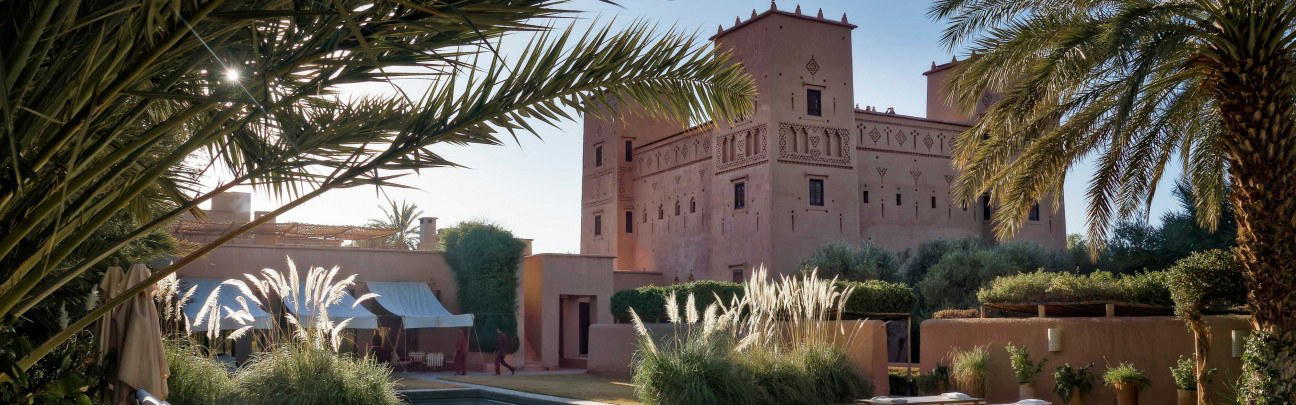
Architecture as Argument: What a Two-Hundred-Year-Old Kasbah Actually Means
Across southern Morocco, the word kasbah gets applied to anything with thick walls and a rooftop terrace. Dar Ahlam is a different proposition. The structure in the Skoura palm grove predates most of the region's tourism infrastructure by two centuries, and its design vocabulary is not a reproduction or a renovation pastiche: it is the original thing, with all the spatial logic that entails. Thick rammed-earth walls that regulate temperature without mechanical intervention. Winding interior staircases that force a particular pace of movement. Wrought iron window screens that filter rather than block light. These are not decorative choices; they are a pre-industrial climate system, and they still function exactly as intended.
The property sits 40 kilometres from Ouarzazate and approximately 250 kilometres southeast of Marrakech, a drive of around four and a half hours that crosses the High Atlas and drops into the pre-Saharan plateau. That distance is the first filter. Guests who arrive at Dar Ahlam have made a choice that most Morocco itineraries do not include, and the property is calibrated for that level of intention. For comparison, the Marrakech cluster of large luxury properties — La Mamounia in Marrakesh, Jnane Tamsna in Marrakech, and resort-scale operations like the Royal Mansour — serve a different travel logic entirely. Dar Ahlam's nearest peer in terms of scale and positioning is closer to properties like Dar al Hossoun in Taroudant or Dar Maya in Essaouira: small-count, character-led, and geographically committed to a region rather than a city hub.
Inside the Structure: Fourteen Suites Across Two Distinct Registers
The fourteen suites divide cleanly into two categories, and the division is architectural rather than merely decorative. The seven kasbah suites occupy the historical core of the building: rooms accessed via the winding staircase, positioned on the first and second floors, ranging from 35 to 40 square metres each. There is no elevator and no ground-floor option within this wing. The suites are named for their design references, Syrian, Indian, Saharan tent, and a local wood-painting tradition called Zouakee, but the underlying spatial experience is consistent: high, thick walls, wrought iron window details, and a connection to the rooftop terrace from which the Skoura palm grove and the wider pre-Saharan plateau become the primary view.
Seven garden suites operate on a different spatial principle. They open directly onto the 1.5-hectare garden rather than onto internal corridors, offering privacy of a lateral rather than vertical kind. Several communicate with each other via shared terraces, making them practical for families or groups travelling together. One suite within this category holds two bedrooms and two bathrooms. Across both wings, the property has made a deliberate decision to exclude televisions, in-room telephones, and minibars. Mobile network coverage is available, and Wi-Fi runs through both the kasbah and garden suites as well as the main salon. The logic is consistent with a property that holds its maximum occupancy at 28 to 30 guests: density of experience rather than density of amenity.
The Garden and the Pool: Landscape as Programme
1.5-hectare garden surrounding the kasbah is planted with date palms, olive trees, fig trees, aromatic herbs, and a working kitchen garden. In the context of southern Morocco's rocky, arid surroundings, a productive garden of this scale is not incidental; it represents sustained water management and horticultural investment. The garden also functions as the property's primary dining venue across multiple settings: breakfast, lunch, and dinner can be taken at various points within it, with the choice of location shifting by time of day and season.
Swimming pool runs 25 metres in a T-shaped configuration, with a width ranging from three to six metres and a depth of one to 2.1 metres. It is heated, which matters for the temperature differentials of the Moroccan south, where clear skies mean cold nights even in months that feel warm by day. For Morocco's broader hotel portfolio, a heated outdoor pool is not universal even at higher price points, properties like Kasbah Tamadot in Asni operate in similarly dramatic landscapes where temperature management becomes a genuine operational question.
Dining: The Hermé Collaboration in Context
Dar Ahlam's kitchen operates on an extensive menu that combines traditional Moroccan preparation with contemporary technique. The savoury programme is attributed to Frederick Grasser Hermé, with the dessert side credited to Pierre Hermé, the French pastissier whose name is among the most recognised in European pastry. That pairing is the dining programme's most legible credential, and it positions the table at Dar Ahlam inside a very specific category: small-count properties where the food programme is designed to match the architectural ambition rather than simply to feed guests adequately. For Morocco's hotel dining more broadly, this is not the standard configuration. Large resort properties in Marrakech and along the Atlantic coast tend toward multi-outlet formats; Dar Ahlam's single-menu approach, served across the garden's various settings, belongs to a different tradition.
Activities and the Southern Moroccan Terrain
The property's activity programme is oriented around the Skoura region and the wider southern terrain. Desert outings with a guide, walking in the Dades Gorges, excursions through the Valley of Almond Trees, horse riding, and cooking classes represent the core offer. Hammam and massage services are available on site. The surrounding landscape, rocky desert plateau transitioning toward the Saharan edge, defines what is possible and what is worth doing, and a guided local presence matters considerably in terrain that is not self-explanatory to most international visitors.
For Morocco beyond the south, the country's hotel infrastructure is distributed across a wide range of formats and cities: coastal properties like Banyan Tree Tamouda Bay in Fnideq or Hilton Taghazout Bay Beach Resort & Spa in Taghazout, urban anchors in Casablanca at Hyatt Regency Casablanca and in Rabat at the Rabat Marriott Hotel, and heritage properties in Fes through Hotel Sahrai, an SLH Hotel in Fes and Fes Marriott Jnan Palace. Dar Ahlam exists outside all those circuits, geographically and experientially. See our full Ouarzazate restaurants and hotels guide for regional context.
Planning Dar Ahlam: What the Logistics Require
Dar Ahlam holds Small Luxury Hotels of the World membership as of 2025, which is the property's primary verifiable affiliation for booking and context purposes. The kasbah runs at a maximum of 28 to 30 guests across its 14 suites, which means availability is constrained in a way that larger Moroccan resort properties are not. The address is Douar Oulad Cheik Ali, Koucheït, in the Skoura palm grove, 40 kilometres from Ouarzazate. Arriving from Marrakech means a 250-kilometre drive over the Atlas, typically four and a half hours by road. For comparison, La Fiermontina Ocean in Larache, La Sultana Oualidia in Oualidia, and Rebali Riads in Sidi Kaouki each require similarly deliberate routing decisions, which is characteristic of Morocco's smaller, design-led properties. Those properties are also linked to Morocco's wider SLH and boutique network. Additional SLH-affiliated context in Morocco is available through Hotel Sahrai in Fez. Other international small-count luxury references include Aman Venice in Venice and Aman New York in New York City, which operate a similarly low-guest-count model at the top of their respective markets, though in entirely different structural and cultural contexts.
Recognition history
Dated appearances from independent guides and award organizations, with the underlying list record or original source where available.
Mr & Mrs Smith Smith Seal of Approval
Mr & Mrs Smith
Virtuoso Luxury Hotel Partner
Virtuoso
Small Luxury Hotels of the World Member
Small Luxury Hotels of the World
At a Glance
- Romantic
- Quiet
- Elegant
- Rustic
- Intimate
- Ornate
- Scenic
- Honeymoon
- Romantic Getaway
- Wellness Retreat
- Anniversary
- Private Villa
- Panoramic View
- Private Dining
- Garden
- Terrace
- Historic Building
- Pool
- Spa
- Wi Fi
- Room Service
- Concierge
- Airport Transfer
- Breakfast Included
- Garden
- Mountain
- Pool
- Spa
- Wi Fi
- Room Service
- Concierge
- Airport Transfer
- Breakfast Included
Tranquil and spiritual with candlelit private dining spots, open fireplaces, and a home-like aura free of modern distractions like TVs and phones.
Know Before You Go
- Getting there
- Douar Oulad Cheik Ali, Koucheït 00000