Google: 4.2 · 5,978 reviews
Konnopke's Imbiss is one of Berlin's most enduring street food institutions, operating beneath the refined U-Bahn tracks at Schönhauser Allee in Prenzlauer Berg since 1930. The Currywurst stand has outlasted political division, reunification, and gentrification alike, making it a reference point for anyone wanting to understand how Berlin eats on its own terms. It is the kind of stop that serious visitors build a route around, not an afterthought.
 Discover on Pearl
Pearl is the En Primeur Club membership app — saves, bookings, and concierge access live there. Same editors, same standards.
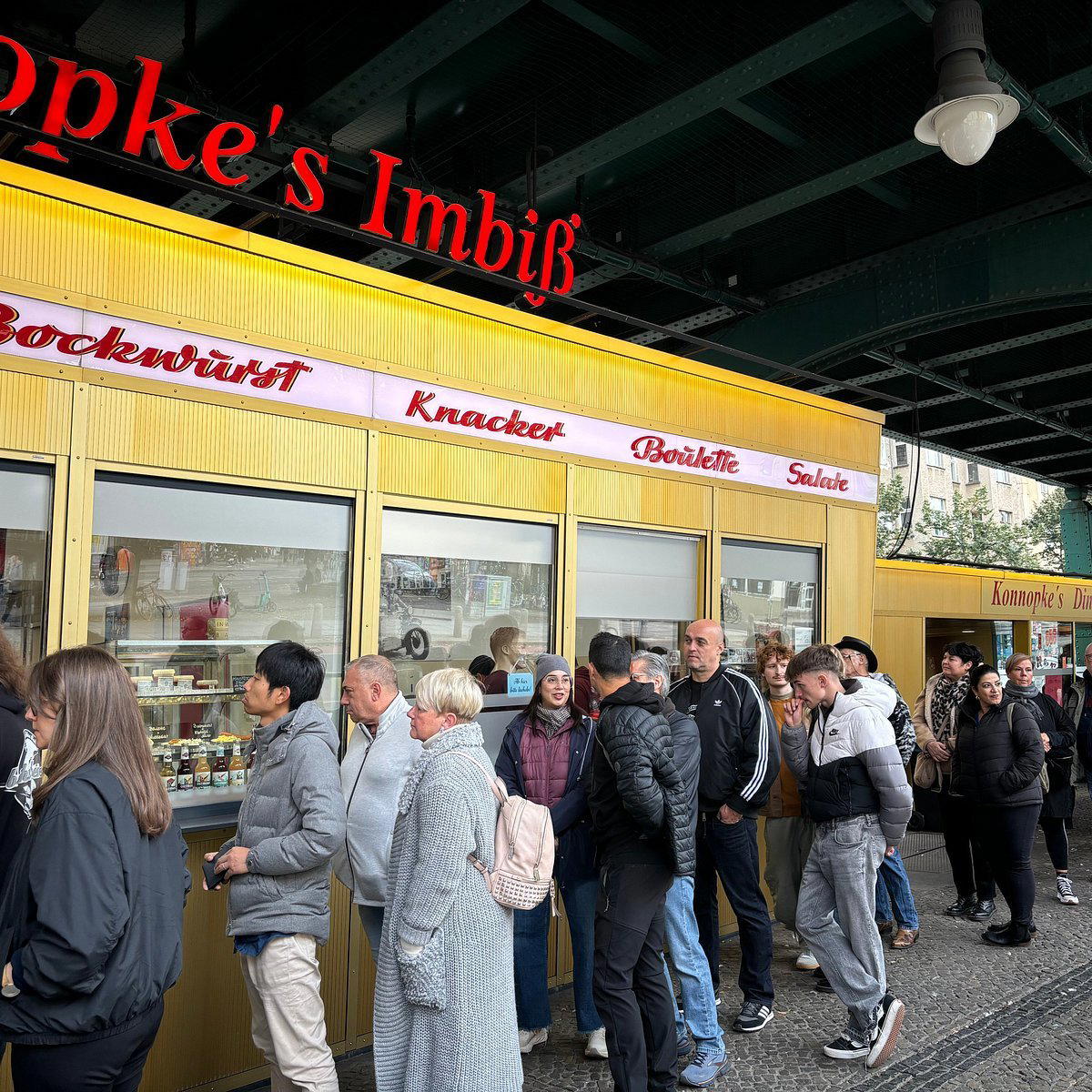
The Stand Beneath the Tracks
There is a particular sound that greets you at Schönhauser Allee 44b: the rhythmic clatter of an S-Bahn or U-Bahn train passing overhead, close enough to feel. The refined rail infrastructure here in Prenzlauer Berg casts a permanent shadow over the pavement, and directly beneath it, Konnopke's Imbiss has been serving Currywurst from essentially the same patch of concrete since 1930. The setting is not designed for lingering in any conventional sense. There are no tablecloths, no ambient lighting decisions, no curated soundtrack. The experience is defined by the rail noise, the queue, and the smell of grilled sausage cutting through the outdoor air. That is the whole point.
In a city that has produced some of Europe's most discussed bars and restaurants, this kind of street food permanence is easy to overlook. Berlin's food culture has split decisively in recent decades between high-concept dining rooms and neighbourhood institutions with deep local roots. Konnopke's belongs entirely to the second category, and it occupies that tier with the confidence of a place that has never needed to announce itself.
What Currywurst Actually Means in This City
Currywurst is often explained to non-Germans as a Berlin snack, which undersells how seriously the city takes the format. The dish, a grilled or fried pork sausage sliced and dressed with a seasoned ketchup-based sauce and curry powder, became a working-class staple in the post-war West Berlin economy and spread across the city in the decades that followed. East Berlin developed its own Currywurst culture, and Konnopke's, operating in what was the eastern sector, represents that lineage directly.
The political geography matters here. When Germany was divided, the stand continued operating under the GDR system, navigating the particular economic constraints of a planned economy while maintaining a product that Berliners on that side of the wall recognised as their own. Reunification brought new pressures, including the gentrification of Prenzlauer Berg, which transformed the surrounding neighbourhood into one of the city's more expensive residential areas. The stand absorbed all of it. That kind of continuity is rare in any food culture and rarer still in a city that has been rebuilt, divided, and rebuilt again.
Occasion Dining, Reconsidered
The editorial angle of occasion dining typically points toward a candlelit tasting menu or a long-table celebration with a wine list. Konnopke's complicates that framing in a way that is worth taking seriously. There are occasions that call for exactly this: the first meal after arriving in Berlin by overnight train, the post-concert stop in the cold, the deliberate choice to eat something real after a day of gallery circuits in Mitte. These are milestone moments in a different register, and they have their own logic.
Berlin visitors who plan their itinerary around a reservation at a Michelin-recognised dining room in Charlottenburg or a craft cocktail session at Buck & Breck often find that the meal they remember most clearly is the one eaten standing up beneath the refined tracks. That is not sentimentality. It reflects how strongly the physical context of a meal shapes its significance. Konnopke's delivers context that no restaurant in Prenzlauer Berg can replicate, because the context is nearly a century of unbroken operation in a place that has seen more history than most European cities accumulate in twice the time.
If you are building a Berlin evening around drinks at Lebensstern or Stagger Lee, a late stop at Konnopke's functions as the kind of grounding counterpoint that those venues, for all their craft, cannot provide. The same logic applies if the night starts at Velvet.
Where It Sits in the Berlin Food Map
Prenzlauer Berg has changed almost completely since reunification. The neighbourhood now runs on organic bakeries, specialty coffee, and wine bars with well-curated natural lists. Konnopke's coexists with all of that without conceding anything to it. The stand's presence on Schönhauser Allee is a reminder that the neighbourhood's current character is a relatively recent development, and that the food culture beneath the U-Bahn tracks predates every artisan intervention by several decades.
For visitors cross-referencing Berlin against Germany's other city food scenes, the comparison is instructive. Frankfurt has its Apfelwein taverns and the craft bar work happening at places like The Parlour. Munich anchors its identity in beer hall tradition, with the Goldene Bar representing the more polished end of that spectrum. Hamburg's cocktail culture runs through bars like Le Lion Bar de Paris. Cologne has its Kölsch culture, and Bar Trattoria Celentano points toward where that city's bar scene is moving. Düsseldorf's Uerige and Kiel's Kieler Brauerei am Alten Markt each carry deep local drinking traditions. Berlin has all of that complexity too, but it also has Konnopke's, which is a different kind of institution entirely: a street food stand that survived a century of German history and still draws a queue.
For broader context on how Berlin's food and drink scene is organised across its neighbourhoods, the EP Club Berlin guide maps the city's current dining and drinking character in more detail. For international context, the bar work at Bar Leather Apron in Honolulu represents what the premium end of the casual-but-serious format looks like in a very different setting.
Planning Your Visit
Konnopke's is located directly at the Eberswalder Strasse U-Bahn station on the U2 line, which puts it within easy reach of most central Berlin accommodation. The stand operates outdoors in all weather, so the experience in January differs considerably from August. Neither version is wrong, but the winter version, with steam rising from the sauce and the overhead rail noise amplified by the cold air, has its own particular character. Current hours and seasonal variations should be confirmed before visiting, as the stand's schedule has shifted across its operating history. Booking is not applicable here: you queue, you order, you eat. The format has not changed in the ways that matter, and that is precisely why it still draws visitors who have already done everything else Berlin has to offer.
Price and Positioning
A quick comparison pulled from similar venues we track in the same category.
| Venue | Awards |
|---|---|
| Konnopke's ImbissThis venue — the venue you are viewing | |
| Buck & Breck | World's 50 Best |
| Velvet | World's 50 Best |
| Wax On | World's 50 Best |
| Lebensstern | World's 50 Best |
| Stagger Lee | World's 50 Best |


At a Glance
- Iconic
- Rustic
- Lively
- Casual Hangout
- Late Night
- Historic Building
- Standing Room
- Outdoor Terrace
- Street Scene
Bustling street food stand with vibrant, fast-paced atmosphere under the elevated tracks, filled with the aroma of sizzling sausages and curry sauce.