De Sluyswacht
A seventeenth-century lock-keeper's house perched at the edge of the Oudeschans canal, De Sluyswacht has evolved into one of Amsterdam's most atmospheric brown cafés. The building's crooked silhouette and canal-facing terrace draw regulars who come for Dutch jenever and local beer rather than trend-chasing cocktails. It sits where the Jewish Quarter meets the waterfront, and that address alone tells you something about its staying power.
Pearl is the En Primeur Club membership app — saves, bookings, and concierge access live there. Same editors, same standards.
- Address
- Jodenbreestraat 1, 1011 NG Amsterdam, Netherlands
- Phone
- +31 20 625 7611
- Website
- sluyswacht.nl
- Directions
- Get directions
 Saves & bookings on Pearl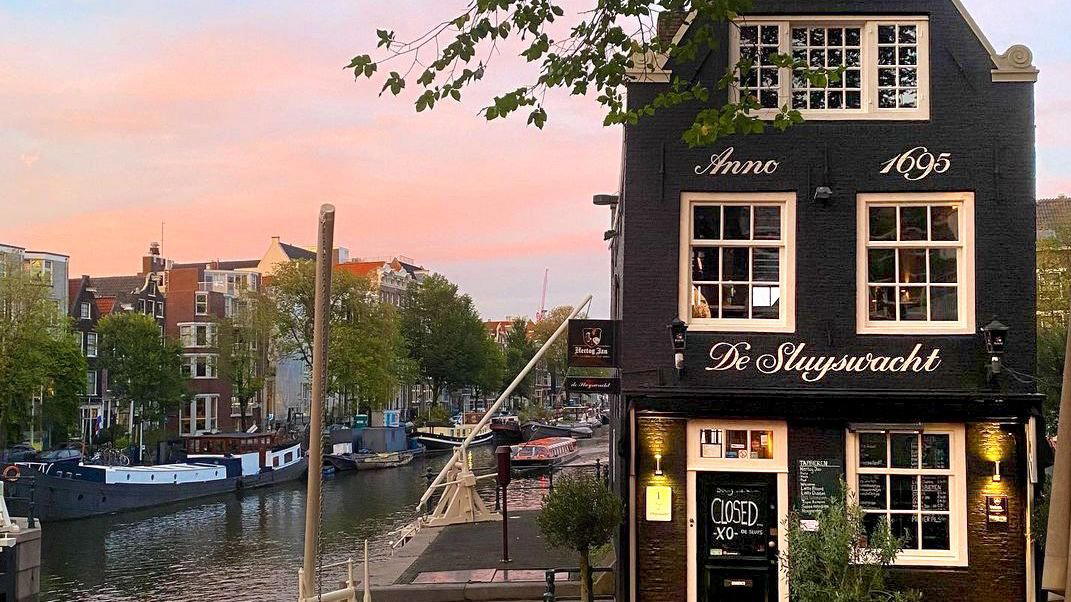
Where the Canal Ends and the Glass Begins
Approach De Sluyswacht from Jodenbreestraat and the building announces itself before you read the sign. The structure tilts at the kind of angle that would alarm a surveyor, its dark timber frame leaning slightly over the Oudeschans canal as if drawn toward the water by habit. This is Amsterdam's canal-house architecture at its most unguarded: a seventeenth-century lock-keeper's post that has spent the better part of four centuries adapting to whatever the neighbourhood needs. What it needs now, apparently, is a place to drink jenever and watch the light change on the water.
The brown café, or bruine kroeg, is a distinctly Dutch format. Low ceilings, tobacco-stained walls, wooden furniture worn smooth by generations of elbows, and a drinks programme built around tradition rather than novelty. Amsterdam has dozens of them, scattered across the old city from the Jordaan to the Plantage, but the ones that endure longest tend to occupy corners with genuine history rather than replicated patina. De Sluyswacht's position at the edge of the former Jewish Quarter, a neighbourhood that carries one of Amsterdam's most complex histories, gives it a weight that purpose-built heritage bars cannot manufacture.
Jenever, Beer, and the Logic of the Brown Café Bar
The editorial angle on De Sluyswacht is not its drinks list in isolation but the relationship between what it pours and the environment in which you drink it. The brown café format is, at its core, a pairing proposition: the food and drink programme is calibrated to the mood of the room, not to the ambitions of a chef or bartender seeking recognition. That is a deliberate positioning, and it separates this tier of Amsterdam drinking from the technically ambitious bars that have emerged in the city over the past decade.
Jenever, the Dutch precursor to gin, is the natural anchor of any bruine kroeg worth the name. Aged jonge and oude varieties drink differently from the botanical-forward London dry styles that dominate modern cocktail menus, and a bar built around a canal-facing heritage property is a reasonable place to understand why. The older distillates carry a malty warmth from the grain spirit base, a characteristic that pairs more naturally with the kind of simple, salt-forward snacks common to the format than a citrus-led cocktail would. Dutch bar food in this register runs toward bitterballen, hard cheese, and bread-based snacks: accompaniments designed to sustain rather than to impress, and to extend the time you spend at the table.
That contrast with Amsterdam's contemporary cocktail scene is worth mapping. Door 74 and Tales & Spirits represent the city's technical cocktail tier, where ingredient sourcing, clarification techniques, and reservation-only formats signal a different kind of drinking culture. De Sluyswacht sits at the other end of that spectrum without apology. The room is not optimised for discovery menus or seasonal produce rotations. It is optimised for staying longer than you planned.
The Terrace as a Seasonal Argument
Amsterdam's outdoor drinking season is short and weather-dependent in ways that Mediterranean cities do not have to reckon with. When the canal-facing terrace at De Sluyswacht works, which is to say on clear days from late spring through early autumn, it becomes one of the more compelling arguments for the building's continued relevance. The Oudeschans stretches out in front, houseboats moored along the far bank, cyclists crossing the bridge in a rhythm that has not changed much in decades. It is the kind of view that makes a glass of jenever feel like a considered decision rather than a default.
In winter, the logic inverts. The interior's low ceilings and close seating, which might feel claustrophobic in warmer months, become the point. Brown cafés were designed for northern European winters, and the building's thermal eccentricities, a consequence of its age and construction, reinforce that. Plan accordingly: summer visits favour the terrace and early evening light; winter visits favour the interior and the company of regulars who treat the place as a neighbourhood constant.
Placed in Amsterdam's Broader Drinking Map
De Sluyswacht occupies Jodenbreestraat 1, which places it within easy reach of Waterlooplein and the Rembrandt House Museum, putting it in a part of the city that attracts both tourists tracing the Jewish Quarter's history and locals who live in the Plantage neighbourhood to the east. That dual audience is common to bars in historically significant areas, and it shapes the atmosphere in ways that purely residential neighbourhood bars do not experience. The crowd here tends to mix rather than stratify by origin.
For those moving across Amsterdam's drinking circuit, the bar sits at a natural starting or ending point for an evening that might continue west toward the canal belt or east into the Plantage. Amsterdam Roest, a more industrial-format venue on the far side of the city's eastern docklands, draws a different crowd at a different hour: check Amsterdam Roest if you want the contrast. Bakers & Roasters serves a different function entirely as a daytime food destination. For a wider map of where the city's food and drink scene is positioned, the full Amsterdam guide covers the category splits in detail.
Elsewhere in the Netherlands, comparable canal-adjacent drinking culture appears in cities like Utrecht, where Florin Utrecht occupies its own historic address, or in Den Haag, where Bowie operates in a different register. In Delft, Brasserie Lalou leans toward the brasserie format rather than the brown café tradition. Rotterdam's Espressobar Kopi Soesoe represents yet another Dutch drinking mode: the colonial coffee heritage. Café Barolo in Eindhoven and Boode Foodbar in Bathmen extend the map into the south and east of the country. For a point of international comparison in a similar heritage-meets-drinks format, Bar Leather Apron in Honolulu shows how the craft-focused bar model translates to an entirely different geography.
Planning Your Visit
De Sluyswacht is located at Jodenbreestraat 1 in Amsterdam's city centre, a short walk from Waterlooplein metro and tram stop. The canal-facing terrace is the primary draw in warmer months, so arrivals before early evening on clear days tend to secure better positions. The brown café format does not require a reservation at most hours, though weekend afternoons in summer bring tourist traffic from the adjacent Rembrandt House Museum. The format is walk-in and informal: no dress code, no tasting menus, no booking infrastructure. That accessibility is part of the proposition.
| Venue | Cuisine |
|---|---|
| De SluyswachtThis venue — the venue you are viewing | This venue |
Continue exploring
More in Amsterdam
Bars in Amsterdam
Browse all →
Restaurants in Amsterdam
Browse all →
Hotels in Amsterdam
Browse all →
Wineries in Amsterdam
Browse all →
At a Glance
- Cozy
- Rustic
- Well Known
- Casual Hangout
- After Work
- Waterfront
- Historic Building
- Outdoor Terrace
- Seated Bar
- Craft Beer
- Conventional Wine
- Waterfront
- Street Scene
Current opening hours
- Monday
- 12 PM–12 AM
- Tuesday
- 12 PM–12 AM
- Wednesday
- 12 PM–12 AM
- Thursday
- 12 PM–12 AM
- Friday
- 12 PM–2 AM
- Saturday
- 12 PM–2 AM
- Sunday
- 12–8 PM
Hours can change for holidays and private events. Last verified .
Cozy and quirky with tilted floors, lively in evenings, charming canal-side atmosphere.
Know Before You Go
- Getting there
- Jodenbreestraat 1, 1011 NG Amsterdam, Netherlands