Berghain and its upper-floor Panorama Bar occupy a converted East Berlin power station that has defined the city's techno culture for two decades. The space operates on its own terms: no cameras, selective door policy, and a sound system calibrated to the room's brutalist concrete shell. For those who gain entry, it remains the reference point against which Berlin's club culture measures itself.

Pearl is the En Primeur Club membership app — saves, bookings, and concierge access live there. Same editors, same standards.
- Address
- Am Wriezener bhf, 10243 Berlin, Germany
- Phone
- +49 30 29360210
- Hours
- Mon 12–6 AMTue–Thu ClosedFri 10 PM–12 AMSat 12–6 AM, 11:59 PM–12 AMSun Open 24 hours
- Website
- berghain.berlin
- Directions
- Get directions
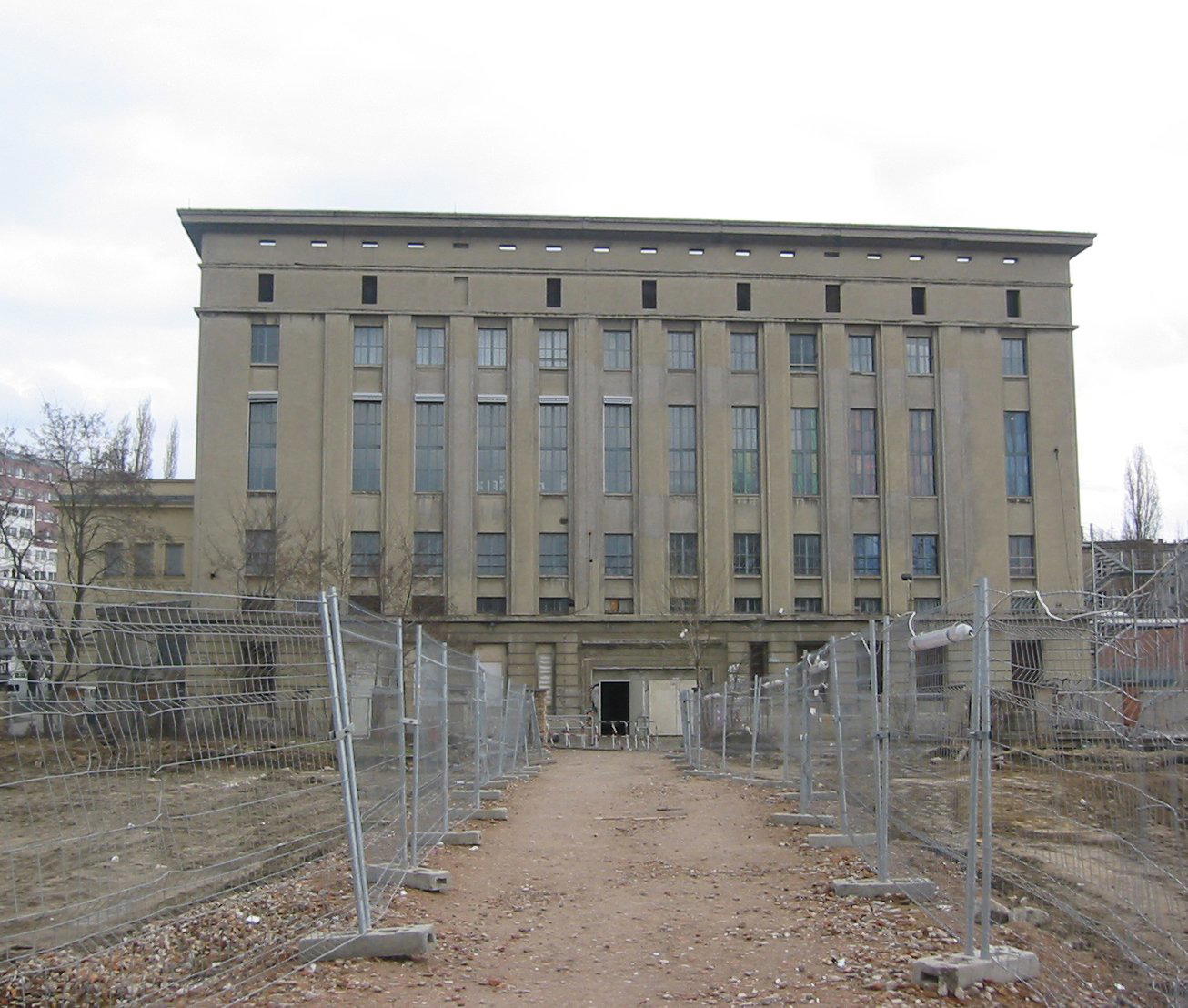
Where the Architecture Does the Work
Berlin's post-reunification club culture grew out of vacancy: empty warehouses, disused factories, and industrial sites that the city had not yet decided what to do with. Most of those spaces have since been redeveloped, priced out, or sanitised into something more commercially legible. The former Heizkraftwerk Mitte, a GDR-era heating plant near Ostbahnhof, became the address that defined that trajectory longest and most completely. The building is immense — raw concrete, cathedral-height ceilings, and a turbine hall that absorbs sound and bodies in proportions few purpose-built venues can match. Approaching along Am Wriezener Bahnhof on a Sunday morning, the queue outside tells you more about the venue's position in the city's cultural economy than any review could.
The two main floors operate as distinct sonic and social environments. The ground-floor main room runs harder techno through a Funktion-One system tuned to the room's specific acoustic character. Panorama Bar, one level up, sits in what was the former boiler room and runs a warmer programme — house and early techno, more light, a different crowd dynamic. The distinction matters because it gives the space editorial range: you are not choosing between clubs but between rooms inside a single, coherent institution.
The Back Bar as Cultural Artefact
Berlin's bar culture has always sorted itself along ideological lines. The cocktail-led rooms of Mitte and Prenzlauer Berg, venues like Buck & Breck with its apothecary-cabinet approach to spirits, or Lebensstern in the west of the city, operate on a fundamentally different philosophy from the club bar format. In a cocktail programme, the back bar is a display of curation, rare bottles as evidence of expertise. In a venue like Berghain, the bar serves a different function entirely, and the choice of what to stock reflects that with precision.
The drinks programme here is deliberately stripped back. Club-context bars across Berlin, from Stagger Lee to smaller Kreuzberg operations, have generally moved toward serving formats that hold up across long sessions: high-quality beer, direct spirit pours, and mixers rather than elaborate builds. At Berghain, this is taken further. The beer selection skews German, the spirits are reliable without being showy, and the format acknowledges that in a 1,500-capacity space running for 60-plus hours across a weekend, the back bar's job is endurance and consistency, not point-of-difference curation. That restraint is its own kind of editorial statement. Compared to the considered craft selections at Velvet or the whisky-forward programmes at some of Berlin's standing bars, the club bar model prioritises function over collection, and does so openly.
What the venue does hold is a kind of institutional rarity that no bottle collection can replicate: the audio infrastructure itself. The Richard Kamlet-modified Funktion-One system, along with the room tuning overseen across years of operation, represents a sunk investment in sound quality that positions Berghain in a different tier from almost any comparable space in Europe. The back bar analogy holds: the collectible here is acoustic rather than alcoholic.
The Door, the Policy, and What It Signals
Selective admission at nightclubs is not new, but Berghain's door policy has become one of the most discussed filtering mechanisms in contemporary nightlife. The practical consequence is real: on busy weekends, queues form in the early morning hours and rejection rates run high enough to have generated their own secondary literature of advice and speculation. This is not theatre. The curation at the door reflects the same logic as the building's approach to its programme: the space operates at its intended capacity and temperature only when the crowd mix is calibrated to it.
For visitors planning a first visit, the operational facts are worth knowing. The main sessions run Friday night through to Monday morning, with the building not closing between. Entry later in a session, particularly Sunday afternoon, tends to carry higher admission rates than peak early Saturday. The dress code is de facto rather than posted: functional, dark, and understated is the consistent read of what passes. Cameras and phones are prohibited inside, enforced by sticker placement on camera lenses on entry, a policy that has been in place long enough to have shaped the visual documentation of the space almost entirely through illustration and external photography.
Berghain in Berlin's Broader Drinking and Nightlife Circuit
Berlin's premium bar circuit and its club circuit intersect less than visitors sometimes expect. The cocktail bar culture running through Mitte, Charlottenburg, and Prenzlauer Berg, from the intimate formats of Buck & Breck to the more international programmes at venues like Stagger Lee, shares an audience with Berghain only at the edges. The club's reference set is different: fabric in London, Tresor and Watergate within Berlin itself, Concrete in Paris, Rex Club for the Panorama Bar's programming style. Understanding where Berghain sits in that peer group clarifies what a visit is and is not. It is not a bar destination in the cocktail-programme sense. It is a closed ecosystem, a weekend-long environment with its own internal economy of movement, rest, and return.
Across Germany, the bar tier operates differently by city. Hamburg's Le Lion Bar de Paris runs a spirits-focused programme closer to the Continental classics tradition; Munich's Goldene Bar anchors its offering in a heritage building with a corresponding identity. Frankfurt's The Parlour, Cologne's Bar Trattoria Celentano, and Düsseldorf's Uerige each reflect their city's particular relationship with drinking culture. Even further north, Kieler Brauerei am Alten Markt in Kiel anchors its identity in a brewing tradition. Berghain's position is not comparable to any of these: it is, categorically, its own format. Internationally, venues like Bar Leather Apron in Honolulu demonstrate how specialist bar formats find their identity through depth of programme. Berghain's depth is architectural and acoustic, not vinous or spirit-led, but the principle of institutional commitment to a format holds.
Planning a Visit
The address is Am Wriezener Bahnhof, 10243 Berlin, accessible from Ostbahnhof S-Bahn station in a few minutes' walk. No bookings are taken; entry is by queue only. Arriving with a small group, dressed without conspicuousness, and without camera equipment gives the most direct path through the door. The space runs continuously across the weekend, and experienced visitors often time arrival for late Saturday night or Sunday afternoon rather than peak Friday-into-Saturday.
Price Lens
| Venue | Price | Awards |
|---|---|---|
| Berghain | Panorama BarThis venue — the venue you are viewing | Not listed | Not listed |
| Buck & Breck | $50–100 | World's 50 Best #37 · Top 500 Bars Best Bars #400 |
| Velvet | $10–20 | World's 50 Best #77 · Top 500 Bars Best Bars #430 |
| Wax On | $20–30 | World's 50 Best #17 · Falstaff Bar - 95 Falstaff Points |
| Lebensstern | Not listed | World's 50 Best #36 |
| Stagger Lee | $20–30 | World's 50 Best #48 · Falstaff Bar - 91 Falstaff Points |
Continue exploring
More in Berlin
Bars in Berlin
Browse all →
Restaurants in Berlin
Browse all →
Hotels in Berlin
Browse all →
Wineries in Berlin
Browse all →
Details
- Energetic
- Industrial
- Well Known
- Lively
- Late Night
- Group Outing
- Celebration
- Live Music
- Historic Building
- Design Destination
- Panoramic View
- Standalone
- Standing Room
- Lounge Seating
- Communal Tables
- Outdoor Terrace
- Classic Cocktails
- Zero Proof
- Street Scene
Current opening hours
- Monday
- 12–6 AM
- Tuesday
- Closed
- Wednesday
- Closed
- Thursday
- Closed
- Friday
- 10 PM–12 AM
- Saturday
- 12–6 AM, 11:59 PM–12 AM
- Sunday
- Open 24 hours
Hours can change for holidays and private events. Last verified .
Dark, intense industrial atmosphere with immaculate lighting in Panorama Bar; suspended steel stairs, massive speaker stacks, and panoramic windows that open to flood the dance floor with natural light at sunrise.