A Ginjinha has served ginjinha, the sour cherry liqueur synonymous with Lisbon, from its tiny counter on Largo São Domingos for generations. There is no cocktail menu, no seating, and almost no interior to speak of: just a bottle, a glass, and one of the city's most enduring drinking rituals. It is the reference point against which every other ginja bar in the capital is measured.

Pearl is the En Primeur Club membership app, where members save venues, book tables and use the concierge.
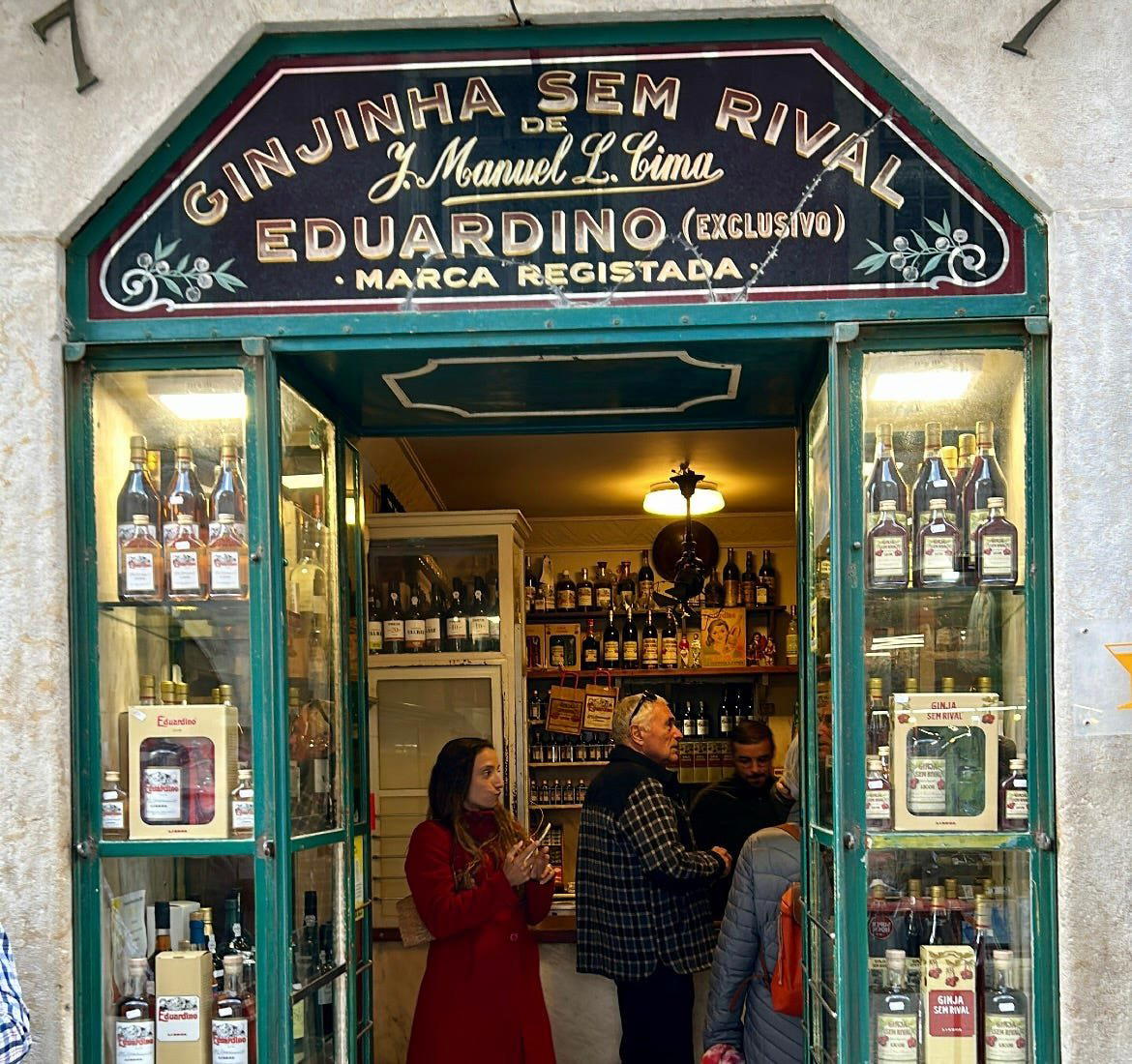
The Square, the Shot, and the Tradition Behind It
Largo São Domingos sits in the lower reaches of the Mouraria district, a few minutes' walk north of the Rossio. The square itself is scuffed and unpretentious, a Gothic church on one side, a worn stone plaza on the other, and it is precisely the kind of place that rewards standing still. At number eight, a counter barely wide enough to accommodate two people side by side opens directly onto the street. A Ginjinha is a bar in Lisbon, Portugal, known for serving ginjinha from this address. From behind it, a bartender pours ginjinha into small ceramic or plastic cups without ceremony, sometimes with a preserved sour cherry at the bottom, sometimes without. That choice, com or sem, is the full extent of the menu at A Ginjinha.
Ginjinha is Portugal's answer to a category of European fruit liqueurs that includes French guignolet and Italian maraschino: sour cherries macerated in aguardente, sweetened, and left to develop a syrupy, warming depth. In Lisbon, it is specifically associated with the area around Rossio and the Mouraria, and A Ginjinha has occupied this corner long enough that the shop itself has become as much a symbol of the drink as the drink is of the city. This is the kind of venue that appears in travel writing because it has remained fundamentally the same for generations.
What the Pour Actually Involves
The drink is served at room temperature. It is sweet but not cloying, with the sharpness of the cherry cutting through the sugar and the aguardente providing enough backbone to make the small glass feel deliberate rather than decorative. The debate over whether to request the cherry, the ginja fruit preserved in the spirit at the bottom of the glass, is one of Lisbon's minor conversational traditions. There is no correct answer, though regulars tend to have strong opinions. The cup is small by design: this is a standing drink, consumed at the counter or a few steps out into the square, not something to nurse over an hour.
Portugal's liqueur culture has historically operated at this scale, the small counter, the single product, the low price, rather than through the cocktail-bar model that has taken hold across the rest of Lisbon's drinking scene. That model, represented by venues like Red Frog, has produced technically ambitious programs built around clarified spirits and fat-washing. A Ginjinha sits at the opposite end of that axis, which is not a criticism. The two traditions are answers to different questions.
Where This Fits in Lisbon's Drinking Map
Lisbon's bar scene has split in recent years between a technically sophisticated cocktail tier, operators who draw comparisons with Lisbon's position in broader Iberian drinking culture, and a set of neighbourhood institutions that predate the international attention by decades. A Ginjinha belongs firmly to the second category of neighborhood institutions. The Mouraria and Alfama districts retain a concentration of these older formats: the taberna, the tasca, the ginja counter. A Tasca do Chico, a few streets away, represents a parallel version of this continuity through fado rather than liqueur. A Marisqueira do Lis extends the same logic into seafood.
Within Portugal, the ginja format appears elsewhere under different regional inflections. Venda Velha in Funchal operates within a Madeiran tradition that shares some of the same counter-service, single-spirit logic. Base Porto in Porto represents the northern city's own approach to casual drinking culture. The Atlantic coast adds further variation: Bar do Guincho in Alcabideche and Bar e Duna da Cresmina in Cascais e Estoril operate in a coastal register that has almost nothing in common with the Mouraria counter experience. Estoril in Estoril and Epicur Wine Boutique and Food in Faro illustrate how far Portugal's drinking geography stretches beyond the capital. Even further afield, Bar Leather Apron in Honolulu shows how the precision cocktail format plays in entirely different cultural contexts, a useful comparison point for understanding what A Ginjinha is deliberately not doing.
Planning the Visit
A Ginjinha is on Largo São Domingos, reachable on foot from the Rossio metro station in under five minutes. There is no reservation system, no booking required, and no seat to take. You walk up, order, pay a small amount per glass, and stand at the counter or in the square. The crowd at any given time reflects the square's own rhythm: local workers at midday, tourists mixing with Lisbon residents through the afternoon, and a quieter late-evening crowd. The standing format makes this a natural starting point before dinner, or a brief stop during an afternoon spent around the Baixa and Mouraria. For the broader context of where to eat and drink around the visit, our full Lisbon restaurants guide maps the surrounding options in more detail.
Comparison Snapshot
| Venue | Price | Awards |
|---|---|---|
| A GinjinhaThis venue (the venue you are viewing) | $1–10 | Not listed |
| Red Frog | $10–20 | World's 50 Best #94 · Falstaff Bar - 95 Falstaff Points |
| Black Sheep | $10–20 | Star Wine List |
| Boca D'uva | $30–50 | Star Wine List |
| Cinco Lounge | $20–30 | Top 500 Bars Best Bars #458 · Falstaff Bar - 94 Falstaff Points |
| Club des Châteaux | $30–50 | Star Wine List |
Continue exploring
More in Lisbon
Bars in Lisbon
All bars in Lisbon →
Restaurants in Lisbon
All restaurants in Lisbon →

Details
- Classic
- Well Known
- Cozy
- Intimate
- Casual Hangout
- Historic Building
- Standing Room
- Counter Only
- Gin
Current opening hours
- Monday
- 10 AM–10 PM
- Tuesday
- 10 AM–10 PM
- Wednesday
- 10 AM–10 PM
- Thursday
- 10 AM–10 PM
- Friday
- 10 AM–10 PM
- Saturday
- 10 AM–10 PM
- Sunday
- 10 AM–10 PM
Hours can change for holidays and private events. Hours as of .
Intimate standing-room-only space with crowds spilling outside, creating a lively traditional atmosphere in a historic tiled shop.