Domaine Bonneau du Martray

One of Burgundy's most historically significant estates, Domaine Bonneau du Martray has produced Corton-Charlemagne and Corton from the same hill since 1847. Holding a Pearl 4 Star Prestige rating from EP Club (2025), the domaine occupies a rare position in the Côte de Beaune: a single-appellation producer with unbroken lineage and a terroir argument that needs little elaboration.
 Discover on Pearl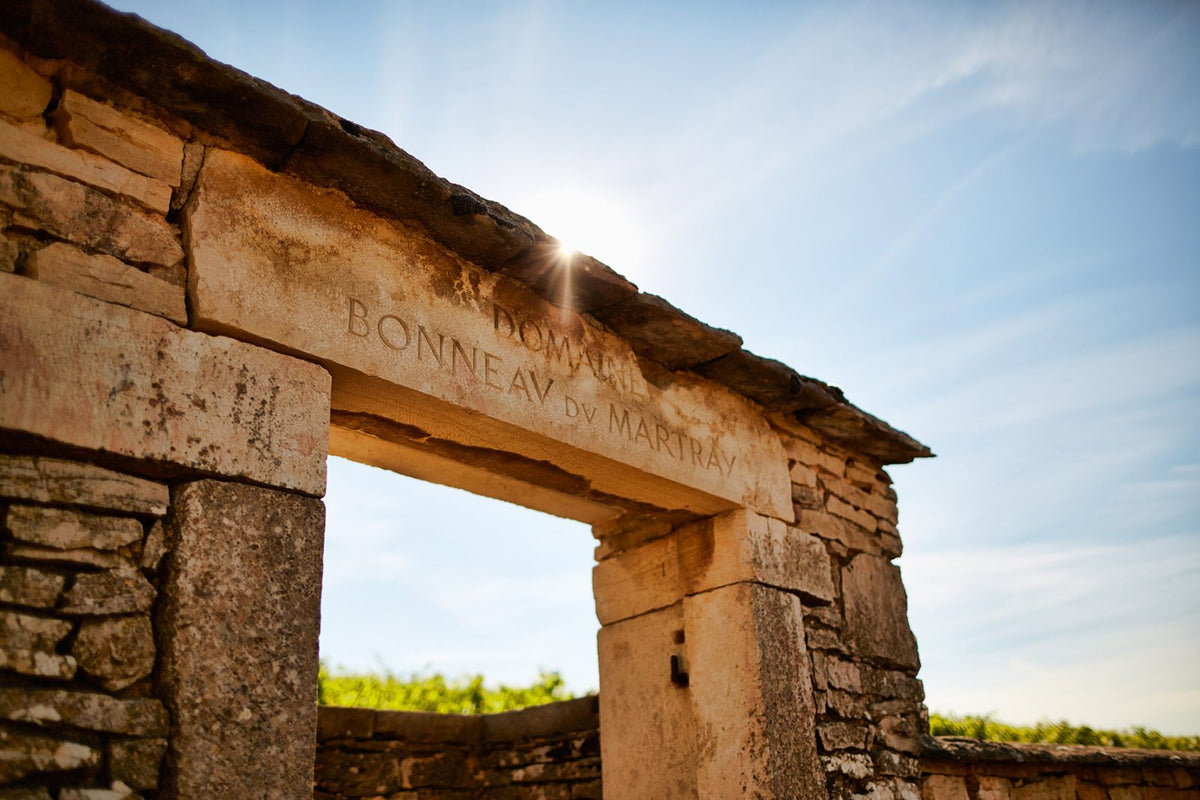
A Single Hill, Nearly Two Centuries of Evidence
The village of Pernand-Vergelesses sits at the northern end of the Côte de Beaune, tucked behind the hill of Corton in a way that keeps it off the tourist circuit even as the vineyards above it command some of the highest prices in Burgundy. The approach from Beaune takes you through Aloxe-Corton before the road climbs and narrows, and the hill itself comes into view: a broad, south-facing amphitheatre of vines that has been shaping wine in this corner of France longer than most of the appellation system that now governs it. Domaine Bonneau du Martray's address — 2 Rue de Fretille — places it physically within the village, but its identity is entirely bound to what grows above it.
For readers planning time in this part of Burgundy, our full Pernand-Vergelesses wineries guide maps the broader producer landscape in the village and surrounding appellations. The Pernand-Vergelesses restaurants guide and hotels guide cover the practical context for staying in or near the village itself.
What the Hill Actually Expresses
Corton-Charlemagne is one of the few Grand Cru white Burgundies that is not Montrachet, and it operates by a different terroir logic. Where Montrachet draws much of its tension from the particular drainage and chalk of its narrow strip, Corton-Charlemagne works through a combination of altitude, easterly and southerly exposures, and the iron-rich, marly limestone soils that distinguish the upper sections of the hill. The result, in the leading vintages and from the best-positioned parcels, is a white Burgundy with significant weight and the structural capacity to age for a decade or more without losing definition.
Domaine Bonneau du Martray holds a contiguous block of roughly 11 hectares on the hill, almost entirely in Corton-Charlemagne with a smaller Corton rouge component. That contiguous holding matters: it removes the blending complexity that affects producers assembling Corton-Charlemagne from multiple, disconnected parcels, and it allows a consistent terroir expression across the entire production. The domaine's first recorded vintage dates to 1847, a span of continuous ownership and vinification that represents one of the longer unbroken records in a region that otherwise fragments holdings across generations through inheritance law. The EP Club Pearl 4 Star Prestige rating, awarded in 2025, positions the domaine at the upper tier of the regional recognition hierarchy.
The Côte de Beaune Benchmark Conversation
White Burgundy at the Grand Cru level involves a relatively small number of producers, and the benchmarking conversation is both intense and geographically narrow. Corton-Charlemagne occupies a distinct space within that conversation: it is the only Grand Cru white on the Côte de Beaune that is not located in the Côte de Nuits, and its character profile , richer and more textural than Chablis Grand Crus, less aromatic than Puligny-based whites at their most precise , means it attracts a different collector and wine drinker than the Montrachet appellations do.
Winemaker Jean-Charles le Bault de la Morinière has been responsible for the domaine's direction for an extended period, and his approach consistently reflects the argument that Corton-Charlemagne is at its most coherent when vinification steps back far enough to let the mineral structure of the upper hill do its work. That argument is not unique to this estate, but few producers have the single-site consistency to test it across vintages the way Bonneau du Martray can. Comparable conversations about single-appellation focus and terroir legibility are being made across France: at Albert Boxler in Niedermorschwihr for Alsace Grand Cru precision, and at estates in the Loire and Rhône that have similarly staked their identity on a specific geological argument rather than a broad portfolio.
Placement Within the Broader French Fine Wine Tier
The French fine wine market at the Grand Cru level has become increasingly stratified over the past fifteen years. A handful of estates in Burgundy, Bordeaux, and the Rhône now occupy a allocation-based upper tier where price and access are determined less by retail channels than by longstanding client relationships and négociant allocations. Bonneau du Martray operates within this structure: production volumes from an 11-hectare holding are inherently limited, and the domaine's reputation means that bottles rarely sit on shelves at release in the way that even well-regarded Village or Premier Cru Burgundies do.
For context on how other French estates at the prestige level manage similar allocation and access dynamics, Château Bastor-Lamontagne in Preignac, Château Branaire Ducru in St-Julien, and Château Cantemerle in Haut-Médoc represent points of comparison in the Bordeaux classified tier. In Saint-Émilion, Château Bélair-Monange operates within a similarly constrained production context. The Médoc classed growths, including Château Batailley in Pauillac, Château Boyd-Cantenac in Cantenac, and the broader tier that includes estates across regions as different as Abadía Retuerta in Sardón de Duero, illustrate how prestige-tier producers across Europe share structural similarities in access and distribution even when the wines themselves are stylistically divergent.
Visiting Pernand-Vergelesses and Planning Around the Domaine
Pernand-Vergelesses is not a village that operates on visitor infrastructure. There is no tasting room open on a drop-in basis, no wine bar at the end of the lane, and the village itself has a population that runs into the low hundreds. What it offers instead is proximity to the Côte de Beaune's working vineyards without the layer of wine tourism that has settled over Beaune and Nuits-Saint-Georges. Visits to Bonneau du Martray, where possible at all, are arranged through advance contact and operate in the tradition of private domaine appointments rather than public tasting hours.
Beaune is the logical base for anyone combining a visit here with the wider appellation circuit: it is under thirty minutes by road and provides access to the full range of restaurants, hotels, and cave operators that the village itself cannot. The D974, the main road that runs along the foot of the Côte, connects Pernand-Vergelesses to Aloxe-Corton and onward south efficiently. For those extending further into France's wine regions, producers with similarly defined terroir arguments include Chartreuse in Voiron and Aberlour in Aberlour, both of which represent distinct regional production traditions worth visiting in their own right. For anyone building a Pernand-Vergelesses itinerary beyond wine, the village bars guide and experiences guide provide further orientation.
Frequently Asked Questions
- What's the atmosphere like at Domaine Bonneau du Martray?
- The atmosphere is consistent with the working-domaine tradition found across the Côte de Beaune's smaller, prestige-tier producers: functional, unhurried, and centred on the vineyards and cellar rather than on hospitality infrastructure. Pernand-Vergelesses itself is a quiet village without significant tourist amenity, which means visits here carry a different register than appointments at more visitor-facing estates. The EP Club Pearl 4 Star Prestige rating (2025) reflects the quality of the wine, not the scale of the welcome.
- What's the leading wine to try at Domaine Bonneau du Martray?
- The Corton-Charlemagne Grand Cru is the estate's primary production and the wine through which its reputation has been built since the first recorded vintage in 1847. Winemaker Jean-Charles le Bault de la Morinière has maintained a consistent approach to expressing the mineral structure of the upper hill. The EP Club Pearl 4 Star Prestige (2025) applies to the domaine as a whole, and the Corton-Charlemagne is the wine most directly supported by the contiguous 11-hectare holding that defines the estate's terroir argument.
- What's the main draw of Domaine Bonneau du Martray?
- The primary draw is the combination of historical continuity and single-site focus that is rare even by Burgundy standards. A first vintage in 1847, an unbroken presence on the Corton hill, and a contiguous Grand Cru holding in both white and red appellations place the domaine in a very small peer group within the Côte de Beaune. The EP Club Pearl 4 Star Prestige rating (2025) is the current formal recognition of that standing.
- Is Domaine Bonneau du Martray reservation-only?
- No phone number or website is listed in the public record for the domaine, which is consistent with the appointment-only or allocation-based access model common among prestige Burgundy producers. Visitors should not expect walk-in access. Outreach through a specialist négociant or fine wine merchant with existing relationships in the region is the most reliable route to arranging a visit, particularly given the village's limited public-facing hospitality infrastructure.
- How does Domaine Bonneau du Martray's 1847 founding year affect the way its Corton-Charlemagne is understood in the market?
- Longevity in Burgundy functions as evidence of terroir consistency rather than simply as heritage marketing. A domaine with recorded production from 1847 has a deeper archive of vintage performance on a specific parcel than producers with shorter histories, and buyers at the allocation level treat that track record as part of the quality argument. Bonneau du Martray's EP Club Pearl 4 Star Prestige (2025) sits within a context where historical depth and single-appellation focus are understood to be mutually reinforcing credentials.
Peer Set Snapshot
These are the closest comparables we have in our database for quick context.
| Venue | Awards | Notes |
|---|---|---|
| Domaine Bonneau du Martray | Pearl 4 Star Prestige | This venue |
| A. Margaine | Pearl 2 Star Prestige | |
| Agrapart & Fils | Pearl 4 Star Prestige | Pascal Agrapart, Est. 1986 |
| Albert Boxler | Pearl 3 Star Prestige | |
| Alfred Gratien | Pearl 4 Star Prestige | Nicolas Jaeger, Est. 1864 |
| Augier | Pearl 2 Star Prestige |
Access the Cellar?
Our members enjoy exclusive access to private tastings and priority allocations from the world's most sought-after producers.
Get Exclusive Access