Yuan Wei Duck Noodle

Folding Stools, Thirty Years, and the Smell of Smoked Duck On Shengli Road in Hsinchu's East District, the setup is as unambiguous as the food. Plastic stools. Folding tables. The building's overhang for a roof. Yuan Wei Duck Noodle has operated...
Pearl is the En Primeur Club membership app — saves, bookings, and concierge access live there. Same editors, same standards.
- Address
- 59 Shengli Road, East District
- Phone
- +886 3 523 4812
- Directions
- Get directions
 Saves & bookings on Pearl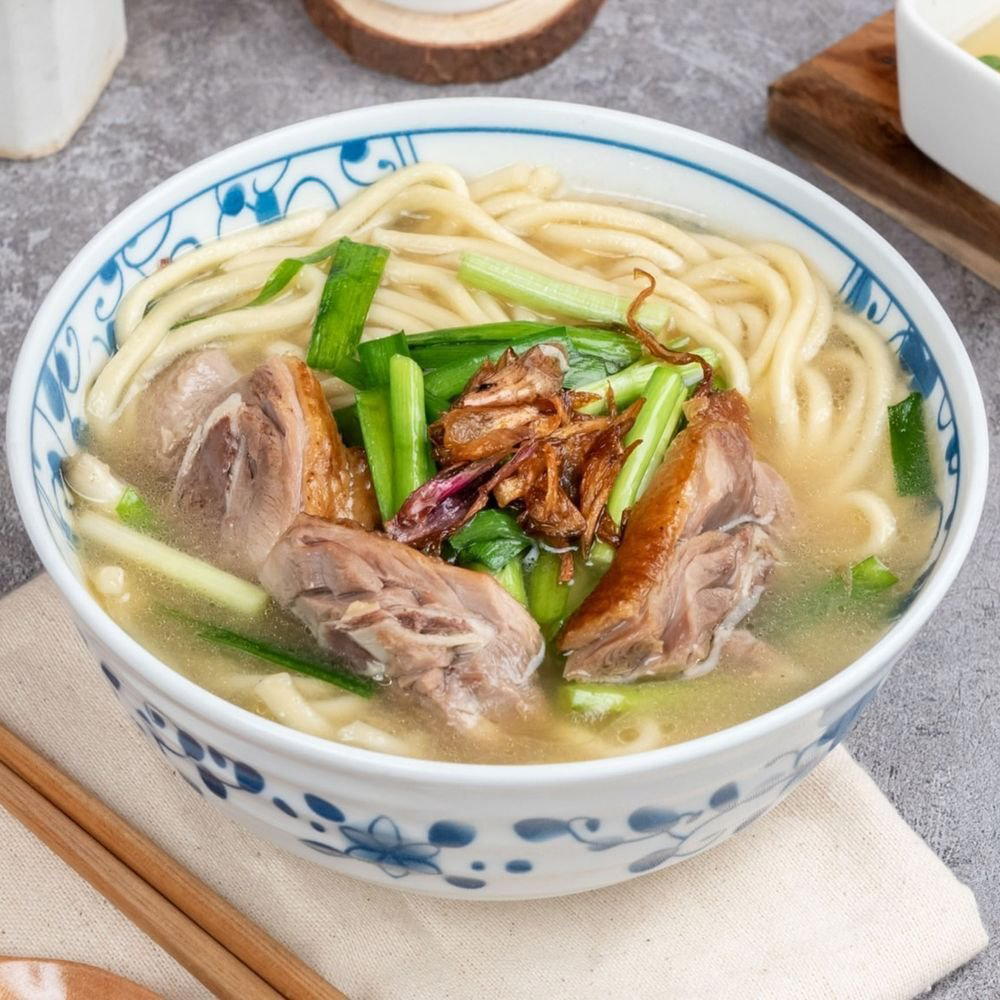
Folding Stools, Thirty Years, and the Smell of Smoked Duck
On Shengli Road in Hsinchu's East District, the setup is as unambiguous as the food. Plastic stools. Folding tables. The building's overhang for a roof. Yuan Wei Duck Noodle has operated from this address for around three decades, and nothing about the physical arrangement has been engineered to impress. What draws people back, repeatedly, is the duck: a mild smoky flavour that arrives without theatre and asks nothing of you except a clear appetite and enough time to eat slowly.
This is a particular kind of Taiwanese lunch ritual. You arrive, you choose your base, you eat. The menu pivots around a single protein served across three formats: steamed rice, fried noodles, or the city's own calling card, Hsinchu rice vermicelli soup. That last option is especially locally resonant. Hsinchu's thin, fast-drying rice vermicelli has been a regional point of pride for generations, produced in the city's famously windy climate, which accelerates the drying process and gives the noodle a texture that differs noticeably from southern variants. Ordering it with smoked duck here is less a novelty choice and more a point of alignment with local habit.
The Ritual of the Meal
The pace of eating at a place like this is dictated by the format, not by a host. You seat yourself. Food comes quickly. There is no tasting menu pacing, no amuse-bouche, no pause between courses for narration. The duck is the dish. The bowl or plate is the frame. What you do with the time in between is your own business.
But there is a second act to the meal that regulars treat as non-negotiable: the sautéed duck blood curd with chives and pickles. Blood curd occupies a specific corner of Taiwanese street food culture, one that polarises visitors but commands loyalty among the people who grew up eating it. The preparation at Yuan Wei is built around contrast. The curd itself has a jelly-like consistency, dense but yielding, and it takes on the sweet, sour, and spicy sauce in a way that a firmer protein would not. The chives and pickles add sharpness and crunch. It is a dish that rewards the committed eater, not the cautious one.
Across Taiwan's food cities, this kind of specialist single-protein shop holds a specific place in the dining order. The high-end end of Taiwan's restaurant scene is well documented elsewhere: JL Studio in Taichung and logy in Taipei operate in a different register entirely, as do GEN in Kaohsiung and Zhu Xin Ju in Tainan. Further afield, restaurants like Akame in Wutai Township and Volando Urai Spring Spa & Resort in Wulai District position themselves within Taiwan's premium experience tier. Yuan Wei sits at the opposite end of that spectrum, and that is not a criticism. It occupies a category that tasting-menu culture cannot replicate: a shop that has stayed in one place, serving one thing well, for thirty years, and accumulated a local following that has nothing to do with awards cycles or media attention.
Hsinchu's Street-Level Dining Scene
Hsinchu is not primarily a food destination in the way Tainan is, but it sustains a street-level dining culture that rewards pedestrian exploration. The East District in particular carries a range of casual formats that read as genuinely local rather than tourist-facing. Dongmen Rice Noodle Soup operates within the same rice vermicelli tradition, while Hai Kou Guabao covers the braised pork bun format that anchors Taiwan's street food canon. Chang Chang Kitchen and Cat House extend the range into different registers. For something in a more composed dining register, Garden.V represents the city's quieter fine-dining tier.
Yuan Wei's longevity in this context is itself a signal. Thirty years in a single location, on a single street, serving a narrow menu without the scaffolding of a recognisable brand or a media profile, means something specific about how the locals have voted with their routines. That is a different kind of credential than a Michelin star, but in Taiwan's food culture, it carries weight. The contrast with the global fine-dining tier is sharp. A restaurant like Le Bernardin in New York City or Emeril's in New Orleans operates within a system of accolades, press cycles, and institutional recognition. Yuan Wei operates within something older: a neighbourhood's daily hunger and the quiet discipline of doing one thing well across decades.
Planning Your Visit
The address is 59 Shengli Road, East District, Hsinchu City. The format is walk-in, self-seating, and fast. No booking infrastructure is available or necessary for a shop of this type. The practical advice for first-time visitors is to arrive with a clear sense of what you want, order the duck blood curd alongside your main choice, and treat the Hsinchu rice vermicelli soup as the format most aligned with what the shop has been doing longest. Timing matters in the sense that popular lunch spots in Taiwan's street food culture see their peak hours in the middle of the day and can run down stock earlier than the posted closing time. Midweek mornings or early lunch hours are generally the lower-pressure entry point.
Cuisine Lens
Comparable venues nearby, for context on price, style, and recognition.
| Venue | Cuisine | Price | Awards | Notes |
|---|---|---|---|---|
| Yuan Wei Duck NoodleThis venue — the venue you are viewing | Taiwanese Duck Noodle Street Food | $ | Bib Gourmand | Not listed |
| Nung Wei Hsiao Chu | Hakkanese | $$ | Bib Gourmand | Xiangshan District |
| Shih Fang Hsiao Ching | Taiwanese Contemporary | $$ | Michelin Plate | North District |
| Miao Kou Ya Xiang Fan (Zhongshan Road) | Taiwanese Smoked Duck Rice | $ | Michelin Plate | North District |
| Ho Chu Yuan | Traditional Taiwanese Chinese | $$ | Michelin Plate | North District |
| Jiu Tian Fu | Taiwanese Beef Noodle Soup | $ | Bib Gourmand | North District |
Recognition history
Dated appearances from independent guides and award organizations, with the underlying list record or original source where available.
Michelin Bib Gourmand
Michelin
Continue exploring
More in Hsinchu City
Restaurants in Hsinchu City
Browse all →
Bars in Hsinchu City
Browse all →
At a Glance
- Rustic
- Casual Hangout
Casual street-side setup with folding tables and plastic stools under building overhang, simple and unpretentious.