Dongmen Rice Noodle Soup

Inside Dongmen Market on Datong Road, this long-running stall has built its reputation on thick rice noodles served in a clear chicken-bone broth. The seafood taro rice noodle soup draws repeat visits for its combination of deep-fried sea bass, milkfish balls, shrimp, fried egg, and a block of melting taro, all finished with house-fried scallions. It is one of the clearest arguments for Hsinchu's market-stall dining tradition.
Pearl is the En Primeur Club membership app — saves, bookings, and concierge access live there. Same editors, same standards.
- Address
- Shop 1116 & 1117, Dongmen Market, 86 Datong Road, East District
- Phone
- +886 908 569 816
- Directions
- Get directions
 Saves & bookings on Pearl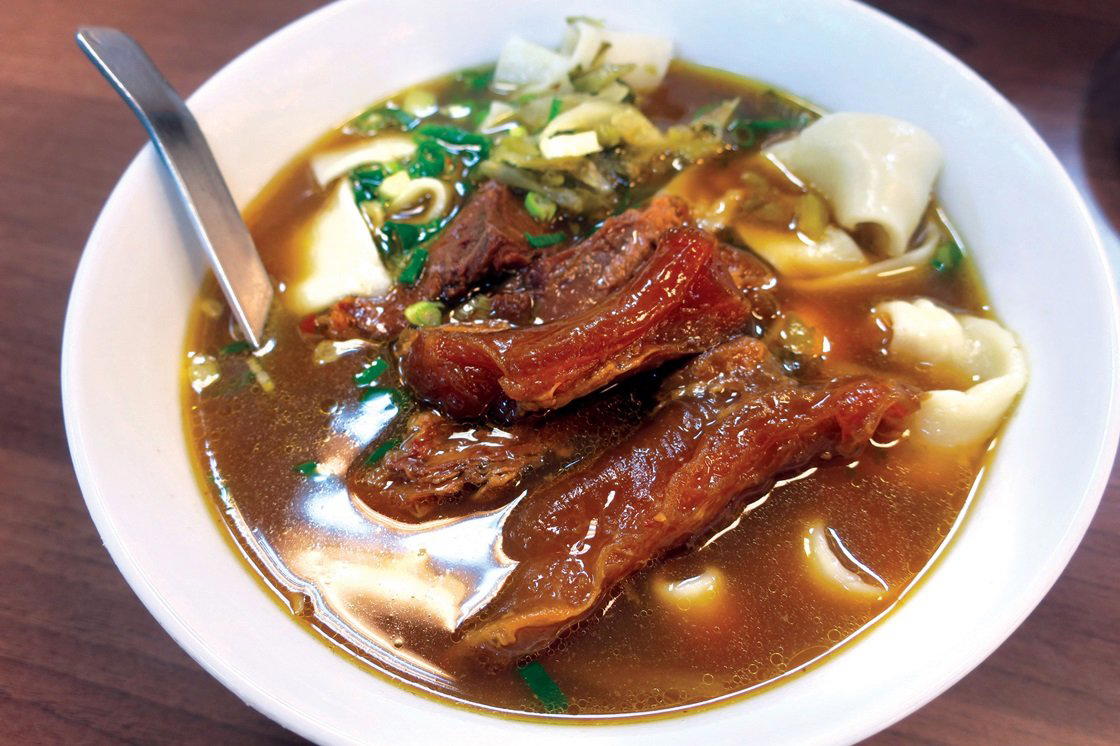
Dongmen Rice Noodle Soup is a casual restaurant in Hsinchu City serving Traditional Taiwanese Thick Rice Noodle Soup at Dongmen Market. Inside Dongmen Market: Where the Broth Tells the Story
Dongmen Market on Datong Road operates the way Taiwan's covered markets always have: vendors arrive early, regulars claim their positions at communal tables, and the rhythm of ordering, eating, and leaving again runs on an unspoken but well-understood tempo. Inside that grid of stalls, Dongmen Rice Noodle Soup occupies units 1116 and 1117, a position that has become a fixed reference point for the thick rice noodle tradition that defines much of Hsinchu's everyday eating culture. The physical setting is the market itself: open stalls, shared tables, the low hum of adjacent vendors, and the smell of broth that has been coaxing flavour from chicken bones for years.
Hsinchu's rice noodle identity runs deeper than most visitors realise. The city produces a style of rice noodle, locally called mǐfěn, that is thicker and more substantial than the fine vermicelli found elsewhere in Taiwan. That weight matters in a bowl: it holds broth differently, gives a different resistance under the teeth, and pairs with more assertive toppings without disappearing into the background. The clear chicken-bone broth used here is not a neutral carrier but a considered base, built for depth without opacity, allowing each component in the bowl to remain legible.
The Ritual of the Bowl
The dining ritual at a stall like this one has little ceremony attached to it, which is part of the point. You arrive, you state your order, and the bowl comes quickly. What makes the experience worth understanding is the assembly logic behind the signature dish: the seafood taro rice noodle soup is not a scattershot collection of ingredients but a considered set of textures and temperatures. Deep-fried sea bass fillet brings a crisped exterior that gradually softens in the broth; milkfish balls add a springy, savoury counterweight; shrimp provide a lighter sweetness; and fried egg bits scatter through the bowl in a way that reads as almost incidental until you realise how much they contribute to the overall texture.
The taro is the element that separates this bowl from its immediate competitors. A single chunk of taro, cooked to the point where it is simultaneously creamy and starchy, sits in the broth and absorbs it gradually as you eat. It does not hold its shape indefinitely, which is by design: by the time you reach it, it has taken on the savour of everything around it. The scallions are fried on site, not in advance, and that distinction matters. Fresh oil, high heat, and immediate plating mean the fragrance is still present when the bowl reaches the table rather than having dissipated in a holding container.
This sequencing of the meal, working from the more structurally firm elements toward the softening taro at the base, is a pattern that mirrors the broader Taiwanese approach to bowl-format eating, where the experience is expected to change from first spoonful to last rather than remain static. It is worth slowing down rather than eating quickly, because the broth temperature and the taro's texture are both time-sensitive.
Hsinchu's Market-Stall Context
Taiwan's food scene runs on multiple tracks simultaneously. At one end sit the tasting-menu restaurants that have drawn international attention, such as JL Studio in Taichung and logy in Taipei. At the other end, and in many ways the more structurally important one for understanding how Taiwanese people actually eat, sit the market stalls and specialist noodle shops that have operated for decades with a single focus and a loyal local following. Dongmen Rice Noodle Soup belongs firmly to that second track, and its longevity within Dongmen Market is itself a form of credential in a context where stalls that do not deliver consistently do not survive long-term competition from their immediate neighbours.
Among Hsinchu's market-stall options, the peer comparison is instructive. Hai Kou Guabao and He Jih Hsiang (Minzu Road) operate in the same tradition of focused, long-running Hsinchu specialists, each anchored to a specific format. Where those stalls work within their own defined products, the restaurant's particular contribution is the seafood-taro combination that places it in a niche within a niche: not the plain rice noodle soup that appears at dozens of stalls across the city, but a more assembled version that rewards the extra few minutes of attention it takes to eat it properly. For a broader picture of where this fits into Hsinchu's dining character, the full Hsinchu City restaurants guide maps the range from market stalls to more formal settings, including Cat House, Chang Chang Kitchen, and Garden.V.
Elsewhere in Taiwan, the same principle of specialist longevity producing a kind of earned authority shows up across different formats and price tiers, from GEN in Kaohsiung to Zhu Xin Ju in Tainan and further afield at places like Akame in Wutai Township. The common thread is focus: a defined product, repeated daily, refined over time.
Getting There and Planning the Visit
Dongmen Market is at 86 Datong Road in Hsinchu's East District, accessible on foot from central Hsinchu. The stall operates within the market's general trading hours, though like most popular market vendors in Taiwan, arriving earlier in the day gives you a stronger chance of finding the full range of toppings available and the stall at full operating pace. No booking system exists for a stall of this format; the process is walk-in, queue if necessary, order at the stall. Payment is handled directly at the counter. For visitors combining the market with a broader Hsinchu trip, the Hsinchu City hotels guide covers accommodation options, and the bars, wineries, and experiences guides round out a complete city itinerary.
Cuisine and Awards Snapshot
Comparable venues nearby, for context on price, style, and recognition.
| Venue | Cuisine | Price | Awards | Notes |
|---|---|---|---|---|
| Dongmen Rice Noodle SoupThis venue — the venue you are viewing | Traditional Taiwanese Thick Rice Noodle Soup | $ | Bib Gourmand | Not listed |
| Ying Wang Meatball | Traditional Taiwanese Ba-wan | $ | Michelin Plate | Xiangshan |
| Yuan Wei Duck Noodle | Taiwanese Duck Noodle Street Food | $ | Bib Gourmand | East District |
| Shih Fang Hsiao Ching | Taiwanese Contemporary | $$ | Michelin Plate | North District |
| Jiu Tian Fu | Taiwanese Beef Noodle Soup | $ | Bib Gourmand | North District |
| Nung Wei Hsiao Chu | Hakkanese | $$ | Bib Gourmand | Xiangshan District |
Recognition history
Dated appearances from independent guides and award organizations, with the underlying list record or original source where available.
Michelin Bib Gourmand
Michelin
Continue exploring
More in Hsinchu City
Restaurants in Hsinchu City
Browse all →
Bars in Hsinchu City
Browse all →

At a Glance
- Well Known
- Lively
- Casual Hangout
- Solo
- Family
- Open Kitchen
- Local Sourcing
Casual market stall atmosphere with air-conditioned indoor dining rooms divided into small sections and outdoor seating; bustling during meal times with long queues typical of popular local eateries.