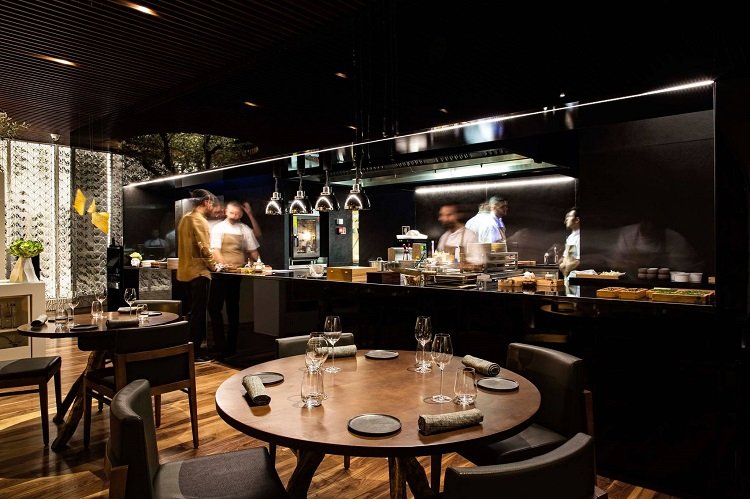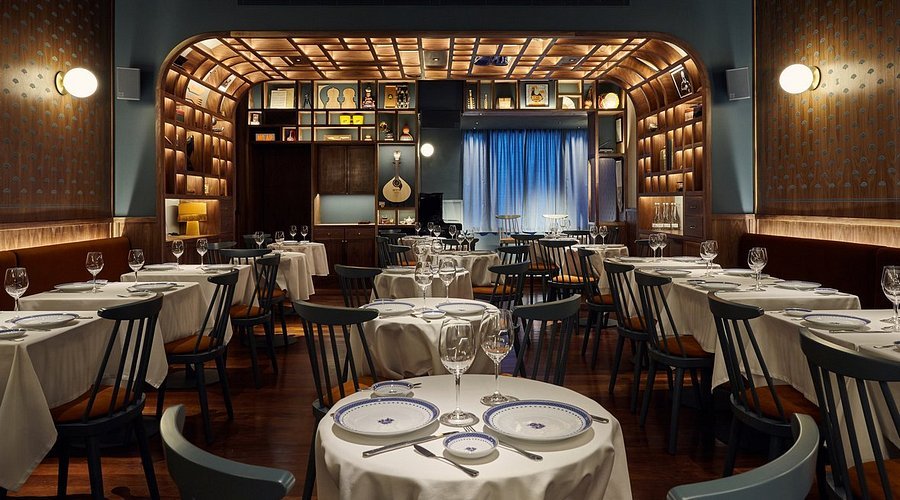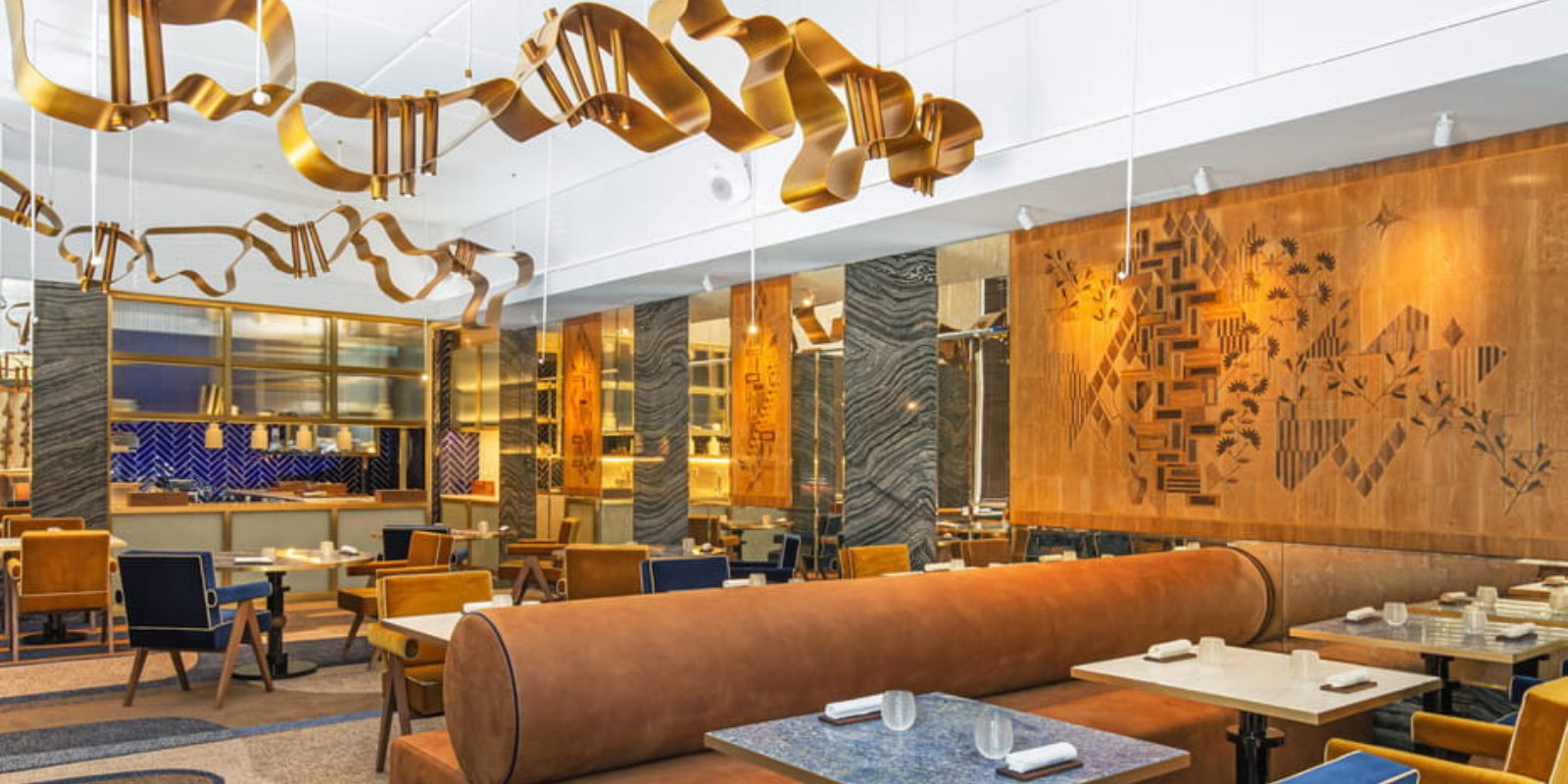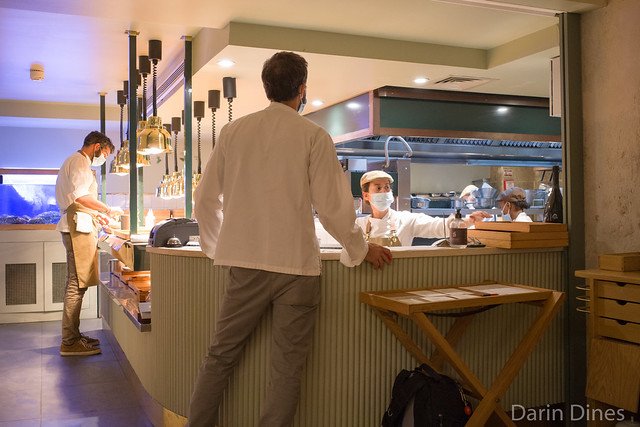
YŌSO holds a Michelin star (2024) for its omakase kaiseki counter in Alcântara, where a ten-seat sushi bar and a single tasting menu built around Portuguese coastal fish define the format. The €€€ pricing sits below Lisbon's four-bracket Michelin tier, and José Balau's wine and sake programme gives the room a cellar depth rare at this counter scale.
 Discover on Pearl
A kaiseki counter in Alcântara's quieter pocket
The western edge of Lisbon's riverfront has been developing a more considered dining identity, separate from the tourist density of Baixa or the louder restaurant blocks of Cais do Sodré. Alcântara operates at a different register: industrial buildings repurposed without spectacle, and addresses that reward the effort of finding them. YŌSO sits on Rampa das Necessidades, a short approach that filters out accidental footfall almost entirely. The counter holds ten diners. You do not arrive here by chance.
That physical compression is deliberate. The ten-seat omakase format — now well established in Tokyo's Ginza district, increasingly adopted in European cities seeking to import kaiseki discipline — requires a room that serves the food rather than the other way around. At YŌSO, the sushi counter is the room. There is no ambient dining section to absorb the energy; every seat faces the same direction, every course arrives in sequence, and the pace is set by the kitchen rather than the table. This is a format where Omakase RI and Kabuki Lisboa each occupy different brackets in Lisbon's growing Japanese dining tier, but YŌSO's Michelin one-star recognition in 2024 places it at a level where format discipline and ingredient sourcing are held to a stricter standard than the broader Japanese-influenced category in the city.
The omakase structure and what it actually contains
Kaiseki, in its traditional form, is the most structured of Japanese meal sequences: a procession of small courses ordered by technique and seasonal logic, each course named for its preparation method rather than its ingredients. YŌSO follows this architecture, and the dish nomenclature makes the philosophy explicit. Courses are titled Sakizuke (opening appetiser), Otsukuri (sliced raw fish), Niguirizushi (hand-formed sushi), and Agemono (deep-fried preparation), among others. The names describe what is being done to the ingredient, not what the ingredient is , a framing that foregrounds craft over provenance, even when the provenance is doing considerable work.
That provenance is specifically Portuguese. The fish sourced for the counter comes from the Atlantic-facing coast and the Azorean archipelago: seabream, Atlantic leerfish, eel, and Azorean bonito appear as the identified species. This is a deliberate editorial decision within the menu's architecture. Kaiseki as practised in Japan is inseparable from the seasonality of its local waters; transplanting the format to Lisbon and substituting Iberian Atlantic catch for Japanese Pacific species is not a compromise but a structural reframing. The technique remains Japanese in discipline; the raw material is entirely Portuguese. Kanazawa operates at a comparable conceptual register in Lisbon's Japanese dining tier, but the direct Atlantic sourcing at YŌSO gives it a coastal specificity that anchors the menu to its geography.
The menu extends beyond the raw preparations that dominate popular understanding of Japanese counter dining. Hot dishes , broths and grilled preparations , are built into the kaiseki sequence. This matters because it expands the wine and sake pairing surface considerably: a counter that moves from cold raw fish through warm broths to grilled preparations requires a cellar with more range than one serving only sashimi and nigiri.
The cellar and the sommelier's role at the counter
José Balau holds the roles of dining room director and sommelier simultaneously, which is a structural choice worth noting. At small counters with a fixed tasting menu, the wine service is not a secondary function; it is half of what determines whether the meal works as a sequence rather than a series of individual dishes. A kaiseki format that moves through contrasting temperatures, textures, and cooking techniques demands pairing decisions that can shift from sake to natural Portuguese white to something more structured course by course.
Portugal's own wine production provides an unusually strong foundation for pairing with Japanese technique applied to Atlantic fish. The mineral-driven whites from Vinho Verde, the oxidative styles from Colares, and the textural complexity of aged white Douro wines all carry acidity structures that hold against the clean, clean flavours of raw fish and the deeper savoury register of dashi-based broths. Whether the YŌSO cellar draws on these specifically is not confirmed in available data, but a sommelier operating at Michelin-starred level in Lisbon, with a menu this precisely structured, is working inside a wine culture that gives him better raw material for fish-course pairing than most European cities can offer.
The sake component , standard at any omakase counter operating at this level , adds a second dimension to the pairing programme. Sake's range, from junmai daiginjo brightness through to aged koshu depth, mirrors the temperature and technique arc of a kaiseki sequence closely enough that a well-constructed sake list can carry the pairing through the Japanese-technique courses while the Portuguese wine selection handles the Atlantic-ingredient courses. That interplay between two distinct cellar traditions is what separates a genuinely considered omakase pairing programme from one that simply offers a few imported bottles alongside the food.
For comparison: Lisbon's broader Michelin tier in the €€€€ bracket , venues including Belcanto and 2Monkeys , carries wine programmes calibrated to Portuguese creative cooking. YŌSO's €€€ pricing positions it below that bracket while running a cellar programme that has to handle more stylistic range than most single-cuisine restaurants require.
Where YŌSO sits in the Portuguese Michelin picture
Portugal's Michelin-starred tier has become one of southern Europe's more geographically spread networks. Beyond Lisbon, there are strong one- and two-star properties in the Algarve, Porto, Madeira, and along the Douro: Vila Joya in Albufeira, Antiqvvm in Porto, Casa de Chá da Boa Nova in Leça da Palmeira, Il Gallo d'Oro in Funchal, and The Yeatman in Vila Nova de Gaia and Ocean in Porches. Within that national picture, YŌSO is unusual: a Japanese kaiseki counter operating at Michelin level inside a country whose starred tier is otherwise dominated by modern Portuguese and European creative formats. The 2024 star places it in a small peer group of non-Portuguese-cuisine restaurants earning recognition in a guide with a strong appetite for local product.
The Tokyo reference points for the kaiseki counter format , places like Myojaku and Azabu Kadowaki , operate in a market where omakase is a default premium format and competition is stratified over dozens of counters. In Lisbon, the comparable counter tier is small enough that YŌSO's recognition in 2024 is a signal about the format's potential in southern Europe rather than confirmation of an already-established tier.
Planning your visit
YŌSO is closed on Mondays and Sundays. Tuesday through Saturday, the kitchen runs two sittings: lunch from 12:30 to 3:00 PM and dinner from 8:00 PM to 11:30 PM. At ten seats, both sittings fill in advance; a counter at this size and recognition level typically books several weeks out, and the dinner sitting on Fridays and Saturdays should be assumed to require the longest lead time. Arriving by taxi or rideshare to Rampa das Necessidades is the practical approach; the address is navigable but the approach road is not the kind of street that pedestrian flow makes obvious. The €€€ price range sits below the €€€€ bracket occupied by most of Lisbon's other starred tables, which gives it a different accessibility calculation than peers like Belcanto or Feitoria. For those building a Lisbon dining itinerary beyond this counter, our full Lisbon restaurants guide maps the broader picture, and the city's hotel, bar, winery, and experience options are covered in our Lisbon hotels guide, bars guide, wineries guide, and experiences guide.
Price and Recognition
A compact peer snapshot based on similar venues we track.
| Venue | Price | Awards | Notes |
|---|---|---|---|
| YŌSO | €€€ | Michelin 1 Star | This venue |
| Belcanto | €€€€ | Michelin 2 Star | Modern Portugese, Creative, €€€€ |
| 50 seconds from Martin Berasategui | €€€€ | Michelin 1 Star | Progressive Spanish, €€€€ |
| Eleven | €€€€ | Michelin 1 Star | Portugese, Creative, €€€€ |
| Feitoria | €€€€ | Michelin 1 Star | Modern Cuisine, €€€€ |
| Grenache | €€€€ | Michelin 1 Star | French Contemporary, €€€€ |
Continue exploring