Yoshi's
Yoshi's at 510 Embarcadero West in Oakland has anchored the Bay Area's live jazz and Japanese dining scene for decades, occupying a position where West Coast ingredient culture meets the precision of Japanese culinary tradition. The venue sits at a crossroads few American restaurants have successfully held: serious music programming alongside a kitchen that draws from both sides of the Pacific. For San Francisco Bay Area visitors, it remains a reference point for that dual identity.
 Discover on Pearl
Pearl is the En Primeur Club membership app — saves, bookings, and concierge access live there. Same editors, same standards.
- Address
- 510 Embarcadero West, Oakland, CA 94607
- Phone
- (510) 238-9200
- Website
- yoshis.com
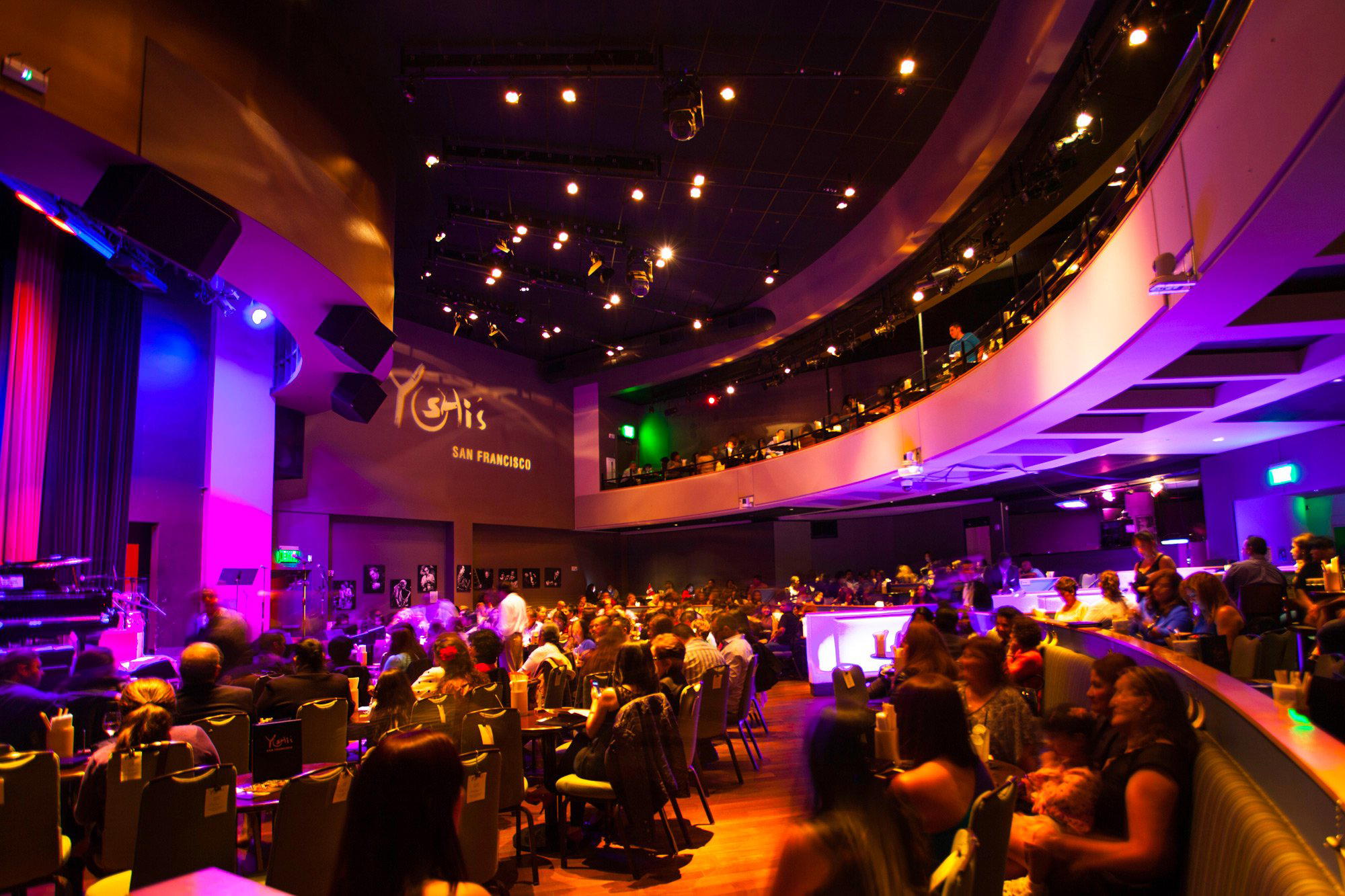
Where the Pacific Rim Meets Jack London Square
The Bay Area has long operated as one of America's most productive intersections of Japanese culinary discipline and California's ingredient-first cooking philosophy. That convergence runs through the region's history in ways that stretch well beyond any single restaurant: Japanese-American farming communities in the Central Valley shaped what arrived at Bay Area markets for most of the twentieth century, and the same proximity to the Pacific that made San Francisco a port city gave it early access to Japanese fish culture, technique, and hospitality sensibility. Yoshi's, situated at 510 Embarcadero West on Oakland's waterfront, is a restaurant and jazz club in Oakland, California, known for its modern Japanese jazz club cuisine and its long-running place in Jack London Square.
The dual-programming model that Yoshi's operates, Japanese dining alongside one of the Bay Area's most active jazz venues, is rarer than it appears. Across the United States, restaurants that take both their kitchen and their stage seriously tend to collapse into one identity or the other. The jazz-and-supper format has a long American history, running from New Orleans institutions like Emeril's in New Orleans to the broader fine-dining-with-performance tradition. Holding both sides at a competitive level is the harder problem, and it is the one Yoshi's has spent its institutional life attempting to solve.
Japanese Technique in a California Kitchen
Editorial angle worth examining here is not the venue's biography but the broader question of what happens when Japanese culinary methods meet the Bay Area's agricultural abundance. That intersection has produced some of the most interesting cooking in American dining over the past two decades. At the high end of the San Francisco market, venues like Benu have built three-Michelin-star reputations on exactly this kind of cross-Pacific synthesis, folding Korean and Chinese reference points alongside French and Japanese technique into menus that read as distinctly West Coast. Atelier Crenn approaches the same terrain from a French foundation, while Lazy Bear and Saison work a Progressive American framework that leans heavily on Northern California's seasonal supply chains.
Yoshi's sits in a different register from those $$$$ tasting-menu destinations, but the underlying logic is similar: Japanese methods applied to ingredients shaped by California's growing seasons. The discipline of Japanese knife work, the emphasis on fish quality and temperature control, the restraint in seasoning that allows primary ingredients to carry the plate, these are techniques that translate well to a kitchen sourcing from the same Bay Area producers that feed the region's more celebrated fine-dining rooms. What separates execution at this level from the Michelin-tracked tier is largely the format: Yoshi's accommodates a live-music audience whose priorities include timing and access as much as culinary precision.
For comparison, venues like Quince in San Francisco's Financial District and Single Thread Farm in Healdsburg represent the fully committed, booking-intensive end of Northern California's technique-meets-local-ingredient model. At the other end of the American fine-dining conversation, Le Bernardin in New York City and Alinea in Chicago show how imported European and modernist technique can define a room's identity even in cities with deep local food cultures. The Bay Area's version of that story runs through its Japanese-American agricultural history in ways those cities' versions do not.
The Oakland Waterfront Context
Jack London Square, where Yoshi's holds its address on the Embarcadero, is Oakland's most historically legible waterfront district. The neighborhood has cycled through phases of industrial use, cultural activation, and redevelopment pressure over the past several decades, and the venues that have persisted there tend to be those with strong institutional identities that extend beyond any single chef or programming cycle. Yoshi's place in that district is reinforced by its music reputation, which pulls audiences across the Bay from San Francisco proper and from deeper into the East Bay. That cross-city draw is operationally significant: it sustains the kind of consistent traffic that makes a dual-format venue viable in a neighborhood that has not always been the Bay Area's first-choice dining destination.
Nationally, the dining conversation around Japanese-influenced American cooking has also been shaped by venues like Atomix in New York City, Providence in Los Angeles, and Addison in San Diego, each of which handles the import-technique-plus-local-ingredient problem in its own regional idiom. Internationally, 8 1/2 Otto e Mezzo Bombana in Hong Kong offers a useful parallel: a venue whose identity rests on the productive tension between a rigorous imported culinary tradition and an intensely local dining culture.
Planning Your Visit
Yoshi's Oakland address at 510 Embarcadero West is accessible from San Francisco via BART to the 12th Street Oakland City Center station, with the waterfront a short walk or rideshare from there. The venue's dual nature as a restaurant and jazz club means show nights operate on a different rhythm from stand-alone dining: kitchen timing aligns with set times, and the experience of arriving early enough to eat before a performance is structurally different from arriving for a late sitting at a tasting-menu room. Prospective visitors should account for that format difference when planning. Yoshi's recommends reservations, especially on show nights when dining and concert demand both rise.
Comparable Venues
Comparable venues nearby, for context on price, style, and recognition.
| Venue | Cuisine | Price | Awards | Notes |
|---|---|---|---|---|
| Yoshi'sThis venue — the venue you are viewing | Modern Japanese Jazz Club Cuisine | $$$ | , | |
| Mokuku | Modern Japanese Shabu-Shabu | $$$ | , | Inner Richmond |
| Zentarou | Modern Japanese Sushi & Omakase | $$$ | , | Tenderloin |
| iza | Authentic Japanese Ramen | $$ | , | Lower Haight |
| Nabe | Japanese Hotpot (Shabu Shabu & Sukiyaki) | $$ | , | Inner Sunset |
| The Wild Fox | Japanese Cafe | $$ | , | Financial District/South Beach |
Continue exploring
More in San Francisco
Restaurants in San Francisco
Browse all →
Bars in San Francisco
Browse all →
Hotels in San Francisco
Browse all →

At a Glance
- Sophisticated
- Elegant
- Lively
- Date Night
- Special Occasion
- Group Dining
- Live Music
- Open Kitchen
- Sake Program
- Craft Cocktails
- Street Scene
Sophisticated atmosphere with comfortable seating overlooking the jazz stage and street views, blending elegant dining with an energetic live music vibe.