
A 10-seat counter in Nishitenma puts Yakitori Shinose in Osaka’s serious occasion-dining tier: reservation-only, smoke-free, and selected for Tabelog 100 Yakitori WEST 2025. The format suits milestone dinners built around grilled chicken skewers, drinks that run from sake and shochu to wine and cocktails, and a price band of JPY 20,000 to JPY 29,999.
Pearl is the En Primeur Club membership app — saves, bookings, and concierge access live there. Same editors, same standards.
- Address
- 大阪府大阪市北区西天満4-3-7
- Website
- tabelog.com
 Saves & bookings on Pearl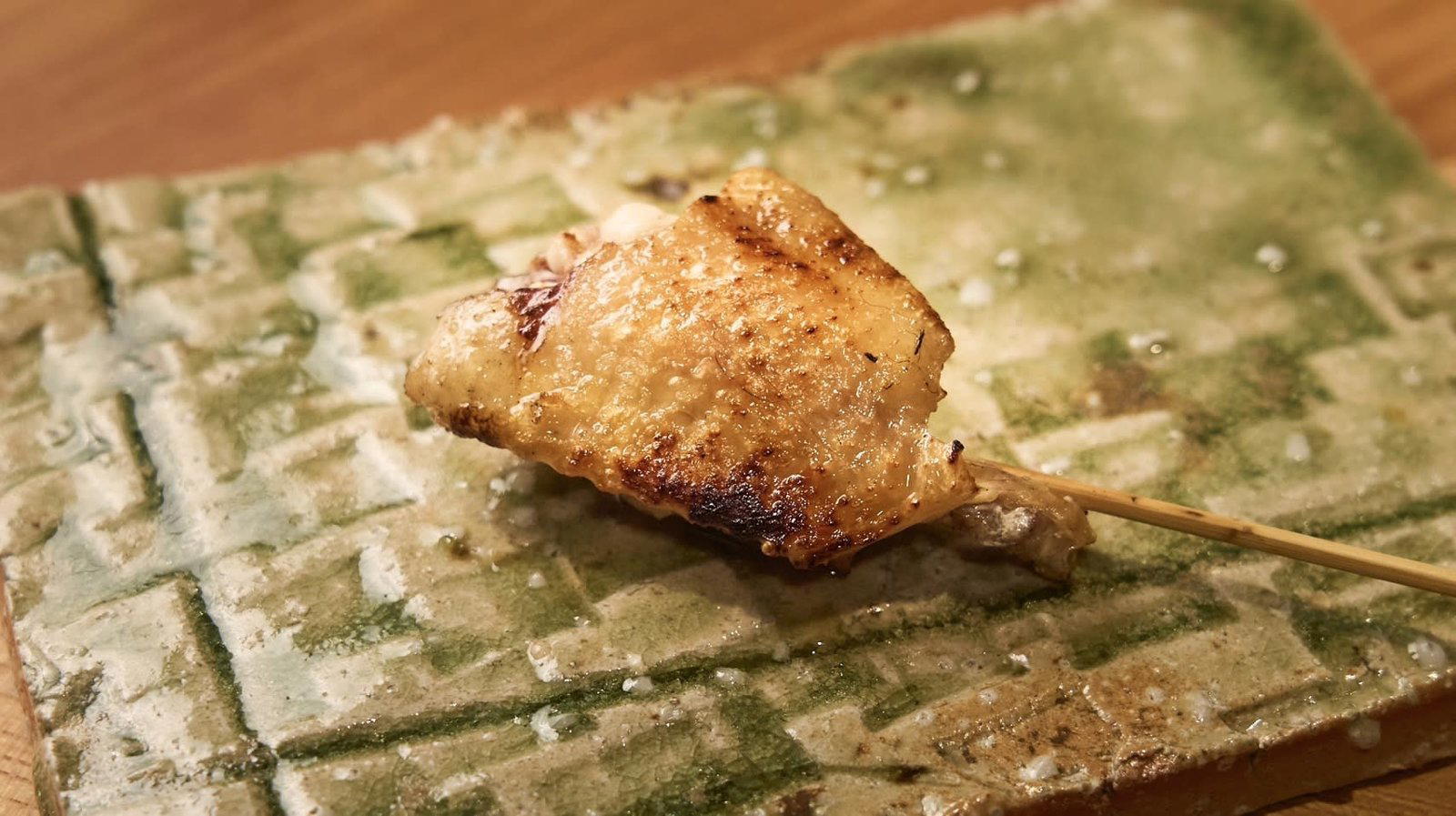
Nishitenma changes tone after office hours. The district’s legal buildings and side-street restaurants give Osaka a quieter register than Namba’s neon or Umeda’s department-store dining floors, and that restraint matters for yakitori. At a counter built around fire, the room is not background scenery; it is the mechanism. Ten seats concentrate attention on timing, heat, and sequence, the elements that separate casual skewers from a special-occasion dinner.
Osaka has long treated chicken over charcoal as both everyday food and technical craft. The premium end now behaves less like an izakaya category and more like counter dining: tighter seating, reservation-only service, a higher spend, and drinks chosen with the same seriousness as the grill. Yakitori Shinose sits in that bracket, with a JPY 20,000 to JPY 29,999 dinner range and selection for Tabelog 100 Yakitori WEST 2025. That combination places it closer to a milestone meal than a spontaneous skewer stop.
A small counter for Osaka's celebration-dinner version of yakitori
Occasion dining in Japan often rewards formats that reduce distraction. Sushi counters, kappo rooms, tempura bars, and high-end yakitori all share the same logic: a narrow field of view, a sequence controlled from the counter, and a meal that asks guests to follow pace rather than build a large shared order. In that sense, yakitori’s humility is deceptive. Chicken demands repeated decisions, not a single grand gesture, with cuts, fat, seasoning, and heat management doing the work course by course.
The counter-only format also changes the social rhythm. A group meal here is not built around long table conversation and side dishes passing across plates. It suits pairs or small parties marking a birthday, anniversary, closing dinner, or a quieter business occasion where the meal itself can carry the evening. Private rooms are not part of the proposition, which is a useful filter: this is counter theatre for diners comfortable with a focused room, not a place for a sprawling family gathering.
Recognition helps clarify the tier. Tabelog’s Hyakumeiten lists function differently from star systems, but for Japanese diners they remain a meaningful signal of category strength. Selection for the 2025 Yakitori WEST list puts the restaurant within a regional conversation rather than a generic Osaka dining list. The distinction matters because yakitori is judged against yakitori, not against French tasting menus, steak restaurants, or sushi counters. A score of 3.93 reinforces that local audience has treated the address seriously since its 2024 opening.
Where Nishitenma fits between Osaka's casual appetite and formal counters
Osaka’s dining identity is often flattened into speed, appetite, and value: takoyaki, okonomiyaki, kushikatsu, and late-night noodles. That version is real, but incomplete. North of the louder entertainment zones, Nishitenma and nearby Kitashinchi support a different mode: compact rooms, dinner reservations, and chefs cooking for guests who already understand the category. In that setting, yakitori does not need to imitate kaiseki formality to feel serious. Its discipline is narrower and more visible.
The price band sets expectations. This is not the same Osaka as a quick stop at 551 Horai (551蓬莱), a bakery run such as 52CHO-ME BAKERY, or a casual coffee pause at .cafe. It also differs from Italian-leaning addresses such as a canto (Italian) and 99 Pizza Napoletana Gourmet, where occasion dining follows another grammar entirely. The useful comparison is not cuisine-to-cuisine; it is how much ceremony a room creates from focus, pacing, and scarcity.
Within the local frame, the spread is wide. Mori Shoten and Karakuchi Meshiya Morigen occupy far lower everyday price territory, while Kamifukawa sits nearer the serious-dinner conversation. Nishitemma Nakamura points toward a Japanese dining lane rather than yakitori specifically. That range explains why a 10-seat, reservation-only yakitori counter can feel both modest in physical scale and expensive in intent. It is buying precision and intimacy, not spectacle.
Who should choose this counter, and who should look elsewhere
The clearest fit is a two-person celebration where the point is a concentrated meal rather than a room with social breadth. The drinks list is broad for the format, spanning sake, shochu, wine, and cocktails, which helps when one diner wants a Japanese pairing direction and another prefers wine. The non-smoking policy also makes the room more appropriate for diners who want the grill to define the evening without tobacco competing for attention.
There are limits. Family-friendly dining is not the angle here, and the counter format leaves little margin for restless children or guests who need menu flexibility. Vegetarian requests require particular caution in serious yakitori, because the cuisine is built around chicken and grill sequencing rather than a separate plant-led menu. Diners seeking a broader Osaka night can frame this as one part of the city rather than the whole story, then cross-check the wider scene through the Osaka restaurants guide, Osaka bars guide, Osaka hotels guide, Osaka experiences guide, and Osaka wineries guide.
The broader Japan and overseas context is useful for calibrating appetite. A beef-led meal such as -Grilled beef Sukiyaki- KAMAKURA TANUKIAN 鎌倉 たぬき庵 in Kamakura, a Tokyo charcoal address like. 鮪と炭火焼き うお炭 秋葉原店 in Tokyo, or a Kyoto room such as [ki:] in Kyoto all answer different versions of the same question: how much structure does the diner want around the meal? For lighter detours.know in Kumamoto, (Shoku) Vietnam in Kawasaki, [Curry Senmon Ten] Maruyama Kyoju. in Sapporo, Jōdo Saké Bar in Los Angeles, and Onigiri Time in Pasadena show how differently Japanese dining codes travel across formats and cities.
The editorial read is simple: choose Yakitori Shinose when the occasion calls for a small room, a controlled grill sequence, and the seriousness of a recognized yakitori counter. Choose somewhere else when the night needs flexible ordering, children, private-room privacy, or Osaka’s louder appetite. Its strength is not breadth; it is concentration.
Awards and Standing
Comparable venues for context, by category and price tier.
| Venue | Cuisine | Price | Notes |
|---|---|---|---|
| Yakitori ShinoseThis venue — the venue you are viewing | High-End Yakitori Omakase | $$$$ | Not listed |
| Pegopa | High-end Yakiniku & Horumon | $$$$ | Nishi |
| Oimatsu Miyamoto | High-end Yakitori Counter | $$$$ | Kita |
| Niku Kappou Yamaguchi | Meat Kappo | $$$$ | Kita |
| Ippou Honten | Traditional Kansai-Style Tempura Ryotei | $$$$ | Nishi |
| Tenpura Brand Matsuba Kani Matsuyamachi Seiten | Seasonal Japanese Tempura | $$$$ | Chūō |
Recognition history
Dated appearances from independent guides and award organizations, with the underlying list record or original source where available.
Tabelog 100 #67 · No. 67
Tabelog · Tabelog 100 - Yakitori - WEST - 2025
Continue exploring
More in Osaka
Restaurants in Osaka
Browse all →



Bars in Osaka
Browse all →


Hotels in Osaka
Browse all →



Wineries in Osaka
Browse all →
At a Glance
- Cozy
- Elegant
- Minimalist
- Intimate
- Date Night
- Special Occasion
- After Work
- Celebration
- Solo
- Chefs Counter
- Open Kitchen
- Design Destination
- Standalone
- Sake Program
- Craft Cocktails
- Extensive Wine List
Serene and quietly theatrical, with earthen walls and a single keyaki-wood counter creating a calm, refined space that highlights the aroma and glow of the charcoal grill.