
Tabelog 100 #82
Our verdict
Osaka’s yakiniku culture rewards timing, heat control, and a room that can keep pace with the grill. Yakiniku Horumon Mansen belongs to the city’s horumon-forward tier, selected for Tabelog 100 - Yakiniku - WEST - 2025, with a format built around Japanese barbecue and tripe rather than ceremonial tasting-menu polish.

Pearl is the En Primeur Club membership app, where members save venues, book tables and use the concierge.
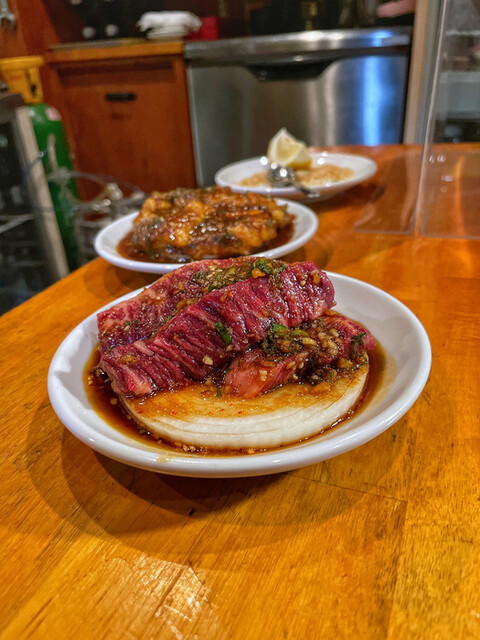
Osaka after dark has the right conditions for yakiniku: narrow streets, late meals, and dining rooms where the rhythm is set by smoke, tongs, and short decisions rather than long explanations. In Osaka, grill culture rarely sits in one lane. It moves between counter snacks, grill rooms, sukiyaki-style meals, offal specialists, and polished restaurants that price themselves closer to fine dining. The horumon end of that spectrum is less about luxury theatre than control: the cut, the heat, the turn, the timing. Yakiniku Horumon Mansen sits in that idiom, with Japanese barbecue and tripe as its defining categories and a 2025 Tabelog Hyakumeiten recognition placing it inside a competitive regional field.
Osaka yakiniku, read through horumon rather than steakhouse ceremony
Yakiniku in western Japan is not a single format. Osaka’s version often feels more direct than glossy counters elsewhere: shorter decisions, later appetites, and a stronger comfort with offal. Horumon carries its own grammar. It asks the kitchen and floor to treat texture as seriously as richness, because the difference between springy, crisp-edged, and overcooked can be a matter of seconds. That makes team coordination more visible than in many quiet tasting rooms. The kitchen has to portion and season for the grill; front-of-house has to keep the pace legible; the diner has to participate without turning dinner into homework.
The useful comparison is not only with other grill restaurants. Tempura Sakugetsu, another Osaka dining room in a different category, represents the opposite discipline: chef-led frying, controlled sequence, and a narrower exchange between counter and plate. Gyoza no Danchan Mikuni Tei Yahatasuji ten sits closer to the casual, repeatable side of the city’s evening economy. Yakiniku occupies the middle ground: convivial, technically dependent, and often more revealing of local eating habits than restaurants built around tasting-menu hierarchy. For a broader read on the city’s dining range, start with Our full Osaka restaurants guide, then cross-check how casual staples, bakeries, and niche rooms map different parts of the same appetite.
The room works when the grill, floor, and table move as one
The team dynamic matters more in horumon than restaurant mythology suggests. There is no chef biography to carry the narrative here, and that is not a weakness. The format depends on a compact relay: preparation before service, heat management once the meal begins, and front-of-house judgment about when a table needs guidance and when it should be left alone. In a city that takes late dining seriously, that operational discipline is part of the pleasure. A yakiniku room can fail through generosity as easily as scarcity if too much lands at once or if the grill becomes a traffic jam.
Recognition in Tabelog’s 2025 Hyakumeiten is the clearest public signal of where the restaurant sits. Tabelog’s genre lists tend to reward local consensus more than international branding, which is useful in Osaka, where many worthwhile addresses are not built for inbound recognition. The listed score of 3.70 also puts it in the tier where regular Japanese diners have already done some sorting. That does not make the experience formal. It suggests the opposite: a specialist place with enough repetition, local scrutiny, and category fit to register beyond everyday convenience.
Osaka’s better food days rarely stay in one register. A visitor might use yakiniku as the anchor for a night after a lighter lunch, or place it between coffee, bakeries, and bars rather than treating it as a standalone trophy meal. Other Osaka dining rooms and independent specialists show how broad the city’s dining has become, while the city’s drinking and stay patterns are better read through broader bar and hotel planning. The point is sequence. Yakiniku rewards an evening that leaves space for smoke, repetition, and conversation.
How to place it within a wider Japan food itinerary
For travellers moving through Japan, Osaka’s grill culture gives a different answer than sukiyaki, counter-led meals, or kappo-style tasting formats. A comparison with other Japanese meals is useful because sukiyaki-style dining organizes the table around broth, sweetness, and sequence, while yakiniku puts heat control at the table. Grill-led rooms elsewhere can bring seafood or broader grilling into the frame, but Osaka horumon keeps the focus tighter. That narrowness is the point.
The broader itinerary should not flatten Japan into a single dining style. Other regional restaurants, immigrant-food rooms, curry specialists, casual counters, and contemporary bars each point to different local food conversations. Even outside Japan, Japanese casual formats have taken on new lives in international cities. Against that spread, Yakiniku Horumon Mansen is valuable because it is specific: Osaka, grill-led, horumon-aware, and shaped by a service rhythm that depends on collaboration rather than spectacle.
There are other Osaka lenses beyond restaurants. Broader Osaka experiences can help place dinner inside city movement and cultural programming, while beverage-led travel can sit beyond the usual restaurant reservation grid. For this address, the editorial case is concise: choose it when the aim is not a choreographed tasting menu, but a focused yakiniku night where offal, grill timing, and floor pacing carry the meal.
Frequently asked questions
Is Yakiniku Horumon Mansen expensive?
Pricing at Yakiniku Horumon Mansen is listed as JPY 5,000 - JPY 5,999.
Where is Yakiniku Horumon Mansen in Osaka?
Osaka.
How hard is it to get a table at Yakiniku Horumon Mansen?
The clearest planning signal is Yakiniku Horumon Mansen’s 2025 Tabelog Hyakumeiten recognition and listed score of 3.70. It is an Osaka yakiniku and horumon venue, so check current booking details directly before going.
What's the defining dish or idea at Yakiniku Horumon Mansen?
The core idea is in the name: yakiniku and horumon, with tripe listed among the categories. At JPY 5,000–JPY 5,999, it reads as a focused Osaka grill stop.
Can Yakiniku Horumon Mansen accommodate dietary restrictions?
Those details are not provided in the available venue facts. Check the venue's official channels for the latest details.
Is Yakiniku Horumon Mansen child-friendly?
Those details are not provided in the available venue facts. Check directly with Yakiniku Horumon Mansen before planning a family visit in Osaka.
The Quick Read
Comparable venues by cuisine and price in the same metro.
| Venue | Cuisine | Price | Awards | Notes |
|---|---|---|---|---|
| Yakiniku Horumon MansenThis venue (the venue you are viewing) | Yakiniku & Horumon Japanese BBQ | $30–50 | Tabelog 100 #82 | Not listed |
| Shimanouchi Ichiyo | Creative Kappo Seafood | $100–150 | Not listed | Not listed |
| Tempura Sakugetsu | Modern Tempura Omakase | $150–200 | Michelin Plate | Tempura |
| Gyoza no Danchan Mikuni Tei Yahatasuji ten | Gyoza & Chinese small plates | $20–30 | Tabelog 100 #90 | JPY 4,000 - JPY 4,999 View spending breakdown |
| Pome | Modern Yakiniku Omakase | $150–200 | Tabelog Bronze #349 | Not listed |
| Saran Shinsaibashimise Korean Restaurant | Korean Restaurant | Not listed | Not listed | Not listed |
Recognition history
Dated appearances from independent guides and award organizations, with the underlying list record or original source where available.
Tabelog 100 #82 · No. 82
Tabelog · Tabelog 100 - Yakiniku - WEST - 2025
Continue exploring
More in Osaka
Restaurants in Osaka
All restaurants in Osaka →




Bars in Osaka
All bars in Osaka →

Hotels in Osaka
All hotels in Osaka →



Wineries in Osaka
Browse all →
Details
- Lively
- Cozy
- Energetic
- Late Night
- Group Dining
- Casual Hangout
- After Work
- Date Night
- Standalone
- A La Carte
- Family Style