Wa'z Seattle
On Cedar Street in Belltown, wa'z occupies a quieter register than Seattle's louder dining rooms, offering a format built around ritual and restraint. The meal unfolds at a deliberate pace, with Japanese sensibility shaping both the kitchen's approach and the room's atmosphere. For those willing to surrender the clock, it rewards the patience.
Pearl is the En Primeur Club membership app — saves, bookings, and concierge access live there. Same editors, same standards.
- Address
- 411 Cedar St, Seattle, WA 98121
- Phone
- +12064417119
- Website
- wazseattle.com
- Directions
- Get directions
 Saves & bookings on Pearl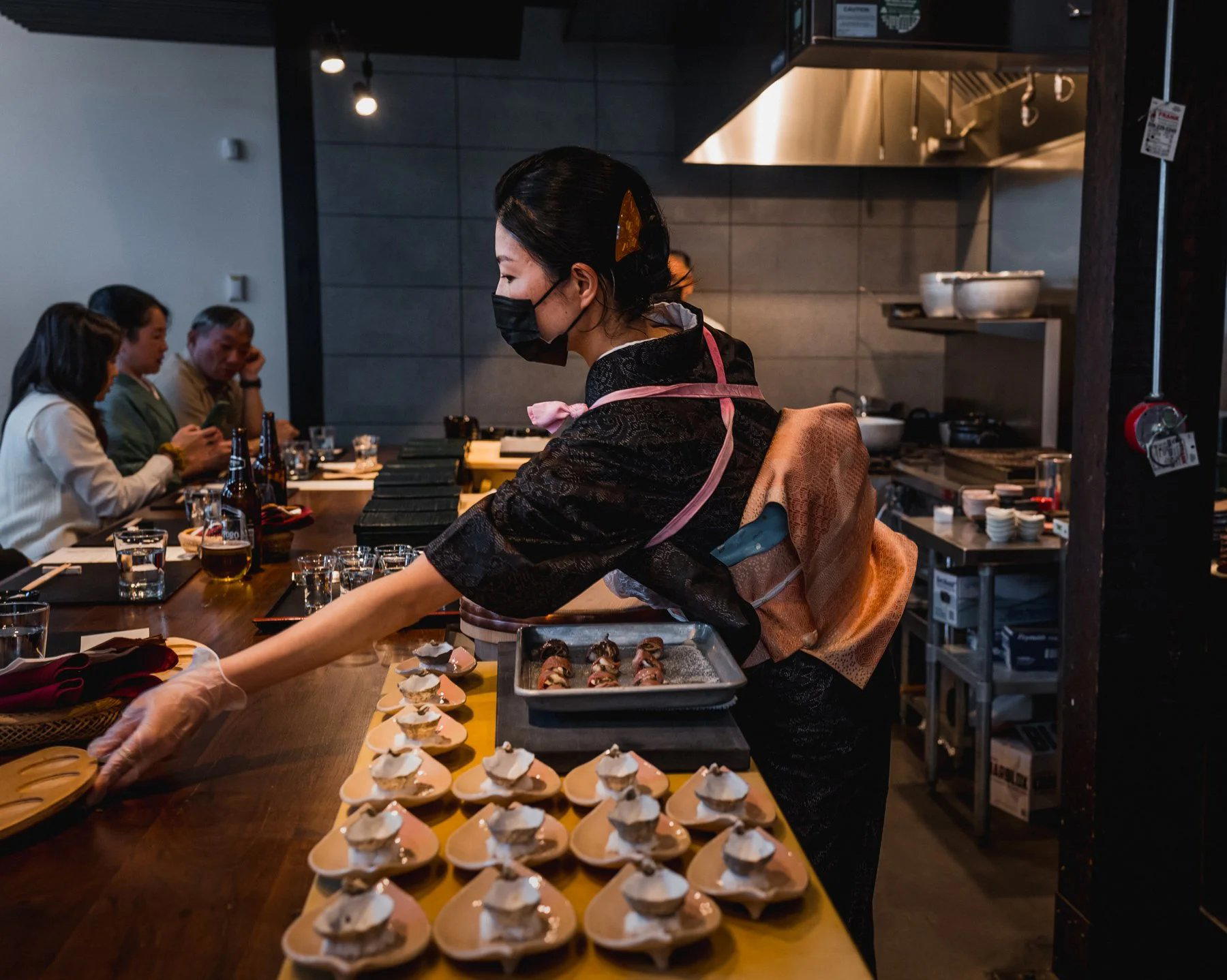
Dining as Ritual: What wa'z Represents in Seattle's Higher-End Scene
Belltown has always been a neighborhood of contradictions: bars that stay loud past midnight a block away from some of the city's more considered dining rooms. On Cedar Street, wa'z sits closer to the latter register. The address, 411 Cedar St, places it within walking distance of the waterfront and the Pike Place Market corridor, but the room itself operates at a different frequency than the tourist-facing restaurants nearby. Approaching, there's little signage designed to pull you in from the street. That restraint is its own signal.
In American cities with a serious dining culture, a small cohort of restaurants now treats the meal itself as a structured sequence with its own etiquette: pacing governed by the kitchen, courses arriving when the cook decides, conversation pitched lower than the ambient hum. Wa'z belongs to this format. The dining ritual here is not incidental to the experience, it is the experience, and readers who approach it expecting a conventional à la carte rhythm are likely to find themselves recalibrated within the first half hour.
The Japanese Sensibility at the Table
Seattle occupies an interesting position in American dining partly because its proximity to Japan, both geographically and culturally, through its significant Japanese-American community, has produced a cluster of restaurants that don't simply serve Japanese food but absorb Japanese dining philosophy into their structure. The distinction matters. Restaurants shaped by that philosophy tend to subordinate the diner's autonomy to the kitchen's sequence, a format more familiar in kaiseki tradition than in the American tasting-menu genre that superficially resembles it.
Wa'z works within this framework. The meal proceeds on its own terms. Where a conventional tasting menu might move from amuse-bouche through a predictable protein arc, a kaiseki-influenced progression observes different logic: seasonal propriety, textural contrast, the temperature of a course as meaningful data rather than afterthought. Pacific Northwest ingredients, shellfish, cold-water fish, foraged material, map well onto this framework, and Seattle's access to that larder gives the kitchen a foundation that restaurants doing similar work in landlocked cities cannot replicate.
For comparative context, the closest analogs to this format operating elsewhere in the United States include Atomix in New York City, which applies Korean fine-dining ceremony to a structured tasting format, and Single Thread Farm in Healdsburg, where kaiseki-influenced hospitality anchors a regionally sourced tasting progression. Both operate at price points and with Michelin recognition that signals their tier; within Seattle, wa'z occupies a comparable niche without the same public profile.
Where wa'z Sits in Seattle's Dining Conversation
Seattle's upper tier of restaurants is smaller than its peer cities might suggest. Canlis, the long-established New American room on Aurora Avenue, remains the city's most recognized fine-dining institution by reputation. Joule, with its New Asian positioning, works in a different register, more kinetic, more à la carte, and appeals to a different kind of evening. Wa'z operates in a quieter niche within that constellation: smaller, more deliberate, more dependent on the diner's willingness to enter the kitchen's rhythm rather than set their own.
That positioning means wa'z doesn't compete directly with the neighborhood spots listed at addresses like 1415 1st Ave, 1744 NW Market St, or 2963 4th Ave S. Those are dining for different reasons and different moods. Wa'z is a specific proposition: a set meal, a specific duration, a room that asks something of you in return for what it offers.
Nationally, the format finds parallels at restaurants like Lazy Bear in San Francisco, which also structures the evening as a communal ritual, and Alinea in Chicago, where the format is more theatrical but equally resistant to diner intervention. The difference is that wa'z draws from a Japanese rather than modernist European or American communitarian tradition, which shapes both the pacing and the aesthetic of the room. For other high-format American dining references, Blue Hill at Stone Barns in Tarrytown and The French Laundry in Napa operate in the same general commitment to a structured evening, though from entirely different culinary traditions.
Planning Your Visit
Wa'z is located at 411 Cedar St in Belltown, a neighborhood that's walkable from downtown Seattle hotels and the Pike Place Market area, and reachable by rideshare without difficulty. Given the format, the restaurant rewards arriving without rushing: the meal is not designed to be eaten quickly, and diners who have an event or commitment afterward will find the experience truncated rather than satisfying. Booking ahead is advisable; restaurants in this tier and format typically operate at limited capacity, and same-week availability is not reliable. Check the restaurant's current booking channel before planning, as smaller Seattle restaurants in this category sometimes shift between reservation platforms.
Readers who have visited comparable ritual-format restaurants, Addison in San Diego, Providence in Los Angeles, Le Bernardin in New York City, or The Inn at Little Washington, will recognize the category of commitment this kind of evening requires. Wa'z asks for the same surrender to the kitchen's sequence, and delivers on that same premise: that a meal structured around ritual, restraint, and seasonal logic is worth more of your evening than a conventional dinner.
For those tracing Japanese fine-dining influence across international markets, 8 1/2 Otto e Mezzo Bombana in Hong Kong represents a different synthesis, European technique absorbed into an Asian city's fine-dining culture, while wa'z inverts that relationship, bringing Japanese structure into a Pacific Northwest American context. And Emeril's in New Orleans offers a useful contrast: American fine dining that celebrates abundance and personality rather than restraint and sequence. Both are legitimate formats; wa'z simply occupies the other end of that spectrum.
Cuisine-First Comparison
Comparable venues nearby, for context on price, style, and recognition.
| Venue | Cuisine | Price | Notes |
|---|---|---|---|
| wa'zThis venue — the venue you are viewing | Modern Japanese Kaiseki | $$$$ | Not listed |
| Wa'z Seattle | Modern Northwest Kaiseki | $$$$ | Belltown |
| Umi Sake House | Japanese Sushi & Izakaya | $$$ | Belltown |
| Momiji SLU | Modern Japanese Sushi & Omakase | $$$ | South Lake Union |
| Daniel's Broiler Downtown | Classic Steakhouse with Prime Steaks and Seafood | $$$$ | Belltown |
| 84 Yesler | Northwest Seafood with Global Influences | $$$$ | Pioneer Square |
Continue exploring
More in Seattle
Restaurants in Seattle
Browse all →
Bars in Seattle
Browse all →
Hotels in Seattle
Browse all →

At a Glance
- Elegant
- Sophisticated
- Intimate
- Quiet
- Modern
- Special Occasion
- Date Night
- Business Dinner
- Celebration
- Group Dining
- Chefs Counter
- Open Kitchen
- Standalone
- Local Sourcing
Current opening hours
- Monday
- Closed
- Tuesday
- Closed
- Wednesday
- 6–8 PM
- Thursday
- 6–8 PM
- Friday
- 5–10 PM
- Saturday
- 5–10 PM
- Sunday
- 1–7 PM
Hours can change for holidays and private events. Last verified .
A refined, meticulous Japanese tasting-menu setting described as fancy and special-occasion oriented, with careful seasonal presentation and a quiet, elegant atmosphere.