Waidmannsruh
Our verdict
Waidmannsruh sits on Neue Hauptstraße in Schleusingen, a small Thuringian town where the surrounding Rennsteig forest and agricultural hinterland define what ends up on the plate. The name itself, a hunter's greeting, signals the kitchen's orientation toward game, foraged ingredients, and the kind of sourcing that is dictated by season and landscape rather than import lists. For travelers passing through central Germany, it represents a style of regional cooking that larger destination restaurants rarely preserve this honestly.

Pearl is the En Primeur Club membership app, where members save venues, book tables and use the concierge.
The menu
What to order
- Nahetaler Hirschkalbsbraten mit Thüringer Klößen
- Kalbsfilet auf geschmorten Pfirsichen
Where the Forest Meets the Table
Approach Schleusingen from any direction and the Thuringian Forest closes in around you, spruce and beech running up the ridgelines, the Rennsteig trail cutting across the plateau above town. The name Waidmannsruh translates loosely as the hunter's rest, a traditional greeting among foresters that doubles here as a declaration of culinary intent. Before you read a menu, the name tells you where the kitchen looks for its raw material: into the woods, not toward a distribution warehouse. That orientation is increasingly rare in German regional dining, where even rurally situated restaurants often source from the same national suppliers as their urban counterparts.
Schleusingen itself is a compact Thuringian town of around 7,000 residents, positioned in the southern part of the forest district between Hildburghausen and Suhl. It holds a modest regional profile, a medieval castle, a few quiet squares, but it is not a dining destination in the way that Baiersbronn draws visitors specifically to eat at Schwarzwaldstube, or the way Hamburg sustains institutions like Restaurant Haerlin. What it has is proximity to some of central Germany's most productive foraging terrain, a tradition of game hunting that predates any restaurant industry, and a local food culture built around what the forest and the surrounding farmland actually produce.
The Sourcing Argument at the Heart of Regional German Cooking
Germany's most decorated kitchens, Aqua in Wolfsburg, Vendôme in Bergisch Gladbach, Victor's Fine Dining in Perl, operate at a level of technical ambition where sourcing is curated globally: Japanese beef, French butter, Scandinavian fish. That model produces extraordinary food, but it is a different project from what happens in a place like Waidmannsruh. Here, the sourcing argument is geographic and seasonal by necessity as much as by philosophy. The Thuringian Forest produces roe deer, wild boar, pheasant, chanterelles, porcini, wild garlic, and bilberries at different points in the year. A kitchen that takes its name from a hunter's greeting is, implicitly, a kitchen organized around that calendar.
This is not an artisanal affectation applied retrospectively. The tradition of Wildküche, game cookery, runs through central German culinary history as a practical reality before it became a selling point. Forests were managed hunting grounds for centuries; the table followed from the land. Restaurants like Waldhotel Sonnora in Dreis or ES:SENZ in Grassau operate in similarly forested, rurally rooted contexts and have built serious reputations around the intersection of fine technique and local provenance. The comparison illuminates what the category can achieve at its ceiling, and what visitors should look for even at more modest levels of the same tradition.
What to Expect at Waidmannsruh
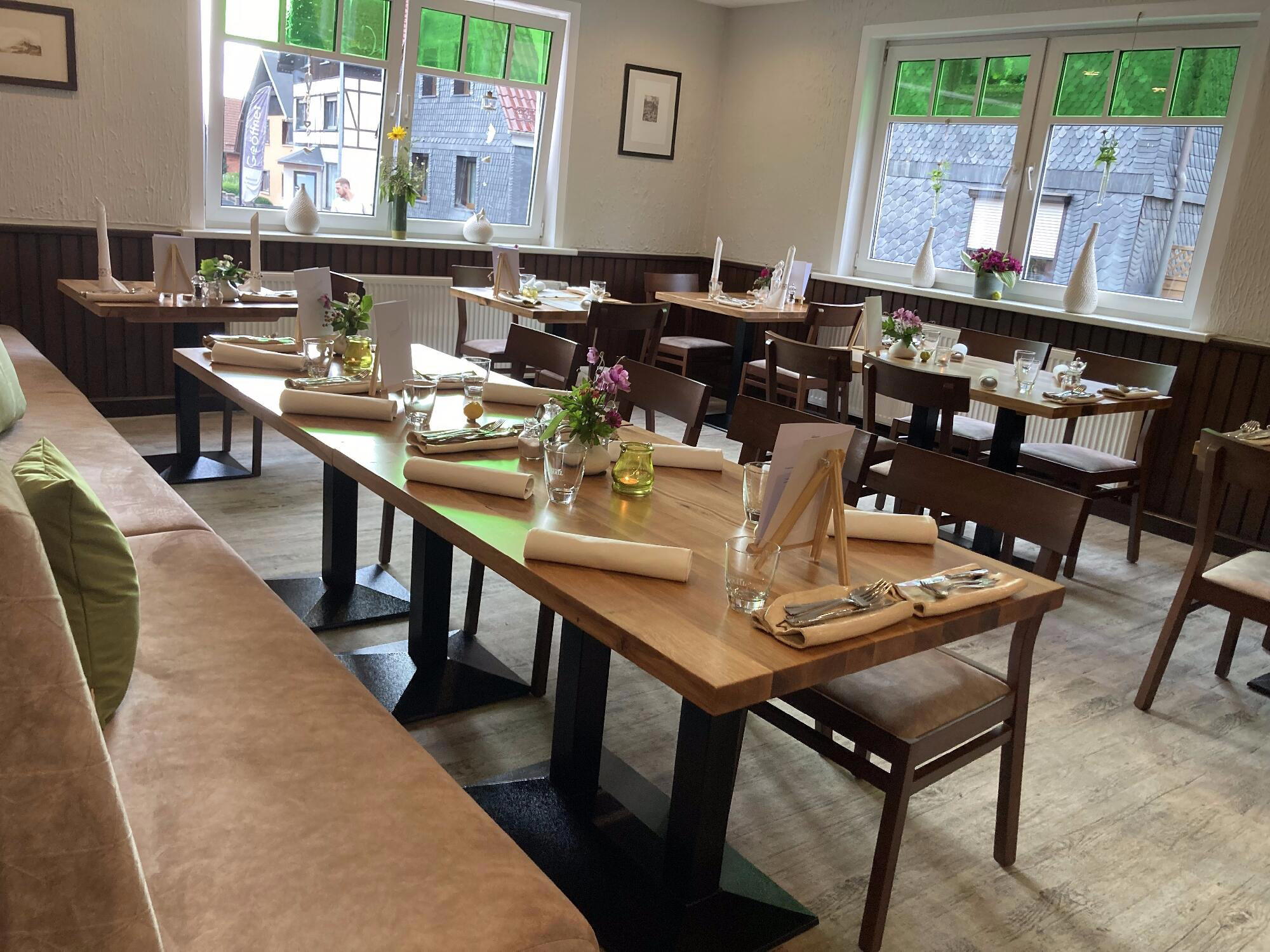
The address, Neue Hauptstraße 7, places the restaurant on one of Schleusingen's main streets, accessible without difficulty from the town center. Because detailed operational data for Waidmannsruh is not publicly available through standard channels, specifics about current menus, opening hours, and pricing are best confirmed directly before visiting. What the name and location together suggest is a kitchen in the Gasthaus or traditional German inn tradition: regionalist in sourcing, seasonal in structure, and oriented toward the kind of guest who wants to eat what the surrounding countryside produces rather than an internationally composed tasting menu.
That format, the serious regional Gasthaus, is worth understanding on its own terms. It sits below the Michelin-starred tier represented by JAN in Munich or AURA in Wirsberg, and well below the dessert-forward avant-garde of CODA Dessert Dining in Berlin. But it occupies a category that has its own integrity: cooking where the sourcing story is not a marketing layer but the actual organizing principle of the menu. For the traveler who has spent time at Schanz in Piesport or ammolite in Rust, a regional inn in the Thuringian Forest offers a deliberately different register, less technically ambitious, more directly connected to a specific place.
Schleusingen as a Staging Point
Visitors to this part of Thuringia are most commonly traveling between Erfurt or Suhl and the southern reaches of the forest, or passing through en route to Franconia. Schleusingen sits roughly at the junction of several regional routes without being an obvious stopping point on any standard German itinerary. That marginality is partly what preserves the character of restaurants like Waidmannsruh: the clientele is predominantly local and regional, which means the kitchen answers to a community that knows the difference between venison from a nearby estate and a frozen import, and between chanterelles picked that morning and those that have spent two days in a chill chain.
The broader restaurant scene in this corner of central Germany rewards travelers willing to consult our full Schleusingen restaurants guide before arriving. The town's dining options reflect its scale, but within that scale there are kitchens doing work that connects directly to the forest-and-farm tradition in ways that more tourist-heavy destinations have largely abandoned. For context on how Germany's more prominent regional kitchens handle similar source material at higher technical levels, the work at Bagatelle in Trier or ATAMA in Sankt Ingbert shows the range the country's mid-tier and fine dining scenes can span. At the other end of the global comparison, kitchens like Le Bernardin in New York and Atomix illustrate what sourcing-led philosophy looks like when combined with maximum technical resources, a useful calibration even if the contexts are entirely different.
Planning Your Visit
Schleusingen is reachable by road from Suhl in under 20 minutes and from Erfurt in roughly an hour. Public transport connections are limited, making a car the practical choice for most visitors. Given the absence of published hours and booking details for Waidmannsruh, calling ahead or checking current local listings before making the journey is the appropriate precaution, particularly if you are visiting outside the summer and autumn months when regional kitchens in forested areas often operate on reduced schedules. The autumn game season, typically September through January, represents the natural peak for a kitchen organized around hunting territory, so timing a visit to that window gives you the leading chance of eating the food that makes the tradition worth seeking out. For comparison with how AUGUST in Augsburg handles seasonal Bavarian produce at a higher technical register, the contrast is instructive.
Frequently asked questions
Is Waidmannsruh okay with children?
The restaurant sits on Neue Hauptstraße 7, one of Schleusingen's main central streets, in a town where family dining is part of everyday life rather than an exception. Nothing in the venue's profile suggests a strict adults-only policy. If a quieter or more formal evening is a priority, calling ahead to confirm is advisable, as the kitchen's regional focus and the local dining culture both lean toward relaxed, cross-generational meals.
Is Waidmannsruh formal or casual?
The name, Waidmannsruh, a term rooted in hunting and forest tradition, signals a setting closer to a traditional German Gasthaus register than a white-tablecloth tasting room. The Schleusingen context reinforces this: the town is a working market center in southern Thuringia, not a resort destination. Expect a relaxed atmosphere without needing to dress for a formal occasion, though the regional cooking ethos suggests the kitchen takes the food seriously.
Is Waidmannsruh worth visiting if you're driving through the Thuringian Forest between Suhl and Erfurt?
Schleusingen sits on the natural route between Suhl, reachable in under 20 minutes by road, and Erfurt, roughly an hour away, making Waidmannsruh at Neue Hauptstraße 7 a practical stop rather than a detour. The town itself marks a transition point between the southern Thuringian Forest and the broader region, and the restaurant's name and location position it as a grounded, forest-adjacent dining option. For travellers covering this corridor, it offers a more locally rooted alternative to motorway stops or chain restaurants in larger centres.
What should I order at Waidmannsruh?
Given the venue's name, Waidmannsruh translates roughly to 'hunter's rest', and its location in the Thuringian Forest, game dishes and forest-sourced produce are a reasonable expectation when in season. Regional Thuringian cooking in this area typically centres on hearty meat preparations, braised dishes, and local accompaniments.
How do I find Waidmannsruh?
Waidmannsruh is located at Neue Hauptstraße 7, 98553 Schleusingen, Germany, Schleusingen.
Fast Comparison
Comparable venues nearby, for context on price, style, and recognition.
| Venue | Cuisine | Price | Notes |
|---|---|---|---|
| WaidmannsruhThis venue (the venue you are viewing) | Traditional German with International Influences | Not listed | Not listed |
| Restaurant Harmonie | Traditional German | Not listed | Augsburg |
| Naumanns Gaststube | Traditional German Gaststube | $20–30 | Lindenau |
| Bamberger Haus | Imperial Austrian-German Court Cuisine | $30–50 | Milbertshofen |
| Café Mainstreet | Modern Café / Breakfast Café | $10–20 | Poing |
| Marstall Festzelt | Traditional Bavarian Oktoberfest | $30–50 | Theresienwiese |
Continue exploring
More in Schleusingen
Restaurants in Schleusingen
All restaurants in Schleusingen →
Bars in Schleusingen
Browse all →
Details
- Cozy
- Rustic
- Classic
- Family
- Special Occasion
- Historic Building
- A La Carte
- Vegetarian Friendly
- Vegan Options
Current opening hours
- Monday
- Closed
- Tuesday
- Closed
- Wednesday
- 5–9 PM
- Thursday
- 5–9 PM
- Friday
- 5–9 PM
- Saturday
- 5–9 PM
- Sunday
- 11 AM–2 PM, 5–9 PM
Hours can change for holidays and private events. Hours as of .
Cozy atmosphere with attentive service and hearty, comforting dishes.