
Tabelog 100 #12
Our verdict
Udon Sanku puts Osaka’s everyday noodle culture into a compact Fukushima setting, with udon and tempura priced in the sub-¥1,000 bracket and recognition from Tabelog 100 Udon WEST 2024. The appeal is not ceremony; it is the discipline of a small, counter-led noodle shop in a neighbourhood where casual eating and serious craft often share the same block.

Pearl is the En Primeur Club membership app, where members save venues, book tables and use the concierge.
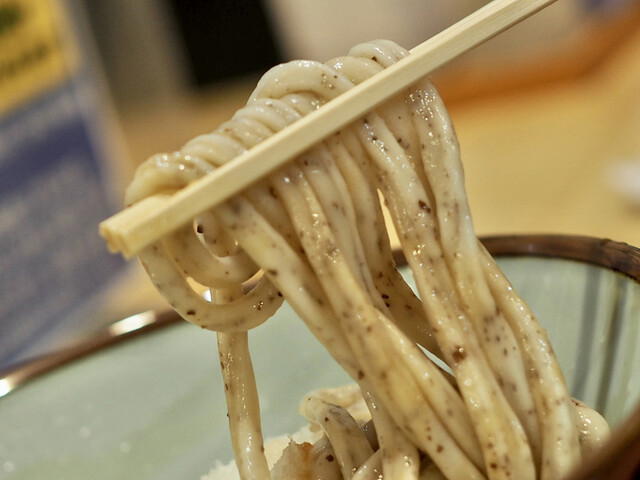
Approaching an udon shop in Fukushima is not like entering Osaka’s grander dining rooms. The pace is practical, decisions happen quickly, and the appeal sits closer to everyday eating than to a long tasting-menu arc. Here, stronger noodle addresses read as daily infrastructure: compact in spirit, accessible, and judged by repeatable execution rather than theatre.
Udon Sanku fits that category. Its Tabelog Hyakumeiten recognition in 2024 matters because udon is a competitive everyday field, not a novelty niche. Kansai has long treated wheat noodles as daily food with regional nuance, from broth balance to noodle texture, and Osaka’s serious udon shops often work in modest formats. The signal is the combination: udon and tempura, Fukushima, and pricing listed at - JPY 999 - JPY 999, keeping the experience within the city’s ordinary lunch grammar rather than special-occasion dining.
Osaka udon culture, without the tasting-menu costume
For travellers used to reservation-led sushi counters or kaiseki rooms, udon can look deceptively simple. That is the point. The form rests on a narrow set of variables: noodle structure, broth discipline, frying consistency, and the speed with which a kitchen repeats those decisions through service. Western Japan’s udon tradition is especially sensitive to balance. It does not need luxury-dining rhetoric; it needs a bowl that makes sense at midday and a room that can turn without losing focus.
That gives this kind of address particular value in Fukushima. The area is close enough to central Osaka’s business and transport patterns to catch practical dining demand, yet it has a restaurant identity broader than office-worker convenience. Higher-end local comparison points can include Agu Buta Shabushabu Senmon Ten Toriou Bettei and Sumibi Yakitori Torio. Against that broader spend, a recognised udon shop listed at - JPY 999 - JPY 999 is not a cheaper substitute, but a separate expression of craft where repetition and access are part of the standard.
Tempura on the menu places the shop within a familiar Kansai pairing rather than making it a full tempura counter. In Osaka, udon shops often use fried items as texture and contrast around the noodle bowl, not as a standalone luxury format. That practical pairing is why the format matters. It sits naturally between a solo noodle stop and a small local meal. It is not built around lingering over multiple courses; it is built around clear ordering, quick attention, and a meal that must justify itself immediately.
Fukushima's casual dining range gives the bowl sharper context
Fukushima’s restaurant map rewards readers who do not reduce Osaka to its most familiar tourist circuits. The area supports different appetites in the same outing: noodle shops, coffee rooms, bistros, curry counters, shabu-shabu specialists, and yakitori rooms within a compact urban rhythm. For a broader read on the district, start with Our full Fukushima restaurants guide, then use the category pages as context rather than itinerary padding: Our full Fukushima hotels guide, Our full Fukushima bars guide, Our full Fukushima wineries guide, and Our full Fukushima experiences guide.
The clearest way to understand the area is by price and format. A specialist udon meal listed at - JPY 999 - JPY 999 sits close to everyday casual spend, while MONDIAL KAFFEE 328 GOLD RUSH and Spice Curry Tairiku help show how broad Fukushima’s informal dining range can be. Agu Buta Shabushabu Senmon Ten Toriou Bettei asks a different question: whether the outing should centre on a more dedicated evening format. That spread makes Fukushima useful for travellers who care about food but do not want every meal to become an event.
Within that spread, Udon Sanku’s recognition has practical meaning. Tabelog’s Hyakumeiten lists tend to reward depth within a category, and the 2024 recognition places the shop in a category conversation rather than a general popularity contest. With a listed Tabelog score of 3.76 and categories of udon and tempura, the address carries a clearer signal than a casual noodle stop without that public recognition. For a cuisine built on daily repetition, that kind of category-specific recognition is more persuasive than novelty.
How to use it in an Osaka eating day
The smarter move is to treat this as the low-ceremony anchor of a Fukushima day, not a trophy stop. Its public profile points to an accessible noodle format, and the listed budget keeps it in the everyday range for both lunch and dinner. Cash planning can still be wise in small Japanese restaurants, especially when payment details are not the point of the visit. The experience is casual by design: udon, tempura, and a meal that works because it is direct rather than elaborate.
That casual frame does not make it generic. It puts the shop in a category where the margin for error is narrow because the meal is so exposed. There is no need for a long wine list or elaborate room to distract from the bowl. Readers who want Osaka’s food culture only through omakase counters will miss how much of the city’s discipline lives in modest formats. Readers who understand that noodle shops can carry regional identity as clearly as formal restaurants will find the logic immediately.
For nearby alternatives and broader trip planning, compare formats rather than chase a single ranking. Other Fukushima dining rooms show how broad the local casual-to-midrange field can be, while Artisan, MONDIAL KAFFEE 328 GOLD RUSH, Spice Curry Tairiku, and Sumibi Yakitori Torio give different ways to read the same area. Further afield, the same editorial lens is useful without needing to name every comparison point: separate category from occasion, then ask how each place turns a narrow format into a reason to cross town. The useful comparison is not cuisine to cuisine; it is how a focused address makes its own case.
Frequently asked questions
Can I bring kids to Udon Sanku?
Udon Sanku is in Fukushima. For child policies, stroller access, and other practical details, check the venue's official channels before visiting.
Is Udon Sanku formal or casual?
Casual. Udon Sanku is an udon and tempura venue in Fukushima, recognised in the 2024 Tabelog Hyakumeiten selection. The recognition speaks to category-specific quality rather than ceremony.
How much does it cost to eat at Udon Sanku?
Pricing at Udon Sanku is listed as - JPY 999 - JPY 999, with the public budget shown as Dinner: - JPY 999; Lunch: - JPY 999.
What is Udon Sanku known for?
Udon Sanku is known for udon and tempura in Fukushima, with a 2024 Tabelog Hyakumeiten recognition and a listed Tabelog score of 3.76.
A Pricing-First Comparison
Comparable options at the same price tier.
| Venue | Cuisine | Price | Awards | Notes |
|---|---|---|---|---|
| Udon SankuThis venue (the venue you are viewing) | Japanese Udon & Tempura | $1–10 | Tabelog 100 #12 | Not listed |
| Tachinomi Jack to Machilda | Standing Japanese sake bar (tachinomi izakaya) | $10–20 | Tabelog 100 #8 | Fukushima, Standing Japanese sake bar (tachinomi izakaya) |
| Ramen Jinsei JET | Japanese Ramen | $10–20 | Tabelog 100 #62 | Fukushima, Japanese Ramen |
| Shoku Pan Kobo Rami Fukushima honten | Japanese shokupan bakery | $1–10 | Tabelog 100 #57 | Fukushima, Japanese shokupan bakery |
| Shoppe Shoppe | Japanese Ramen | $10–20 | Tabelog 100 #11 | Fukushima, Japanese Ramen |
| Rojiura Avant-garde | Standing Oden Izakaya in a Renovated Traditional House | $20–30 | Tabelog 100 #34 | Fukushima, Standing Oden Izakaya in a Renovated Traditional House |
Recognition history
Dated appearances from independent guides and award organizations, with the underlying list record or original source where available.
Tabelog 100 #12 · No. 12
Tabelog · Tabelog 100 - Udon - WEST - 2024
Continue exploring
More in Fukushima
Restaurants in Fukushima
All restaurants in Fukushima →




Bars in Fukushima
Browse all →



Hotels in Fukushima
Browse all →



Wineries in Fukushima
Browse all →
Details
- Cozy
- Classic
- Solo
- Family
- Casual Hangout
- Standalone
- A La Carte
- Counter Dining
Simple, relaxed, and low-key, with a hideout-like house restaurant feel and counter-focused seating that suits a quick, casual meal.