
Tabelog 100 #11
Our verdict
Shoppe Shoppe places Osaka ramen in its lean, ingredient-driven register rather than the city’s louder comfort-food lane. Its Tabelog Ramen OSAKA 100 selections in 2024 and 2025, compact 11-seat format, and sub-¥1,000 listed budget make it a serious stop for readers tracking how everyday ramen can carry award-level scrutiny without fine-dining ceremony.

Pearl is the En Primeur Club membership app, where members save venues, book tables and use the concierge.
The menu
What to order
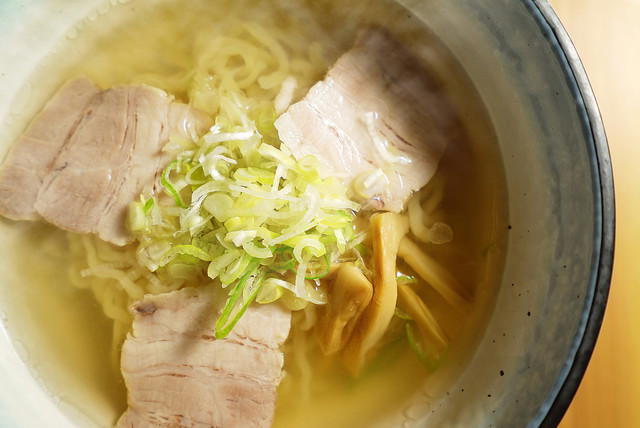
- Aizuyama salt ramen
- Spicy miso mountain salt ramen
Approaching Fukushima, the mood shifts from Osaka’s commercial roar to something more local and practical: everyday dining demand, quick meals, and the quiet arithmetic of deciding where a short stop is worth making. This is useful ramen territory. The category is not built on ceremony; it is built on broth discipline, noodle timing, and the ability to make a compact meal feel complete without adding theatre.
Shoppe Shoppe belongs to that Osaka ramen conversation because it reads as a focused specialist rather than a broad casual restaurant. The appeal is compact in spirit, with ramen at the centre of the experience, and the scale of ambition matters: ramen at this level depends on repetition, narrow focus, and ingredient control. In a city where diners can move from luxury beef rooms to hotel lounges within a short dining itinerary, the appeal here is narrower and sharper.
Osaka ramen, judged by sourcing and restraint
Ingredient sourcing is the quiet test of ramen. The bowl may look simple from a distance, but its credibility depends on choices made before service: what goes into the broth, how seasoning is balanced, whether the noodles suit the soup rather than dominate it, and how toppings support structure instead of turning the bowl into excess. Osaka’s ramen culture has room for many styles, but the more interesting shops often work through control rather than volume.
That context explains why Tabelog’s ramen recognition carries weight. Shoppe Shoppe was selected for the 2025 Tabelog Hyakumeiten ramen list, with a Tabelog score of 3.69 attached to the listing. In Japan’s user-review culture, especially around ramen, that kind of recognition signals more than popularity. It suggests consistency across repeat visits from diners who compare shops closely and punish sloppiness.
The listed price band, - JPY 999 - JPY 999, keeps the experience in ramen’s democratic lane. That is part of the point. Osaka’s dining range includes rooms such as Wagyu Ryori Isseki Sanchou at a much higher spend, and Fukushima also supports hotel and contemporary formats. Ramen operates by a different logic: the meal is brief, the margin for error is small, and the value proposition is exposed because there is little else to hide behind.
For readers mapping the wider city, Shoppe Shoppe sits closer to ingredient-led specialist dining than to casual filler. It can be paired intellectually with other focused formats across the region, where the draw is not breadth but a clear point of view within a specific genre.
A focused ramen stop in a district that rewards precision
Fukushima’s dining identity is useful to understand here. The area does not behave like a single-theme food quarter. It absorbs local traffic, destination diners, and spillover from central Osaka, which creates a market where small restaurants can survive if they deliver a concise promise. Ramen shops in this setting cannot rely only on novelty; they need speed, consistency, and enough depth to pull diners past the nearest convenient option.
The format reinforces that standard. A ramen specialist turns service into a tight production rhythm, where timing and pacing matter as much as the written menu. Ramen changes how the meal is read: the diner notices assembly, heat, and the short interval between bowl and first bite rather than a long, detached sequence. That immediacy suits ingredient-led cooking because ramen is at its best when noodles, broth, and toppings arrive in balance.
Compared with nearby higher-spend or broader-format dining, the decision is not whether ramen can compete on luxury. It cannot, and it does not need to. The useful comparison is discipline per yen. A bowl within the listed budget ceiling has to justify itself through fundamentals. That is why recognition in a ramen-specific list matters more here than a generic popularity badge.
The public record places Shoppe Shoppe within everyday Osaka eating rather than destination-only dining. Still, the award context changes the reader’s approach. This is not a place to treat simply as a fallback between reservations; it is a short-form meal with enough critical signal to plan around if ramen is part of the trip’s food agenda.
How to place it in a Fukushima itinerary
The strongest use case is a focused ramen stop in Fukushima rather than a long evening built around courses. That makes it a useful counterpoint to the area’s more expansive dining options and to hotel-adjacent rooms in the wider city. The absence of a broad public chef narrative also keeps attention where it belongs: on ramen as a craft of sourcing, seasoning, and repetition.
Readers building a wider Osaka and Japan food map can treat this as one data point in a broader specialist circuit. For Fukushima planning, start with Our full Fukushima restaurants guide, then cross-check the wider trip through Our full Fukushima hotels guide, Our full Fukushima bars guide, Our full Fukushima wineries guide, and Our full Fukushima experiences guide. Nearby and wider-reference dining in Osaka helps frame how specialised casual formats sit beside broader regional dining.
For national comparison, the more useful exercise is not ranking ramen against unrelated categories, but noticing how Japan rewards narrow expertise across formats. That same specialist logic appears across many cities and cuisines, from noodle counters and grill rooms to sake bars and casual specialist shops. The common thread is not cuisine type; it is the discipline of doing a narrow thing with enough conviction that the format becomes the argument.
Frequently asked questions
What's the pricing like at Shoppe Shoppe?
Pricing at Shoppe Shoppe is listed as - JPY 999 - JPY 999.
How do I find Shoppe Shoppe?
Shoppe Shoppe is located in Fukushima.
Do they take walk-ins at Shoppe Shoppe?
The public record provided for Shoppe Shoppe does not specify a reservation policy. For a ramen stop in Fukushima, check the venue's official channels for the latest arrival and service details.
What makes Shoppe Shoppe worth seeking out?
Shoppe Shoppe was selected for a Tabelog Hyakumeiten ramen list in 2025, with a listed Tabelog score of 3.69. The appeal here is the stripped-back ramen format and a public price range listed as - JPY 999 - JPY 999. Check the venue's official channels for the latest details.
Is Shoppe Shoppe good for vegetarians?
The public record identifies Shoppe Shoppe as ramen-focused, but it does not provide vegetarian-specific dishes or broth details. In practice, that means vegetarian diners should treat it as a noodle stop first, not a clearly vegetarian-led address. Check the venue's official channels for the latest details.
Is Shoppe Shoppe a family-friendly restaurant?
The provided public record does not specify family-friendly facilities or children policies. Its Fukushima location and ramen focus may make it a compact meal option, but families should check the venue's official channels for the latest details before visiting.
How It Stacks Up
Nearby venues at a similar price tier for orientation.
| Venue | Cuisine | Price | Awards | Notes |
|---|---|---|---|---|
| Shoppe ShoppeThis venue (the venue you are viewing) | Japanese Ramen | $10–20 | Tabelog 100 #11 | Not listed |
| Wagyu Ryori Isseki Sanchou | Modern Wagyu Yakiniku & Course Dining | $50–100 | Tabelog 100 #45 | Fukushima Ward |
| Rojiura Avant-garde | Standing Oden Izakaya in a Renovated Traditional House | $20–30 | Tabelog 100 #34 | Fukushima |
| FLY BOY BURGER & COFFEE | Hamburger & coffee shop | $10–20 | Tabelog 100 #69 | Fukushima Ward |
| Korean Shokudo Iru | Korean Izakaya | $20–30 | Tabelog 100 #44 | Shin Fukushima |
| Sumibiyakitori Coquelet | Modern Yakitori Izakaya | $30–50 | Tabelog 100 #96 | Fukushima |
Recognition history
Dated appearances from independent guides and award organizations, with the underlying list record or original source where available.
Tabelog 100 #11 · No. 11
Tabelog · Tabelog 100 - Ramen - OSAKA - 2025
Continue exploring
More in Fukushima
Restaurants in Fukushima
All restaurants in Fukushima →


Bars in Fukushima
Browse all →


Hotels in Fukushima
Browse all →




Wineries in Fukushima
Browse all →
Details
- Cozy
- Casual
- Solo
- Casual Hangout
- Late Night
- Standalone
- A La Carte
- Counter Dining
- Soft Drinks
Simple and unpretentious ramen counter with a cozy, neighborhood feel; compact space that can feel busy but remains relaxed and informal, focusing attention on the steaming bowls of ramen rather than décor.