
Tabelog 100 #54
Our verdict
Udon Kurajuu puts Osaka’s everyday noodle culture into a small Asahi-ku room where craft matters more than ceremony. Its Tabelog 100 Udon WEST selections in 2020, 2022, and 2024, plus a 3.72 score, place it in a serious regional bracket while the price point stays in the casual Osaka range.

Pearl is the En Primeur Club membership app, where members save venues, book tables and use the concierge.
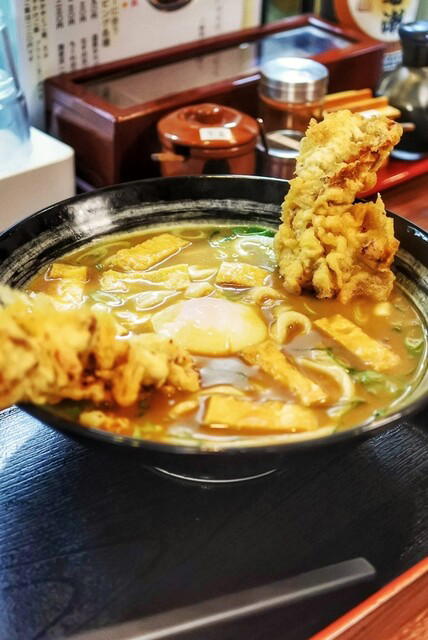
The menu
What to order
- Curry udon
- Chicken tempura
- Kayu-ku gohan (seasoned rice)
- Zaru udon with cucumber toppings
Osaka is not only neon signs and station-mall dining floors. Away from the most theatrical visitor routes, the rhythm can feel residential: bicycles, local buses, shuttered shopfronts between services, and the plain confidence of restaurants built for repeat customers rather than spectacle. In that setting, udon reads correctly. Wheat noodles are part of Kansai’s daily grammar, but the better rooms make a quiet argument about dough, broth, and timing without turning lunch into theatre.
Udon Kurajuu belongs to that serious-casual tier. The restaurant is listed for udon, udon-suki, and tempura, a combination that says much about Osaka’s appetite for comfort food with technical edges. Udon-suki links the bowl to shared-pot dining; tempura brings the fryer into the equation, where oil management and ingredient handling can expose a kitchen quickly. The listed price band remains modest by Osaka standards, yet the recognition is not modest: Tabelog selected it for its Udon WEST 100 in 2024, and the current score provided is 3.72.
Kansai udon depends on restraint before it depends on toppings
Osaka udon is often understood through Kansai’s preference for balance and restraint. The approach gives room to dashi, wheat texture, and the relationship between noodle and broth. That restraint makes fundamentals consequential. Flour handling, water absorption, stock, and frying oil are not decorative concerns; they determine whether a bowl has depth or merely salt. In this category, the kitchen cannot hide behind luxury produce or elaborate plating.
That is why the udon-suki and tempura categories matter. They place the restaurant in a broader Kansai tradition where noodles, hot broth, and fried elements meet without fine-dining choreography. Compared with other Osaka dining in the comparisons set, including Kadoya, this sits in a modest everyday bracket. Alongside names such as Unagi no Uoi Honten or Shibaken, it remains an accessible way to read local taste without committing to a long meal.
The sourcing angle here is not about naming a farm or a branded ingredient. It is about what the format demands. Udon shops with recognition earn attention through repeatable fundamentals: noodle texture, broth clarity, temperature control, and accompaniments that do not overwhelm the bowl. The Tabelog 100 Udon WEST selection gives a useful signal because the list is category-specific. This is not a general popularity badge; it places the shop inside a regional noodle conversation where small differences in dough and stock carry weight.
The format changes how the meal works
The restaurant’s format reinforces the point. Udon Kurajuu reads as a focused noodle stop rather than a broad, multi-course destination. That format also changes expectations. This is not a place for treating udon as a backdrop to a long evening. The style rewards decisive ordering and attention to the bowl while it is in front of the diner.
For solo diners, that focus can be an advantage. Udon has the right frame when it is quick, practical, and built around timing. For families or small groups, the listed categories suit a mixed table better than many narrower formats. The appeal is direct enough for travelers who are mapping casual meals around daytime sightseeing rather than late-night drinking.
There is a useful contrast with Osaka’s broader casual-dining field. Curry Daiya and Tonkatsu Fujii are useful nearby points of comparison in the city’s everyday eating landscape. The shared lesson is that Osaka’s value does not always mean low ambition. In the city’s stronger specialist restaurants, a narrow category becomes the discipline. Udon Kurajuu’s category recognition puts it closer to that specialist pattern than to generic neighborhood convenience.
Where it fits in an Osaka eating plan
For travelers building a food itinerary, the better comparison is not against kaiseki or sushi but against other single-category meals. A day in Osaka can move through casual local staples before arriving at noodles. Udon fits that same practical intelligence: accessible, fast enough to anchor a day, and revealing when the fundamentals are handled with care.
Osaka also rewards cross-category eating. The city absorbs many dining forms, from international cooking to specialist comfort food, but udon remains a cleaner read on Kansai preference: softness over aggression, broth over sauce, repetition over novelty. For broader planning, use Our full Osaka restaurants guide alongside Our full Osaka hotels guide, Our full Osaka bars guide, Our full Osaka wineries guide, and Our full Osaka experiences guide.
Read against the wider Japan file, the shop also clarifies why regional context matters. Different cities and categories speak different local languages: hot pots, grills, curry, seafood, sweets, and casual counters all carry their own grammar. Osaka’s version of that lesson is especially clear in focused everyday restaurants, where a simple format can become expressive through repetition and control.
The verdict is simple: this is a measured Osaka noodle address for travelers who care about how everyday food becomes precise. The case rests on category depth, focused dining, and Tabelog Udon WEST recognition rather than luxury signals. In a city crowded with louder meals, that restraint is the point.
Category Peers
Comparable venues for cuisine and category context.
| Venue | Cuisine | Price | Awards | Notes |
|---|---|---|---|---|
| Udon KurajuuThis venue (the venue you are viewing) | Osaka Udon & Tempura Shop | $10–20 | Tabelog 100 #54 | Not listed |
| Teuchi Men Yasuda | Handmade Noodle Ramen Shop | $1–10 | Tabelog 100 #32 | Higashiyodogawa |
| Yatagarasu Udon | Osaka Udon Shop | $10–20 | Tabelog 100 #35 | Chūō |
| Ebishi | Soba noodle shop | Not listed | Tabelog 100 #61 | Chūō |
| Shiawase Tachinomi Yume Gorilla | Japanese standing bar (tachinomi) with fresh seafood and sake | $10–20 | Tabelog 100 #84 | Kita |
| Sanuki Tachigui Udon Kirin Ya Honmachi honten | Standing Sanuki Udon | $1–10 | Tabelog 100 #80 | Chūō |
Recognition history
Dated appearances from independent guides and award organizations, with the underlying list record or original source where available.
Tabelog 100 #54 · No. 54
Tabelog · Tabelog 100 - Udon - WEST - 2024
Continue exploring
More in Osaka
Restaurants in Osaka
All restaurants in Osaka →

Bars in Osaka
All bars in Osaka →

Hotels in Osaka
All hotels in Osaka →




Wineries in Osaka
Browse all →
Details
- Cozy
- Classic
- Intimate
- Solo
- Family
- Casual Hangout
- After Work
- Standalone
- A La Carte
- Counter Dining
A small, non‑smoking neighborhood udon shop with just 16 seats, simple counter and table layout, and a relaxed, welcoming atmosphere suited to families and solo diners rather than formal occasions.