
Udo An belongs to Osaka’s serious soba-and-drink tradition rather than the city’s louder street-food image. Its Tabelog Soba WEST 100 selection in 2025, 24-seat scale, and soba-izakaya format make it a useful pick for travellers who want craft buckwheat noodles with a more adult evening rhythm.
Pearl is the En Primeur Club membership app — saves, bookings, and concierge access live there. Same editors, same standards.
- Address
- Japan, 〒541-0055 Osaka, Chuo Ward, Senbachuo, 2 Chome−1−4 B215 船場センタービル 4号館B2
- Phone
- +81662631123
- Website
- tabelog.com
 Saves & bookings on Pearl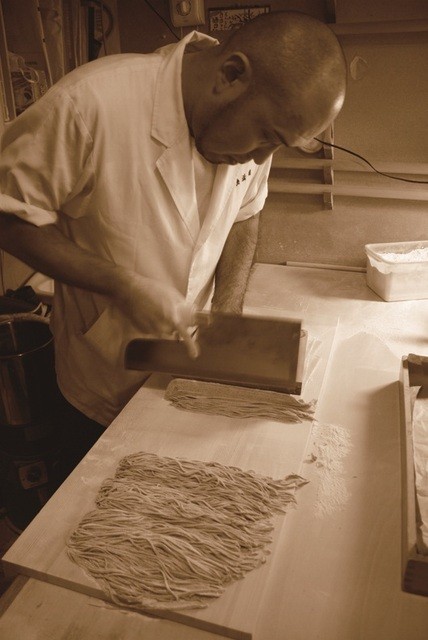
Senba Center Building is not the Osaka fantasy sold in neon postcards. It is a working commercial spine: basement corridors, station-linked movement, shopfronts built for repeat customers rather than spectacle. That setting suits soba. The form rewards precision over theatre, and Udo An sits inside the city’s quieter dining register, where buckwheat, sake, shochu, wine, and Japanese tavern structure can carry a meal without the expense or ceremony of a full kaiseki counter.
Osaka visitors often arrive primed for takoyaki, okonomiyaki, ramen, and late-night drinking. Soba asks for a different tempo. It is less about excess than proportion: noodles, dipping broth, fish-led side dishes, and drinks that make sense across a longer table. Udo An’s selection for Tabelog Soba WEST 100 in 2025 matters because soba is a crowded category across western Japan, and recognition there signals more than tourist popularity. It places the restaurant among specialist noodle rooms rather than general-purpose izakaya.
Soba value in a city that usually sells appetite first
The value proposition here is not cheapness. Osaka already has plenty of lower-cost counters, from ramen specialists such as Ramen Kuon to tonkatsu rooms like Tonkatsu KATSU Hana and quick noodle shops such as Honmachi Seimensho Honten. Udo An occupies a narrower middle ground: more composed than a grab-and-go lunch, less formal than the city’s high-end Japanese dining rooms, and useful for travellers who want a dinner built around a regional craft without committing to a long tasting-menu frame.
That distinction matters in Honmachi and Sakaisuji Honmachi, where business-district dining often splits between efficient daytime meals and after-work drinking. A soba-izakaya can bridge those modes. Lunch reads as noodle-focused and practical; evening allows the category to stretch into fish, sake, shochu, and wine. In Osaka terms, that is a strong trade: the meal keeps the discipline of a specialist shop while giving enough breadth for a proper night out.
The restaurant’s 24-seat scale also shapes the experience. Small rooms in Japan are not automatically intimate in the romantic sense; they are operationally exacting. Counter seating, compact service, and limited covers mean the kitchen’s rhythm becomes visible. For soba, that scale is especially persuasive because texture and timing are the point. The attraction is not a catalogue of dishes, but the confidence that the meal is organized around a craft that does not forgive delay or distraction.
Where Udo An fits in Osaka's specialist dining map
Osaka’s strength is range. A visitor can build a day from pork buns at 551 Horai (551蓬莱), coffee at .cafe, bread at 52CHO-ME BAKERY, and then move into more deliberate dining at a canto (Italian) or 99 Pizza Napoletana Gourmet. Udo An belongs in that same itinerary logic, not as a trophy meal but as a category correction: a reminder that Osaka’s pleasure is not only fried, sauced, and fast.
Compared with Konoha, which sits in a higher Japanese dining bracket, this is a more grounded way to engage the tradition. Compared with STAND AFRO, it is less about the casual standing-bar current and more about a seated noodle-and-drink format. Those comparisons are useful because they clarify the decision. Choose Udo An when the evening calls for craft soba with enough tavern structure to linger, not when the goal is a quick bowl, a bar crawl, or a formal Japanese meal.
For broader planning, it pairs well with a city itinerary built from Our full Osaka restaurants guide, especially if the day is anchored around the Chuo Ward business core rather than Dotonbori. Travellers using Osaka as a base can also cross-reference Our full Osaka hotels guide, Our full Osaka bars guide, Our full Osaka wineries guide, and Our full Osaka experiences guide to keep the meal in proportion with the rest of the trip.
The reader decision: specialist soba over spectacle
Udo An makes the strongest case for travellers who already understand that Japan’s noodle culture is not a single category. Ramen, udon, and soba each carry different expectations, and soba’s appeal is often quieter: grain character, cut, temperature, broth, and the pacing around drinks. The restaurant’s fish emphasis and drink list give the meal adult range without turning it into a chef-driven performance.
It is also a useful counterpoint to dining choices elsewhere in Japan. A beef-focused meal such as -Grilled beef Sukiyaki- KAMAKURA TANUKIAN 鎌倉 たぬき庵 in Kamakura, a Tokyo izakaya-grill address like. 鮪と炭火焼き うお炭 秋葉原店 in Tokyo, or a regional modern room such as.know in Kumamoto all tell different stories about Japanese casual dining. Soba in Osaka adds another: technical restraint inside a city better known internationally for appetite and noise.
For travellers mapping a wider Japan-and-beyond food circuit, the same category discipline applies when comparing (Shoku) Vietnam in Kawasaki, [Curry Senmon Ten] Maruyama Kyoju. in Sapporo, [ki:] in Kyoto, Jōdo Saké Bar in Los Angeles, and Onigiri Time in Pasadena. The question is not which place is louder on a feed. It is which format gives the clearest expression of its ingredient and occasion. On that measure, Udo An is a serious soba choice for Osaka, particularly when value is judged by focus rather than volume.
A Quick Peer Check
Comparable venues for cuisine and category context.
| Venue | Cuisine | Price | Notes |
|---|---|---|---|
| Udo AnThis venue — the venue you are viewing | Handmade Soba & Seasonal Izakaya | $$ | Not listed |
| Tanaka no Chuka Soba | Japanese Ramen | $$ | Nishi |
| Odashi to Spice Ganso Electroni Curry | Dashi-based Japanese Spice Curry | $$ | Miyakojima |
| Nomiba Umeda Umeda | Modern Japanese Lamb & Soba | $$ | Yodogawa |
| Mizuno (美津の) | Traditional Osaka Okonomiyaki | $$ | Dotonbori |
| Makino | Soba noodle shop | $$ | Osaka |
Recognition history
Dated appearances from independent guides and award organizations, with the underlying list record or original source where available.
Tabelog 100 #99 · No. 99
Tabelog · Tabelog 100 - Soba - WEST - 2025
Continue exploring
More in Osaka
Restaurants in Osaka
Browse all →




Bars in Osaka
Browse all →

Hotels in Osaka
Browse all →



Wineries in Osaka
Browse all →
At a Glance
- Cozy
- Classic
- Rustic
- After Work
- Group Dining
- Solo
- Casual Hangout
- Business Dinner
- Standalone
- Sake Program
- Beer Program
- Local Sourcing
- Sustainable Seafood
Current opening hours
- Monday
- 11:15 AM–2 PM, 5:10–10 PM
- Tuesday
- 11:15 AM–2 PM, 5:10–10 PM
- Wednesday
- 11:15 AM–2 PM, 5:10–10 PM
- Thursday
- 11:15 AM–2:10 PM, 5:10–10 PM
- Friday
- 11:15 AM–2 PM, 5:10–10 PM
- Saturday
- 11:15 AM–2 PM
- Sunday
- Closed
Hours can change for holidays and private events. Last verified .
A small, classic soba-izakaya inside Semba Center Building with counter seating and simple, cozy interiors; atmosphere is relaxed but lively at peak times, with a focus on craftsmanship rather than design flash.