The Prime Rib
The Prime Rib is Baltimore's enduring benchmark for the American steakhouse ritual, operating from a clubby Mount Vernon address where white tablecloths, tuxedoed servers, and a jazz piano soundtrack have defined the format for decades. The room codes immediately as old-school East Coast formality, and the kitchen anchors that expectation with aged prime beef and classic tableside service. For Baltimore's broader dining scene, see our full city guide.
Pearl is the En Primeur Club membership app — saves, bookings, and concierge access live there. Same editors, same standards.
- Address
- 1101 N Calvert St, Baltimore, MD 21202
- Phone
- +14105391804
- Website
- theprimeribs.com
- Directions
- Get directions
 Saves & bookings on Pearl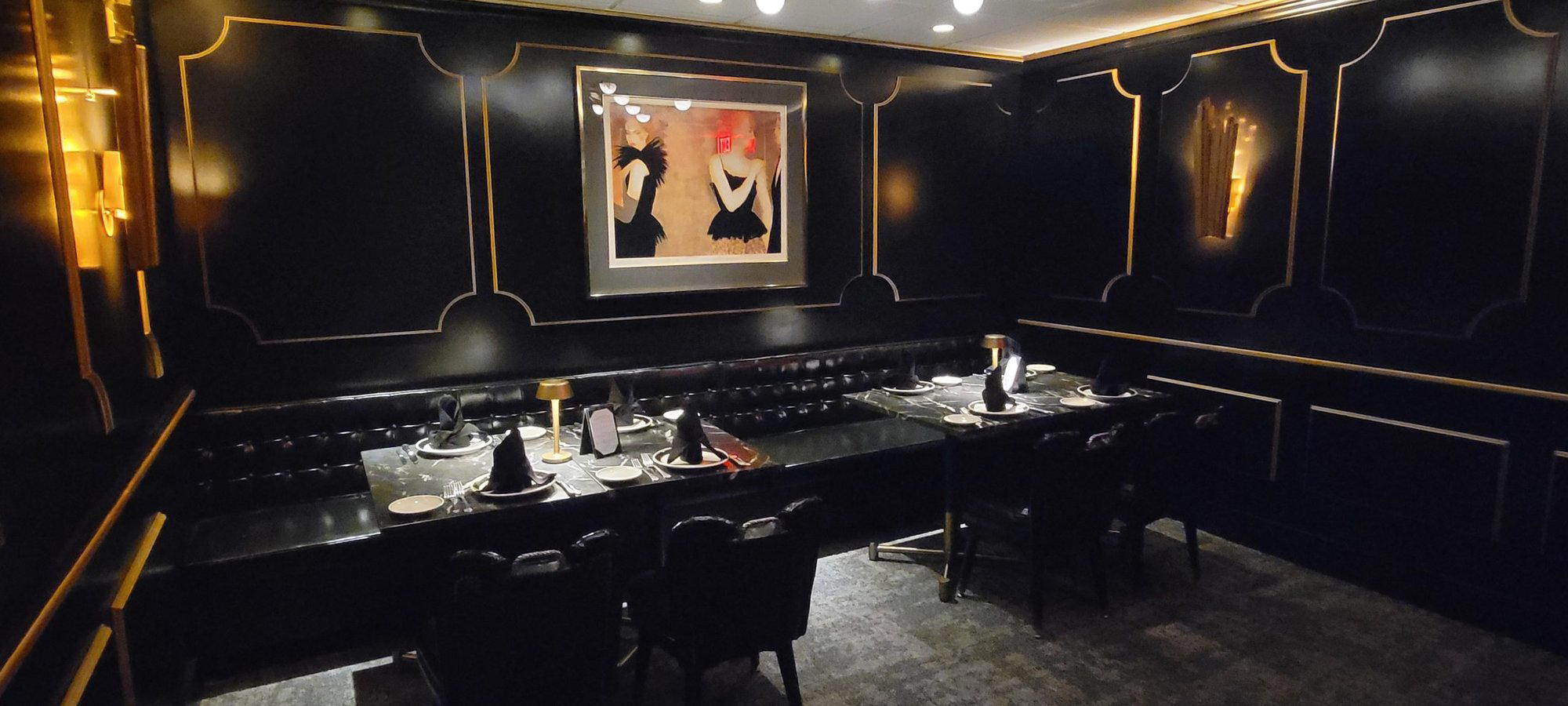
The Dining Room as Time Capsule
Baltimore's Mount Vernon district carries the weight of the city's old-money civic identity, and The Prime Rib, at 1101 N Calvert Street, sits at the center of that tradition in a way few restaurants elsewhere on the Eastern Seaboard manage. The room reads before you order: black walls, leopard-print carpet, a pianist working through the American songbook, servers in tuxedos moving with the unhurried confidence that only comes from institutional routine. This is not a room that has been styled to evoke a past era. It is that era, largely intact.
For a certain kind of American dining tradition — the kind that predates open kitchens, tasting menus, and chef-as-auteur positioning — the steakhouse carried the weight of occasion. A booking here was a social statement as much as a meal. That cultural grammar has thinned considerably at most addresses, but Mount Vernon's geography, with its brownstones and concert halls, still supports it. The Prime Rib benefits from neighbourhood context in a way that a comparable room dropped into a hotel corridor or waterfront development simply would not.
The Structure of the Meal
The American prime rib format is a study in deliberate pacing. The ritual moves through a defined sequence: cocktails, a breadbasket with the weight of habit behind it, a starter course typically anchored by shellfish or a wedge salad, and then the main event: beef, aged and slow-roasted, sliced tableside or plated to order. At its finest, this structure enforces a rhythm that tasting-menu restaurants have to engineer artificially. Here it arrives organically, because the format has been rehearsed long enough to become reflex.
Tableside service, which has been largely retired at most American restaurants in favour of kitchen-plated presentations, survives at old-school steakhouses as both practical tradition and theatre. The carving cart, the ladle of au jus, the creamed horseradish in a ramekin: these gestures slow a meal down in a way that attentive guests tend to appreciate more than they expect. That pacing is the point. This is not a format built for speed. Two hours at the table is neither unusual nor rushed.
The dress code, formal by contemporary Baltimore standards, reinforces the ceremony. Jackets are expected for men in the evening, which functions as a social signal that this room is operating under different rules than the city's more casual dining tier. Compared to the range of options across the Baltimore scene, from the ingredient-led approach at Cindy Wolf's Charleston to the neighbourhood energy of Angeli's Pizzeria or the Turkish-focused menu at dede, The Prime Rib occupies a tier defined less by cuisine category and more by the formality of its dining contract with the guest.
Placing It in the American Steakhouse Tradition
The American prime rib house belongs to a specific lineage that split from the broader steakhouse category mid-twentieth century. Where the New York steakhouse tradition (Luger, Keens, Christ Cella) ran on dry-aged strip and porterhouse served on sizzle platters with minimal ceremony, the prime rib house built its identity around the standing rib roast: a larger, more theatrical cut that demanded carving at tableside and generated a room dynamic organized around presentation rather than pure beef tonnage.
Baltimore's version has run long enough to be the reference point rather than the tribute act. That longevity places it in the same cultural bracket as a handful of American dining institutions, not the modernist ambition of Alinea in Chicago or the farm-anchored tasting format of Blue Hill at Stone Barns in Tarrytown, but closer in spirit to the enduring service formalism of Le Bernardin in New York City or the regional institution weight of The Inn at Little Washington. The comparison isn't about cuisine category, it's about what it means for a dining room to have genuine tenure.
Against out-of-town peers like Emeril's in New Orleans, Providence in Los Angeles, or Lazy Bear in San Francisco, The Prime Rib represents a different axis entirely, not cuisine evolution or tasting-menu architecture, but the durability of a format that never needed to modernise because its audience never stopped showing up. Similarly, Single Thread Farm in Healdsburg, The French Laundry in Napa, Addison in San Diego, and Atomix in New York City each represent the contemporary fine dining pole, the Prime Rib's staying power reads as its own form of credential against that backdrop.
The Baltimore Context
Baltimore has a dining scene that tends to get underread by national critics, partly because its strongest venues operate without the press infrastructure of New York or Chicago, and partly because its culinary identity is genuinely split. The crab house tradition (steamed blue crabs, newspaper-covered tables, mallets) anchors one end. At the other, a tier of serious restaurants has developed quietly, Charleston has sustained one of the Mid-Atlantic's more consistent fine dining programs, while addresses like 16 On The Park and Akbar represent the breadth of the city's mid-tier. For a full orientation, see our full Baltimore restaurants guide.
The Prime Rib sits between those poles without belonging to either. It is not a crab house and it is not a tasting-menu destination. It is a formal occasion restaurant that happens to have survived the period in which most of its format peers either modernised into irrelevance or closed. That survival record is itself data. If the room had stopped matching guest expectations at any point across several decades of Baltimore dining, the formula would have been adjusted or abandoned. The fact that it has not tells you something about the consistency of execution.
Internationally-minded readers who have dined at addresses like 8 1/2 Otto e Mezzo Bombana in Hong Kong will recognise the underlying dynamic: formal room, practiced service, a menu organised around reliable anchors rather than seasonal reinvention. The specific content differs, but the contract with the guest is structurally similar.
Know Before You Go
| Address | 1101 N Calvert St, Baltimore, MD 21202 |
|---|---|
| Neighbourhood | Mount Vernon |
| Format | Classic American prime rib house; full à la carte |
| Dress Code | Jacket expected for men in the evening; the room is formal by Baltimore standards |
| Booking | Reservations recommended, particularly on weekends and for large parties |
| Context | Long-running Baltimore institution; peer tier to East Coast formal dining addresses rather than contemporary fine dining |
How The Prime Rib Baltimore compares with similar nearby venues.
| Venue | Cuisine |
|---|---|
| Magdalena | Alpine-Vegetarian |
Continue exploring
More in Baltimore
Restaurants in Baltimore
Browse all →
Bars in Baltimore
Browse all →
At a Glance
- Classic
- Elegant
- Sophisticated
- Well Known
- Date Night
- Business Dinner
- Special Occasion
- Live Music
- Historic Building
- Private Dining
- Extensive Wine List
Current opening hours
- Monday
- Closed
- Tuesday
- 5–9 PM
- Wednesday
- 5–9 PM
- Thursday
- 5–9 PM
- Friday
- 5–9 PM
- Saturday
- 5–9 PM
- Sunday
- 5–9 PM
Hours can change for holidays and private events. Last verified .
Dark, elegant setting with lower lighting, black lacquered walls, leopard-print carpet, comfortable leather seating, and live music evoking 1940s sophistication.
Know Before You Go
- Getting there
- 1101 N Calvert St, Baltimore, MD 21202