The Marshall Store
Our verdict
A weathered roadside oyster shack on the edge of Tomales Bay, The Marshall Store is where Marin County's shellfish tradition meets the cold, clean waters that make it possible. Drive up Highway 1, order from the window, and eat on the dock while watching the bay pull past. This is sourcing-as-setting: the oysters come from farms visible from your seat.

Pearl is the En Primeur Club membership app — saves, bookings, and concierge access live there. Same editors, same standards.
- Address
- 19225 CA-1, Marshall, CA 94940
- Phone
- (415) 246-9306
- Hours
- Mon 11 AM–3 PMTue–Wed ClosedThu–Fri 11 AM–3 PMSat–Sun 11 AM–4 PM
- Website
- themarshallstore.com
- Directions
- Get directions
- Booking
- Book on the venue's website
The menu
What to order
- Raw Oysters
- Smoked Tri-Tip Sandwich
- Grilled Rock Cod
- Dungeness Crab
- New England Clam Chowder
Where the Source Is the View
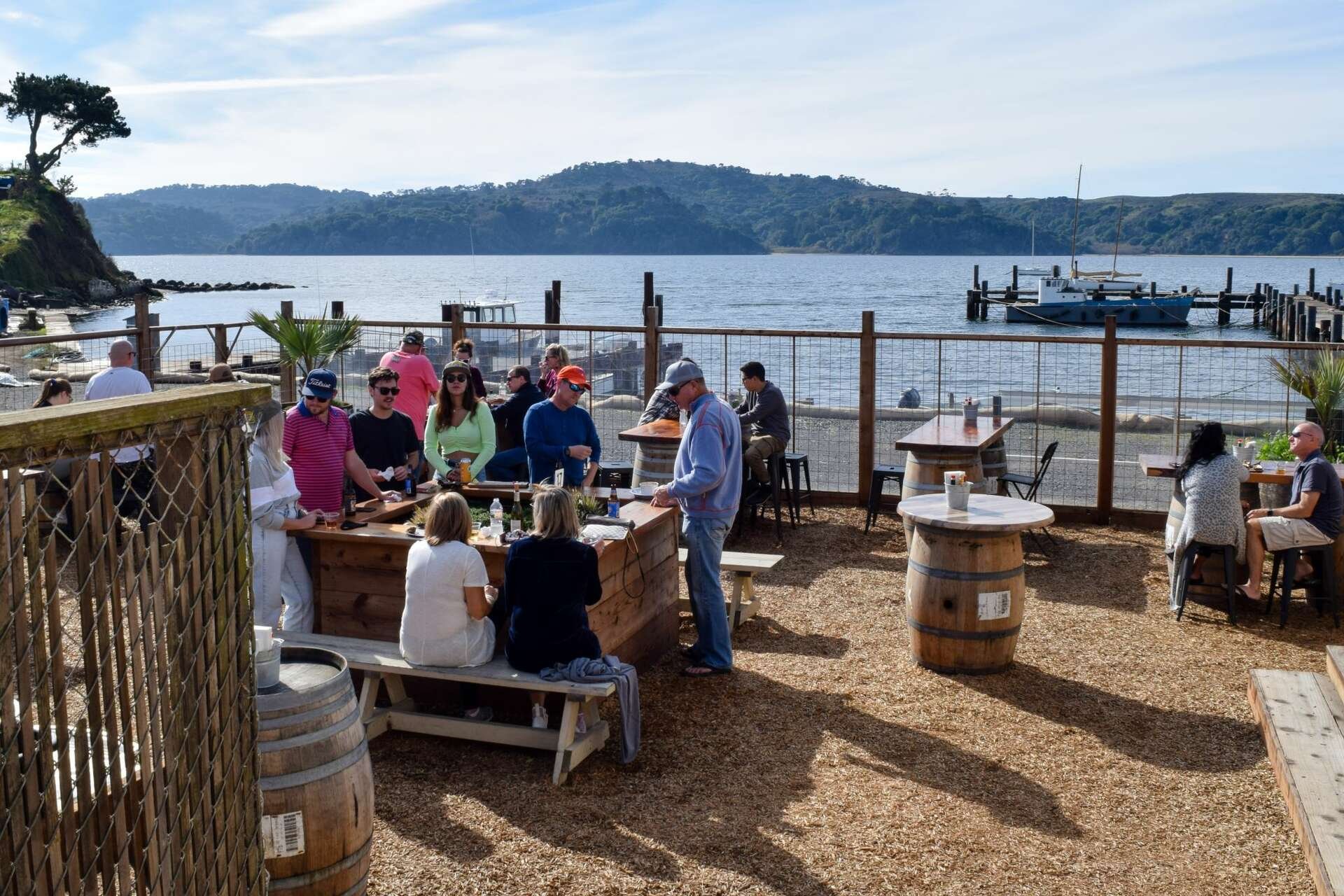
Highway 1 north of Point Reyes runs through some of the most deliberately slow country in California. The road narrows, the hills press closer, and by the time Tomales Bay comes into view, the instinct to stop somewhere and eat something pulled from that water becomes difficult to resist. The Marshall Store answers that instinct with unusual directness: it sits at the bay's edge at 19225 CA-1, and the oyster farms it draws from are visible across the water from the spot where you sit and eat. Few dining experiences in the American West compress the distance between harvest and plate so legibly.
Tomales Bay occupies a particular position in California's shellfish geography. The bay is fed by cold Pacific water through a narrow channel, and its relative isolation from agricultural runoff has made it one of the state's most consistently productive oyster-growing environments. The farms operating here, including those associated with the Marshall area, raise primarily Pacific oysters alongside smaller quantities of Kumamoto and European flat varieties. The cool water and strong tidal exchange produce oysters with pronounced salinity and a clean, mineral finish that distinguish them from the warmer-water product grown further south. For anyone interested in where American oyster culture concentrates its quality, Tomales Bay sits near the best of that short list.
The Format, Stripped Down
The Marshall Store operates in the format that has become almost canonical for serious roadside shellfish on the California coast: order at a window, collect your tray, find a seat on the dock or at an outdoor table, and deal with the wind off the bay. There is no theatre in the service model, and none is needed. The setting does the work that a dining room would otherwise attempt through design. On a clear afternoon, the light on the bay, the working boats, and the visible geometry of the oyster beds create a context that no interior could replicate.
This is the format's defining tension: it is both completely casual and completely serious about what it is selling. The same dynamic appears at a handful of comparable waterfront shellfish operations along the Pacific coast, where the informality of the experience is part of the quality signal rather than a compromise of it. At places like Blue Hill at Stone Barns in Tarrytown or Single Thread Farm in Healdsburg, the sourcing narrative is built into a formal tasting structure. At The Marshall Store, the sourcing narrative is simply the view.
Ingredient Sourcing as the Whole Point
The broader movement toward provenance-driven dining has produced a wide spectrum of expressions. At the formal end, restaurants like The French Laundry in Napa or Smyth in Chicago build multi-course tasting menus around hyperlocal sourcing, with written narratives for each component. At Lazy Bear in San Francisco, provenance is woven into a communal, technique-forward format. At Le Bernardin in New York City, the sourcing rigor is expressed through classical precision. The Marshall Store operates at the opposite end of that formality spectrum, where the product is so close to its source that documentation feels redundant.
That proximity matters in a way that goes beyond marketing. Oysters are filter feeders, and their flavor is a direct record of the water they grew in. The mineral content of Tomales Bay, its temperature, its salinity, and the particular phytoplankton composition of its water all transfer directly into the shell. Eating oysters here is not a metaphor for terroir; it is terroir in the most literal sense. The same argument, applied to wine, built the reputation of places like Frasca Food and Wine in Boulder that center their lists on place-specific viticulture. Applied to shellfish on a California bay, it produces a version of that argument that requires no sommelier to explain.
The sourcing model also positions The Marshall Store within a growing subset of American dining that treats ingredient access as the primary luxury. Across the country, venues from Providence in Los Angeles to Addison in San Diego compete partly on the quality and exclusivity of their ingredient relationships. The Marshall Store's version of that competition is geographic: you cannot get Tomales Bay oysters this fresh anywhere that is not on Tomales Bay.
Marin County's Broader Food Context
Marin County has developed a food identity that runs parallel to, but distinct from, San Francisco's. Where the city concentrates technique and restaurant density, Marin concentrates production. Point Reyes Farmstead Cheese, the Straus Family Creamery, and the oyster operations of Tomales Bay represent a food-production geography that has been intentionally preserved through the Point Reyes National Seashore and related land protections. The result is a county where the agricultural base that most American regions lost in the twentieth century remains largely intact, and where the connection between land, water, and table is closer than almost anywhere else in the Bay Area.
The Marshall Store sits inside that context, not as an exception but as one of its clearest expressions. Visitors coming from San Francisco, roughly an hour south depending on traffic on the 101 corridor, often pair a stop here with visits to the broader West Marin food corridor: the cheese caves at Point Reyes, the farmland around Nicasio, and the coastal access points that define the area's character. For anyone building a day around Marin County's food production, the bay-side shellfish stop at Marshall functions as both a destination and a logical endpoint. See our full Marin County restaurants guide for broader itinerary context.
Comparable sourcing-led experiences elsewhere in the country, from Oyster Oyster in Washington, D.C. to Bacchanalia in Atlanta, build their menus around the same sourcing philosophy but within conventional restaurant structures. The Marshall Store's distinction is that it collapses the structure entirely. The kitchen, the farm, and the table exist within visual range of each other, which is a condition that even the most sourcing-rigorous restaurants, including The Inn at Little Washington, Emeril's in New Orleans, Atomix in New York City, ITAMAE in Miami, and The Wolf's Tailor in Denver, can gesture toward but cannot reproduce. Even Atelier Moessmer Norbert Niederkofler in Brunico, which anchors its entire ethos to Alpine regional sourcing, operates within the formal restaurant mode that Marshall explicitly sidesteps.
Planning Your Visit
The drive from San Francisco takes approximately 60 to 75 minutes via the 101 north to Point Reyes-Petaluma Road, or through Sausalito and Fairfax for a more scenic approach along Sir Francis Drake Boulevard. The outdoor format means weather is a real factor: Tomales Bay runs cold and foggy from June through August, while September through November tends toward clearer skies and calmer winds, making it the more reliable window for comfortable outdoor eating. Weekends draw visitors from across the Bay Area, and the limited seating at the dock fills quickly on clear days, so arriving before midday gives you the leading read on availability. The Marshall Store does not take reservations in the conventional sense, and the experience is oriented around the dock-side, order-at-the-window model, which makes it an accessible stop for groups with children, provided the adults set appropriate expectations around seating and weather exposure.
Frequently asked questions
Is The Marshall Store suitable for children?
The format works well for families with older children who are comfortable with an outdoor, order-at-the-window setup. Located at 19225 CA-1, the experience is informal and self-directed, with no table service or fixed seating protocol. Younger children may find the setting straightforward, though the focus is almost exclusively on shellfish, so picky eaters should plan accordingly.
Is The Marshall Store better for a quiet night or a lively one?
The Marshall Store is a daytime and early-evening destination, not a late-night one. Highway 1 through Marshall moves at its own pace, and the roadside format encourages lingering over the water rather than a charged social atmosphere. On weekends, the crowd reflects the Bay Area day-trip circuit, which adds energy without tipping into noise.
How far is The Marshall Store from San Francisco, and is it worth the drive?
The Marshall Store sits at 19225 CA-1 in Marshall, roughly 60 to 75 minutes from San Francisco depending on your route through Marin County. The drive via Point Reyes-Petaluma Road or through Fairfax passes through West Marin's agricultural corridor, which is part of the context for the meal rather than just transit time. For anyone following California's provenance-driven food movement, the location is the argument.
What dish is The Marshall Store famous for?
Oysters pulled directly from Tomales Bay are the reason most people make the drive out to Marshall on CA-1. The bay's cold, nutrient-rich waters produce shellfish with a salinity and flavor profile that differ noticeably from farmed oysters sold further inland. The format — order at a window, eat at the rail above the water — keeps the focus entirely on the product.
Comparable Spots, Quickly
| Venue | Cuisine | Price | Awards | Notes |
|---|---|---|---|---|
| The Marshall StoreThis venue — the venue you are viewing | Oyster Bar & Smokehouse | $20–30 | Not listed | Not listed |
| Le Bernardin | French Seafood Fine Dining | $300–500 | 3 Michelin Stars · World's 50 Best #13 | French, Seafood |
| Lazy Bear | Modern American Tasting Menu | Not listed | 2 Michelin Stars · World's 50 Best #25 | Progressive American, Contemporary |
| Atomix | Modern Korean Tasting Menu | $300–500 | 2 Michelin Stars · World's 50 Best #7 | Modern Korean, Korean |
| Per Se | French Fine Dining Tasting Menu | $300–500 | 3 Michelin Stars · World's 50 Best #40 | French, Contemporary |
| Masa | Traditional Japanese Omakase | $500+ | 2 Michelin Stars · World's 50 Best #27 | Sushi, Japanese |
Continue exploring
More in Marshall
Restaurants in Marshall
Browse all →
Bars in Marshall
Browse all →

Hotels in Marshall
Browse all →







Details
- Rustic
- Scenic
- Casual
- Casual Hangout
- Brunch
- Waterfront
- Standalone
- Beer Program
- Farm To Table
- Local Sourcing
- Sustainable Seafood
- Waterfront
- A La Carte
- Counter Dining
- Beer
- Wine
- Gluten Free Options
- Vegetarian Friendly
- Pescatarian Friendly
Current opening hours
- Monday
- 11 AM–3 PM
- Tuesday
- Closed
- Wednesday
- Closed
- Thursday
- 11 AM–3 PM
- Friday
- 11 AM–3 PM
- Saturday
- 11 AM–4 PM
- Sunday
- 11 AM–4 PM
Hours can change for holidays and private events. Last verified .
Casual, tranquil waterfront atmosphere with a charming, weather-beaten aesthetic; humble counter-service setup with views of Tomales Bay creating a relaxed, authentic coastal experience.