The Burger's Priest on Queen Street East is one of Toronto's most discussed counter-service burger spots, operating in the tradition of small-format smash-and-grind burger joints that prize consistency over theatre. With a cult following built on a focused menu and no-frills format, it occupies a distinct tier in the city's casual dining scene, serious about the product, indifferent to the trappings.
Pearl is the En Primeur Club membership app — saves, bookings, and concierge access live there. Same editors, same standards.
- Address
- 1922 Queen St E, Toronto, ON M4L 1H5, Canada
- Phone
- +1 647 805 9768
- Website
- theburgerspriest.com
- Directions
- Get directions
 Saves & bookings on Pearl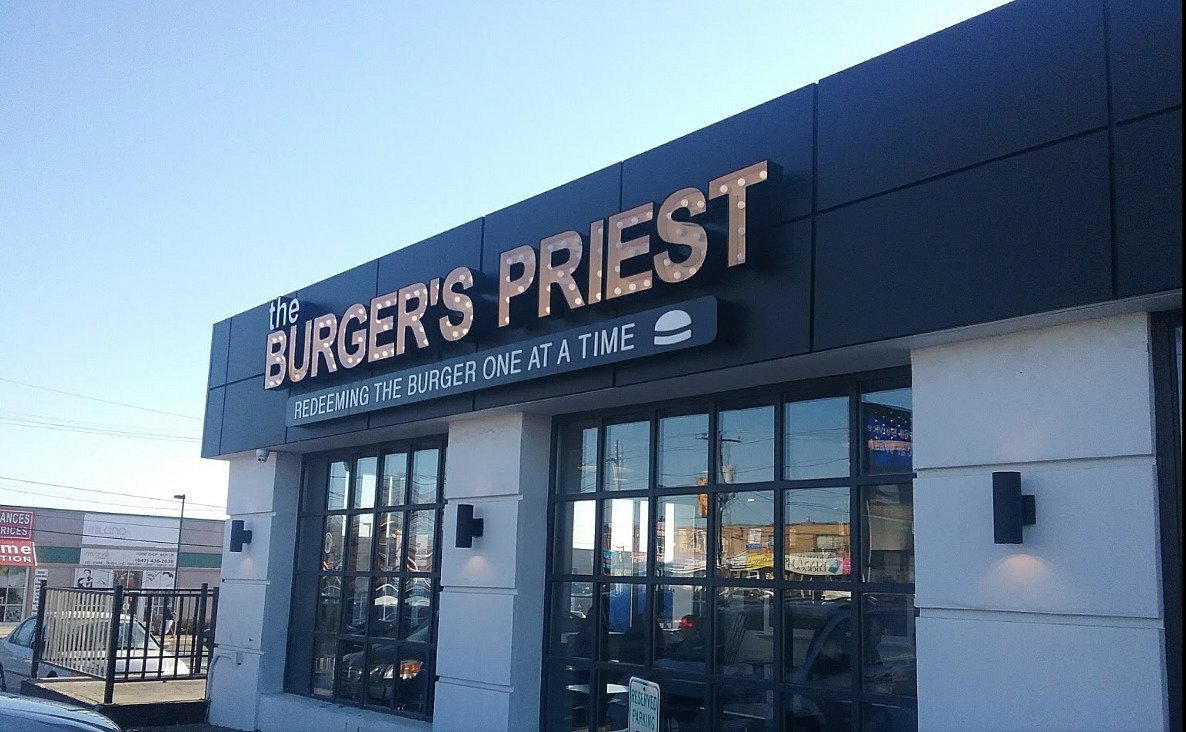
Toronto's Casual Counter and the Burger as Craft Object
Toronto's casual dining scene has long included fast-casual chains that offer customisation at scale, and smaller, format-disciplined spots where a tightly controlled menu signals intent more clearly than any design budget could. The Burger's Priest, operating from its Queen Street East address in the Beaches neighbourhood, belongs firmly to the second camp. The format, counter service, short menu, and walk-in policy place it in a peer group that values repetition and calibration over novelty.
That approach has built a following that looks less like a restaurant fan base and more like a constituency. In Toronto, where the conversation about serious food tends to gravitate toward tasting menus at Alo or omakase counters like Sushi Masaki Saito, the Burger's Priest occupies a different register entirely. Its credibility comes from operational fidelity, showing up, doing the same thing, doing it well.
What the Format Says About the Food
Counter-service burger spots succeed or fail on consistency. The absence of tableside service removes the buffer that full-service restaurants rely on; there is nowhere to hide a substandard product behind a skilled front-of-house team. In that sense, the format is the editorial angle. Every element of execution, grind, cook temperature, bun choice, condiment balance, is exposed without ceremony.
This is the same discipline that defines the better end of the American smash-burger tradition, a category that has been revisited seriously in cities from New York to Los Angeles over the past fifteen years. In Canada, that tradition found a particular footing in Toronto, where the Queen Street East corridor has long supported a mix of neighbourhood restaurants, cafes, and counter spots that serve a local population with specific expectations about value and quality. The Burger's Priest has been part of that corridor long enough to function as a fixture.
The contrast with the city's formal dining tier is worth mapping. At Aburi Hana or Don Alfonso 1890, the collaboration between chef, sommelier, and front-of-house is the visible architecture of the experience. At a counter-service burger spot, that collaborative dynamic compresses into a smaller cast: the kitchen line and the person taking your order. The operational coherence still matters; it just presents differently. A well-run counter is a kind of tight ensemble performance, even if the audience rarely registers it as such.
The Beaches and Its Place in Toronto's Dining Geography
Queen Street East, east of Woodbine, runs through one of Toronto's most distinct residential neighbourhoods. The Beaches draws a clientele that is largely local and loyal, which shapes the kind of restaurant that survives there. High-concept openings with financial models dependent on destination traffic tend to struggle; format-disciplined neighbourhood spots with repeat custom tend to last. The restaurant fits that template precisely.
Toronto's dining geography rewards understanding the east-west axis. The downtown core and King West attract the tasting-menu crowd and the expense-account dinner; the east end, particularly around the Beaches and Leslieville, has historically supported a different register, casual, specific, neighbourhood-first. The restaurant sits on that axis and draws accordingly. It is not positioned against DaNico or the city's other formal dining addresses. It is positioned against nothing in particular, which is itself a position.
Where It Sits in the Broader Canadian Casual Scene
Across Canada, the serious-casual dining category has diversified significantly. In Quebec City, Tanière³ represents the fine-dining end of local-produce commitment. In rural Ontario, Eigensinn Farm operates at the opposite extreme of accessibility. Between those poles sits a wide range of formats, and the counter-service burger spot occupies a democratic tier that Canadian cities have consistently supported. Busters Barbeque in Kenora and Cafe Brio in Victoria reflect the same appetite for format-specific, product-focused dining that does not require a tasting menu to be taken seriously.
The restaurant is part of that lineage in Toronto specifically. It belongs to a generation of spots that made a credibility argument through product focus rather than concept, and that argument has held up in a city that tends to be hard on places that overpromise.
Planning Your Visit
The Queen Street East location operates as a counter-service spot, with walk-in access at peak times. Weekend lunch and early evening are particularly pressured windows; arriving outside those windows reduces wait time. The format is walk-in only, which makes it accessible in a way that the city's tasting-menu tier, with booking windows of weeks or months, is not.
How It Compares to Nearby Dining Formats
| Venue | Format | Price Tier | Booking Required |
|---|---|---|---|
| The restaurant | Counter service | $ | No |
| Alo | Tasting menu | $$$$ | Yes (weeks ahead) |
| Sushi Masaki Saito | Omakase counter | $$$$ | Yes (months ahead) |
| Aburi Hana | Kaiseki | $$$$ | Yes |
If the casual-first approach of the restaurant reflects a broader dining preference, the same logic applies in cities like San Francisco, where Lazy Bear sits at the opposite end of the formality axis, or in Vancouver, where AnnaLena occupies the serious-casual register at a higher price point.
Elsewhere in Canada, Restaurant Pearl Morissette in Lincoln and The Pine in Creemore represent the rural Ontario fine-dining model, while Fogo Island Inn Dining Room and Narval in Rimouski anchor the Atlantic and Quebec ends of the country's serious dining circuit. In Montreal, Jérôme Ferrer's Europea occupies the formal end of the city's Franco-continental tradition. The restaurant does not compete with any of them, which is precisely what makes it legible as a category of its own.
Pricing, Compared
Comparable venues nearby, for context on price, style, and recognition.
| Venue | Cuisine | Price | Notes |
|---|---|---|---|
| The Burger's PriestThis venue — the venue you are viewing | The Beaches, Smashburgers | $$ | Not listed |
| The Ballroom Bowl | Rosedale, American Bowling Pub | $$ | Not listed |
| George's Deli & B B Q | Not listed | $$ | Harbord Village, BBQ & Rotisserie Chicken Deli |
| Mildred's Temple Kitchen | Not listed | $$ | Liberty Village, American Brunch Classics |
| The Craft Brasserie & Grille | Not listed | $$ | Liberty Village, American Brasserie & Brew Pub |
| Sap | Downtown Yonge, Canadian Comfort Food | $$ | Not listed |
Continue exploring
More in Toronto
Restaurants in Toronto
Browse all →
Bars in Toronto
Browse all →
Hotels in Toronto
Browse all →

At a Glance
- Trendy
- Lively
- Energetic
- Casual Hangout
- Late Night
- Beer Program
Current opening hours
- Monday
- 11 AM–12 AM
- Tuesday
- 11 AM–12 AM
- Wednesday
- 11 AM–12 AM
- Thursday
- 11 AM–12 AM
- Friday
- 11 AM–12 AM
- Saturday
- 11 AM–12 AM
- Sunday
- 11 AM–12 AM
Hours can change for holidays and private events. Last verified .
Casual fast-food atmosphere with a modern twist on classic burger joint vibes, often busy and energetic.