
Tabelog 100 #37
Our verdict
Synergy compresses Osaka’s curry culture into a small Dojima room shaped by counter seating, weekday lunch rhythm, and repeat Tabelog Curry 100 recognition. The appeal is not luxury theatre; it is the precision of a nine-seat curry specialist operating inside Kitashinchi’s denser, more expensive dining grid.

Pearl is the En Primeur Club membership app, where members save venues, book tables and use the concierge.
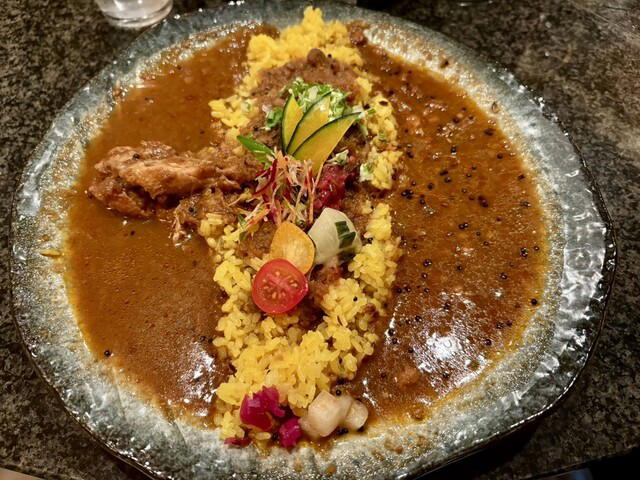
Osaka’s dining rooms often announce themselves softly: an elevator, a corridor, a door that gives little away until the room’s focus becomes the point. In Osaka, where polished counters and after-dark dining often dominate the local map, Synergy works in a different register. The appeal is not built on spectacle, but on concentration: a curry venue whose category asks diners to pay attention to pace, texture, aroma, and the directness of the plate. That restraint shapes the experience before the first order is placed, putting curry into the same closely observed frame Osaka often reserves for counters, skewers, and bar drinking.
Osaka curry is too often treated as a casual detour between larger meals, but the city’s serious curry venues have built a parallel culture around focused menus and strong repeat followings. Synergy belongs to that line. Its selection for Tabelog’s curry recognition in 2024 gives it a different kind of authority from Michelin-style formality: this is recognition inside a category where local demand, consistency, and category devotion matter more than linen, stemware, or ceremony.
A curry address inside Osaka's dining landscape
The category contrast is the useful lens. Osaka’s better-known dining pattern often skews toward evening restaurants with higher checks, private entertaining, and chef-facing counters. In the same broader city orbit, comparison venues such as Dojima Samboa, Kitashinchi Kushikatsu Bon, Yakitori Ichimatsu, Kitashinchi Yamagata Ya, and Tori Yaki Saji point to familiar rhythms: bars, skewers, poultry counters, and serious dinner budgets. Synergy changes the equation by placing curry, a dish category with democratic roots in Japan, inside a focused listing where category identity and everyday appeal define the experience.
That format matters because curry venues are not neutral containers. A broad menu can become anonymous quickly; a category-led venue forces attention onto the plate and the logic of the meal. The emphasis falls on curry rather than ceremony, but this is still a precision-led way to read a restaurant. Solo dining is not a consolation prize in this kind of Osaka itinerary. It is one of the formats that makes sense, especially in a city where quick, focused meals have their own social grammar.
There is also a useful class tension in the setting. Osaka is associated with every level of eating, from casual staples to polished counters and after-work spending, yet curry venues in Japan often succeed through concentration rather than display. Synergy sits between those worlds: category-specific and recognized by a national restaurant platform’s curry list, but not dressed as grand dining. That is the interesting part. The restraint around the listing gives the category room to carry the weight.
Why curry recognition in Osaka means something different from fine-dining awards
Tabelog’s curry lists function differently from star systems. They reward category devotion and local consensus across a field where shops may be informal and resistant to standard luxury cues. For travelers used to building Osaka itineraries around sushi counters, kappo rooms, or yakiniku, the signal is worth reading carefully: a curry selection does not promise a long-form tasting menu, but it does identify a place operating above generic comfort food within its own category.
Synergy’s 2024 curry recognition also places it within western Japan’s broader curry conversation. Osaka has long absorbed influences from trade, spice retail, kissaten food culture, and the postwar rise of Japanese curry rice. The contemporary specialist scene has moved beyond the simple binary of Japanese-style curry versus South Asian curry. Many venues now occupy a hybrid zone where spice layering, rice, sauce texture, and portion logic are calibrated for local habits rather than imported restaurant templates. Without needing chef mythology, that broader shift explains why an Osaka curry address can carry editorial weight.
The listed price tier reinforces the point without turning the meal into a bargain hunt: Synergy is recorded at - JPY 999, with lunch budget information in the same range. Osaka has plenty of inexpensive curry; recognition here is not about low cost alone. It is about a category venue holding attention in a city full of higher-ticket alternatives. That makes the venue useful for a traveler who wants one Osaka meal that is not built around expense-account theatre.
For a wider read on the city’s dining range, Our full Osaka restaurants guide sets curry beside sushi, kushiage, udon, yakiniku, and contemporary counter restaurants. The same planning lens applies beyond restaurants: Our full Osaka hotels guide, Our full Osaka bars guide, Our full Osaka wineries guide, and Our full Osaka experiences guide help frame Synergy against the city’s broader dining, drinking, and travel map.
How to read Synergy against Osaka's casual-specialist scene
The more revealing comparison is not only with luxury counters, but with Osaka’s everyday specialists. The city is unusually good at narrow formats: bakeries, pork buns, pizza counters, kissaten, standing bars, and curry venues can all command serious loyalty when they do one thing with discipline. In that sense, Synergy belongs in a wider Osaka category: not similar in cuisine to every other specialist, but related in the way the city rewards format clarity, repetition, and a clear reason to return.
That same specialist logic travels across Japan and beyond. Curry obsessives comparing regional approaches can look at other cities generically, while Japan-focused diners tracking focused venues will recognize the same pattern in many places: limited scope, high repetition, close attention, and a menu that benefits from not trying to do too much. For readers mapping Japanese casual precision abroad, the broader lesson is similar. Tight formats translate when the idea is strong enough, even when removed from the original city context.
The editorial read is simple: Synergy is compelling because the venue refuses excess. Its curry focus, Osaka setting, accessible listed price, Tabelog score of 3.71, and 2024 curry recognition all point in the same direction. This is Osaka specificity in miniature, a serious curry address hiding none of its discipline behind luxury language.
Frequently asked questions
When can I go to Synergy?
Public guide data for Synergy confirms its Osaka location and curry recognition, but current opening hours should be checked through the venue’s official channels before visiting.
Where is Synergy in Osaka?
Osaka.
What's the pricing like at Synergy?
Pricing at Synergy is listed as - JPY 999.
What's the standout thing about Synergy?
Its clearest credential is Tabelog curry recognition for 2024, alongside a listed Tabelog score of 3.71. The venue is an Osaka curry venue rather than a grand fine-dining room.
Can Synergy accommodate dietary restrictions?
The public record provided here does not list dietary policies, so requests such as vegetarian, vegan, or allergy handling should be checked in advance. Check the venue's official channels for the latest details.
Is Synergy okay with children?
No child policy is listed in the public record provided here. Because Synergy is presented as a focused Osaka curry venue, families should check the venue's official channels for the latest details before visiting.
Comparable Spots
Comparable options at the same price tier.
| Venue | Cuisine | Price | Awards | Notes |
|---|---|---|---|---|
| SynergyThis venue (the venue you are viewing) | Japanese Curry | $10–20 | Tabelog 100 #37 | Not listed |
| Dojima Samboa | Classic Japanese cocktail bar | $20–30 | Tabelog 100 #77 | JPY 3,000 - JPY 3,999 View spending breakdown |
| Kitashinchi Kushikatsu Bon | Michelin Kushikatsu Omakase | $150–200 | Michelin Plate | Kushiage |
| Yakitori Ichimatsu | Michelin-starred Yakitori Chicken Kaiseki | $100–150 | 1 Michelin Star · Tabelog 100 #89 | JPY 15,000 - JPY 19,999 JPY 15,000 - JPY 19,999 |
| Kitashinchi Yamagata Ya | Japanese Yakiniku | $150–200 | Tabelog 100 #71 | JPY 20,000 - JPY 29,999 |
| Tori Yaki Saji | Yakitori & Chicken Grill | $50–100 | Tabelog 100 #68 | JPY 10,000 - JPY 14,999 View spending breakdown |
Recognition history
Dated appearances from independent guides and award organizations, with the underlying list record or original source where available.
Tabelog 100 #37 · No. 37
Tabelog · Tabelog 100 - Curry - WEST - 2024
Continue exploring
More in Osaka
Restaurants in Osaka
All restaurants in Osaka →




Bars in Osaka
All bars in Osaka →



Hotels in Osaka
All hotels in Osaka →




Wineries in Osaka
Browse all →
Details
- Cozy
- Modern
- Casual Hangout
- Solo
- Group Dining
- Standalone
- A La Carte
Current opening hours
- Monday
- 11:30 AM–2 PM
- Tuesday
- 11:30 AM–2 PM
- Wednesday
- 11:30 AM–2 PM
- Thursday
- 11:30 AM–2 PM
- Friday
- 11:30 AM–2 PM
- Saturday
- Closed
- Sunday
- Closed
Hours can change for holidays and private events. Hours as of .