Sushi Yoshitake
The Manhattan outpost of Tokyo's three-Michelin-starred Sushi Yoshitake brings the Ginza omakase tradition to New York City's upper tier of Japanese dining. Counter seating, a sequenced nigiri-forward menu, and the weight of its Tokyo pedigree place it inside a small comparable set that includes Masa. Advance reservations are essential.
 Discover on Pearl
Pearl is the En Primeur Club membership app — saves, bookings, and concierge access live there. Same editors, same standards.
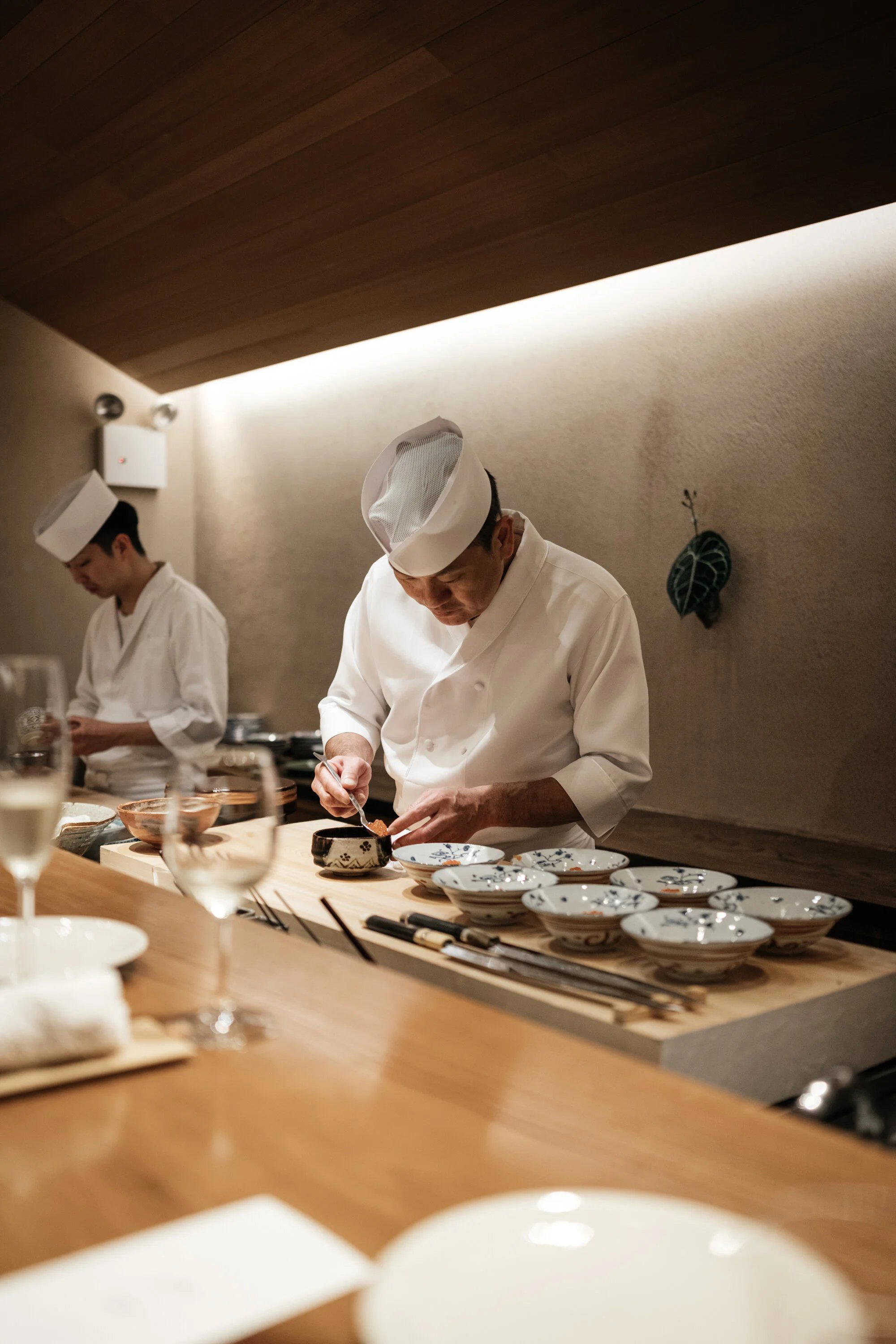
The Omakase Counter as Architectural Statement
There is a specific grammar to the Ginza-lineage omakase counter, and it arrives before the first piece of fish. The room is spare. The counter is close. The distance between diner and chef is measured in inches, and that compression is intentional: it eliminates the buffer of tableside service and replaces it with something more direct. Sushi Yoshitake's Manhattan location imports that grammar into New York City, where the omakase format has expanded considerably over the past decade but where counters carrying verified three-Michelin-star Tokyo heritage remain rare.
New York's premium sushi tier has grown more stratified since the mid-2010s. At one end sit approachable omakase formats running under $150 per person; at the other, a smaller cohort of counters where the price of admission reflects Tokyo-trained lineage, strict seat counts, and a sequencing philosophy that treats the meal as a composed structure rather than a selection exercise. Sushi Yoshitake belongs to the latter group, operating alongside Masa among New York's high-end Japanese counters.
Menu Architecture: Sequence Over Choice
The defining feature of the Yoshitake approach is not any single ingredient but the structure of the meal itself. In the Ginza tradition from which this counter draws, omakase is not a tasting menu in the Western sense. It does not build toward a climax through escalating richness. Instead, the sequence is calibrated around balance: the interplay of temperature, fat content, acidity, and texture across successive pieces. Each nigiri arrives as part of a deliberate argument about proportion and restraint.
That architecture contrasts with the Western tasting-menu format practiced at addresses like Eleven Madison Park or Per Se, where the progression tends toward narrative escalation. The sushi counter operates on a different logic: repetition of form with variation in content, the rice as constant and the fish as variable. What changes across twenty-odd pieces is the expression of a single medium, not the medium itself. For a diner accustomed to multi-cuisine tasting formats, this demands a recalibration of expectations.
The vinegar profile of the shari (sushi rice) is among the most consequential variables in high-end omakase, and counters in the Yoshitake lineage typically operate with a red-vinegar-seasoned rice that reads richer and more acidic than the milder white-vinegar styles common in casual sushi. This is not a cosmetic choice. The rice functions as seasoning for the fish, not merely as a vehicle, and the balance shifts the entire character of each piece. It is the kind of structural decision that separates a counter operating at this level from the broader market.
Where It Sits in New York's Omakase Geography
New York's Japanese dining scene has absorbed waves of Tokyo-trained talent over the past two decades, but not all of that talent carries equivalent institutional weight. The Yoshitake name traces directly to Tokyo's Ginza, where the original counter holds three Michelin stars and operates within a comparable set of perhaps six or eight counters globally considered to be at the apex of the form. That provenance matters because it signals not just technique but a specific philosophy of restraint: fewer theatrics, more precision, the fish doing the argument rather than the setting.
By comparison, New York addresses like Le Bernardin or Atomix operate with different structural priorities. Le Bernardin's seafood treatment is French in its architecture, sauce-forward and technique-heavy. Atomix constructs its tasting sequence around Korean culinary logic and contemporary plating. Neither is a benchmark for the omakase counter form. The relevant peer for Yoshitake in New York is Masa, which has set a high bar for Japanese omakase in this city. The two counters represent the same stratum of seriousness, differentiated by lineage and aesthetic approach rather than quality tier.
For readers building a broader picture of New York's restaurant scene, our full New York City restaurants guide maps the city's dining tiers across cuisine categories.
Planning Your Visit
Omakase counters at this tier in New York operate with booking windows that routinely extend several weeks, and in some cases months, ahead. The seat count at counters of this format is typically between eight and twelve, which means availability is structurally limited regardless of demand patterns. Dining alone or as a pair generally offers more flexibility than larger groups, where simultaneous seating becomes a logistical constraint. The meal itself runs between ninety minutes and two hours at this pacing, so arriving without time pressure on either side is advisable.
Midweek seatings at premium omakase counters in New York tend to be marginally more accessible than Friday and Saturday, where business and leisure demand overlap. That pattern holds across the city's high-end Japanese tier. Cancellation lists exist at most counters in this category, and direct contact with the venue is the most reliable route to late-availability seats.
Those extending their stay in New York will find further orientation in our full New York City hotels guide, our full New York City bars guide, and our full New York City experiences guide. For wine context outside the city, the comparison points at The French Laundry in Napa and Single Thread Farm in Healdsburg illustrate the upper bracket of US fine dining for reference. Internationally, Alain Ducasse at Louis XV in Monte Carlo and Alléno Paris au Pavillon Ledoyen sit in the same tier of institutional credibility. Domestically, Alinea in Chicago, Lazy Bear in San Francisco, Providence in Los Angeles, and Emeril's in New Orleans each represent their city's version of the serious fine dining commitment. Our New York City wineries guide is available for those interested in extending the drinks dimension of their visit.
Cuisine Lens
Comparable venues nearby, for context on price, style, and recognition.
| Venue | Cuisine | Price | Awards | Notes |
|---|---|---|---|---|
| Sushi YoshitakeThis venue — the venue you are viewing | Edomae Omakase | $$$$ | , | |
| Kumiko Room | Modern Japanese Cocktail Bar & Omakase | $$$$ | , | West Loop |
| Azabu New York | Traditional Edo-Mae Omakase | $$$$ | , | Tribeca-Civic Center |
| Sushi Yoshitake | Modern Japanese Omakase | $$$$ | , | Midtown |
| Rei Restaurant | Modern Japanese Kaiseki | $$$$ | , | Greenwich Village |
| Nobu Downtown | New Style Japanese | $$$$ | 1 recognition | Financial District-Battery Park City |
Continue exploring
More in New York City
Restaurants in New York City
Browse all →
Bars in New York City
Browse all →
Hotels in New York City
Browse all →
Wineries in New York City
Browse all →
At a Glance
- Elegant
- Sophisticated
- Intimate
- Minimalist
- Special Occasion
- Date Night
- Chefs Counter
- Sake Program
- Sustainable Seafood
Refined and minimalist with an intimate sushi counter atmosphere focused on purity and seasonality.