
Michelin Bib Gourmand
Our verdict
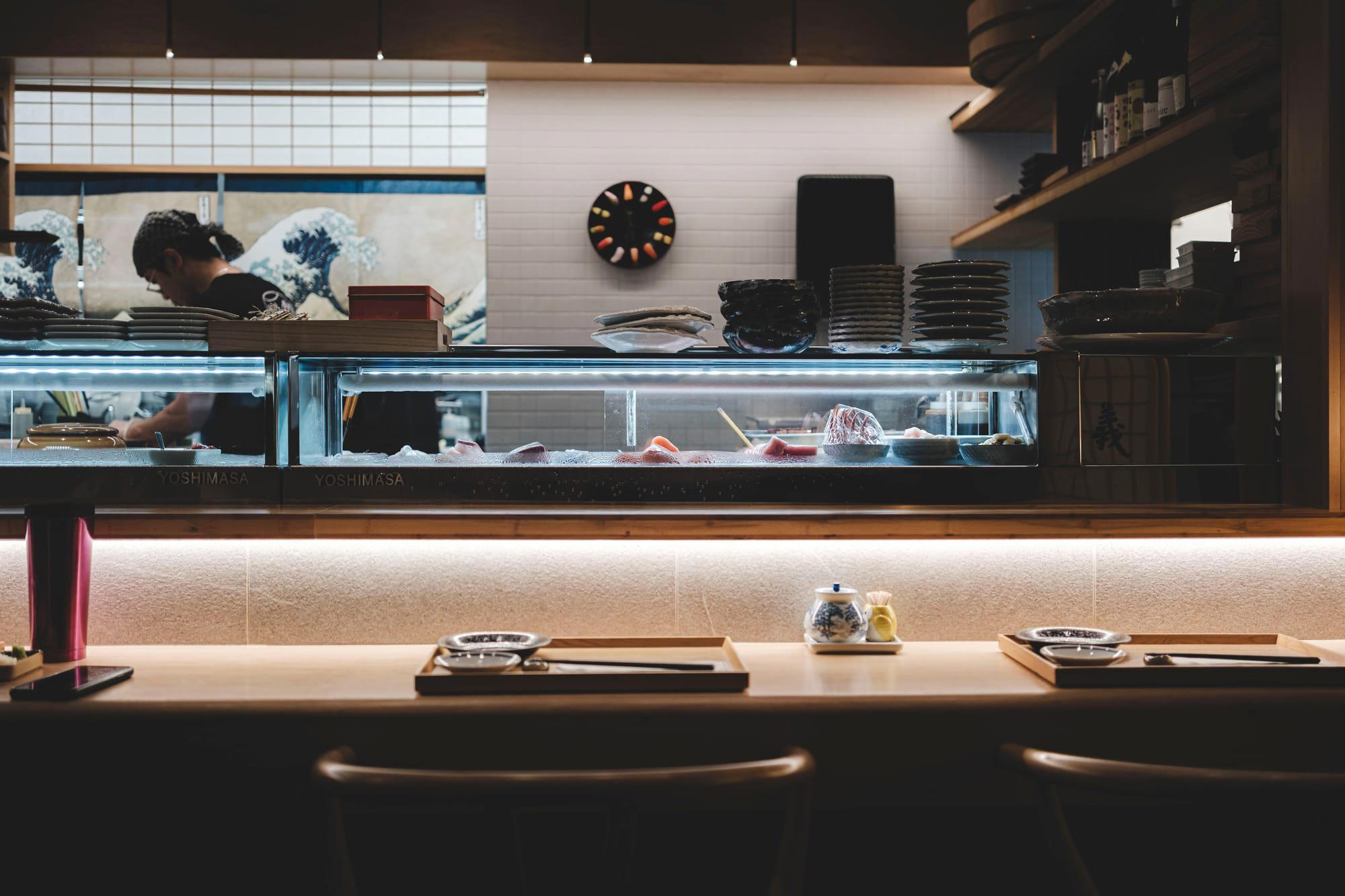
On Main Street's increasingly serious dining corridor, Sushi Hil has earned back-to-back Michelin Bib Gourmand recognition in 2024 and 2025, a signal that chef Hilary Nguy's Japanese kitchen is delivering at a level well above its modest price point. The room and the sourcing are both quietly considered, and the.

Pearl is the En Primeur Club membership app, where members save venues, book tables and use the concierge.
The menu
What to order
- Chirashi Royale
- King Salmon Oshi Roll
- Bluefin Tuna Tasting
Main Street and the Mid-Range Japanese Question
Vancouver's Japanese dining tier has split sharply in recent years. At the leading end, omakase counters on the west side and in Coal Harbour charge prices that position them against Tokyo's better ryotei rather than against each other. Masayoshi operates in that bracket, as does the tasting-menu format at Kissa Tanto, which layers Japanese technique through an Italian-inflected lens at the $$$$ tier. Below that upper band, however, the mid-range Japanese category in Vancouver is thinner than the city's reputation for Pacific Rim cooking might suggest.
Sushi Hil occupies the kind of address that doesn't announce itself. Main Street between 16th and 30th has become a corridor for independent restaurants serving technically serious food at prices that still feel grounded, a pattern visible across several cuisines along that stretch. The Bib Gourmand, Michelin's designation for cooking that delivers quality at moderate cost, fits the neighbourhood's register precisely. Receiving it consecutively in 2024 and 2025 places chef Hilary Nguy's kitchen in a small group of Vancouver addresses where the guide's inspectors have found sustained rather than singular value.
What Bib Gourmand Actually Means in This City
When Michelin arrived in Vancouver, the distinction between a full star and a Bib Gourmand mattered enormously to how a restaurant sat in the public imagination. Stars, by definition, go to a smaller group: AnnaLena and Barbara, both in the $$$$ contemporary bracket, compete in that starred tier. The Bib Gourmand operates differently. It is not a consolation category, it is a separate editorial judgment about the ratio of quality to price, and it draws on a different inspection lens. A restaurant earning it twice, in consecutive years, at the $$ price point, is telling you something specific: the kitchen has not traded on opening momentum, and the sourcing and execution that earned the first recognition held through a full second cycle.
For a $$ Japanese address, that consistency is harder than it looks. Fish-forward menus are sensitive to supply quality in ways that meat-driven kitchens can partially buffer through aging and preparation. When sourcing gets thinner, whether from seasonal fluctuation, supplier change, or distribution pressure, the plate tells the story immediately. Sushi Hil's repeat recognition suggests a sourcing relationship and kitchen discipline that can absorb that pressure without visible compromise at the table.
Sourcing on the Pacific Rim: Why Vancouver's Position Matters
The editorial angle on ingredient sourcing at a Vancouver Japanese address is not simply about freshness marketing. British Columbia's coastline gives the city genuine structural advantages for Japanese-style fish cookery: Pacific salmon in several species, halibut from Haida Gwaii, spot prawns from local waters, and sea urchin harvested from both the BC coast and the waters off Northern California. For a kitchen working in the Japanese tradition, this is not a minor advantage. It is the difference between building a menu around what arrives frozen from a distant distribution hub and building around what the local Pacific can actually support at a given time of year.
That seasonal specificity matters more in spring and early summer, when BC spot prawns run for a narrow window, often six weeks or fewer, and represent one of the few ingredients in North American seafood that can stand comparison with Japanese amaebi on its own terms. A $$ Japanese kitchen that is paying attention to that window, and to the Haida Gwaii halibut harvest that peaks in late summer, is operating with a sourcing intelligence that the price point doesn't always suggest.
For comparison, the sourcing conversation at a $$$$ counter like Masayoshi is partly underwritten by the price: higher check averages permit airfreight from Toyosu, aged fish programs, and premium domestic species that cost more than mid-range menus can absorb. At the $$ tier, the sourcing equation depends more heavily on local supply relationships and on a kitchen that can make something precise and considered from what the regional market provides. That is a different discipline, and arguably a more revealing one.
Where It Sits in Vancouver's Wider Table
Main Street's dining character has shifted toward a particular kind of independent seriousness over the past decade. The neighbourhood does not have the theatre-budget rooms of Yaletown or the trophy-hunting energy of the downtown core, where iDen & QuanJuDe Beijing Duck House plays to a different kind of visitor. Main Street restaurants tend to be smaller, more personal in format, and more dependent on a neighbourhood repeat-visitor base that is less forgiving of inconsistency than tourists or special-occasion diners.
Within the broader Canadian dining conversation, the Bib Gourmand tier connects Sushi Hil to a cohort of restaurants across the country where accessible pricing and genuine craft coexist. In Quebec, Tanière³ and Jérôme Ferrer - Europea occupy the higher-price end of that national conversation, while places like Narval in Rimouski and The Pine in Creemore demonstrate that serious cooking outside major urban centres follows similar sourcing-first logic. In Toronto, Alo sets the tasting-menu benchmark at a price point far above Sushi Hil's register. The point is not direct comparison across price tiers, it is that Michelin's Canadian inspection program rewards the same underlying values at different price levels, and the $$ Bib Gourmand is a substantive credential, not a runner-up ribbon.
Internationally, the mid-price Japanese category has been reframed by venues like Prime Fish in Charlotte and the sustained critical attention paid to accessible fish cookery in cities without Tokyo-level import infrastructure. Vancouver, with its Pacific coast geography, is better positioned than most North American cities for that kind of mid-range Japanese programme. Le Bernardin in New York City demonstrates what full investment in sourcing can produce at the top end of fish cookery; Sushi Hil is making a related argument at a fraction of the price point, and the Michelin inspectors have twice agreed it holds.
Planning a Visit
Sushi Hil is at 3330 Main Street in Vancouver's Mount Pleasant neighbourhood, accessible by the 3 Main bus from downtown in roughly 20 minutes, or a short drive south from Cambie Street. At the $$ price point with back-to-back Bib Gourmand recognition, this is a restaurant that fills on word of mouth, and the 560-review Google footprint suggests it has been doing so for long enough that walk-in availability on weekends should not be assumed. Booking ahead, particularly for Thursday through Saturday evenings, is the practical approach. For the full picture of where Sushi Hil sits within the city's dining options, see our full Vancouver restaurants guide, and for broader trip planning, our Vancouver hotels guide, bars guide, wineries guide, and experiences guide cover the surrounding city in similar depth. For Japanese cuisine at higher price points within Vancouver, Masayoshi is the obvious next step up. For Restaurant Pearl Morissette in Lincoln, the sourcing-first philosophy at a wine-country address offers a useful parallel in a different culinary register.
Frequently asked questions
What dish is Sushi Hil famous for?
Sushi Hil's Michelin Bib Gourmand recognition in both 2024 and 2025 points to a kitchen where the full programme rather than a single signature dish drives the reputation. Chef Hilary Nguy works within the Japanese tradition at a $$ price point that demands consistent sourcing discipline across the menu. The Michelin inspection process assesses the overall quality-to-value ratio, which means the cuisine as a category, Pacific-inflected Japanese cooking at accessible prices, is the credential, rather than any single plate. For the specific current menu, checking directly with the restaurant is the reliable approach.
Do I need a reservation for Sushi Hil?
At the $$ price point in a neighbourhood with a strong local repeat-visitor base, and with two consecutive Michelin Bib Gourmand distinctions driving broader city-wide awareness since 2024, Sushi Hil is the kind of address where arriving without a booking on a weekend evening carries real risk. The 560-review Google footprint at 4.7 reflects durable demand rather than a recent spike, and Vancouver's mid-range dining scene does not have an abundance of comparable Japanese addresses at this price tier.
Peers You’d Cross-Shop
A short peer table to compare basics side-by-side.
| Venue | Cuisine | Price | Awards | Notes |
|---|---|---|---|---|
| Sushi HilThis venue (the venue you are viewing) | Modern Sushi Omakase | $50–100 | Michelin Bib Gourmand | Not listed |
| AnnaLena | Modern Canadian Tasting Menu | $100–150 | 1 Michelin Star · World's 50 Best #35 | Contemporary |
| iDen & QuanJuDe Beijing Duck House | Beijing Roast Duck Fine Dining | $100–150 | 1 Michelin Star | Chinese |
| Kissa Tanto | Japanese-Italian Fusion | $100–150 | 1 Michelin Star · La Liste Top Restaurants | Fusion |
| Masayoshi | Modern Japanese Omakase | $200–300 | 1 Michelin Star | Japanese |
| Published on Main | Contemporary Canadian | $150–200 | 1 Michelin Star · World's 50 Best #17 | Contemporary |
Recognition history
Dated appearances from independent guides and award organizations, with the underlying list record or original source where available.
Michelin Bib Gourmand
Michelin
Full recognition history (2 entries)
Michelin Bib Gourmand
Michelin
Continue exploring
More in Vancouver
Restaurants in Vancouver
All restaurants in Vancouver →
Bars in Vancouver
All bars in Vancouver →



Details
- Modern
- Intimate
- Minimalist
- Sophisticated
- Date Night
- Special Occasion
- Business Dinner
- Chefs Counter
- Open Kitchen
- Sake Program
- Sustainable Seafood
- A La Carte
- Omakase
- Counter Dining
- Sake
- Vegetarian Friendly
Current opening hours
- Monday
- 11:30 AM–2:30 PM, 5–9:30 PM
- Tuesday
- 11:30 AM–2:30 PM, 5–9:30 PM
- Wednesday
- 11:30 AM–2:30 PM, 5–9:30 PM
- Thursday
- 11:30 AM–2:30 PM, 5–9:30 PM
- Friday
- 11:30 AM–2:30 PM, 5–9:30 PM
- Saturday
- 11:30 AM–2:30 PM, 5–9:30 PM
- Sunday
- Closed
Hours can change for holidays and private events. Hours as of .
Natural light floods the minimalist dining room with blonde wood furnishings, creating a clean, contemporary, and sophisticated atmosphere.