
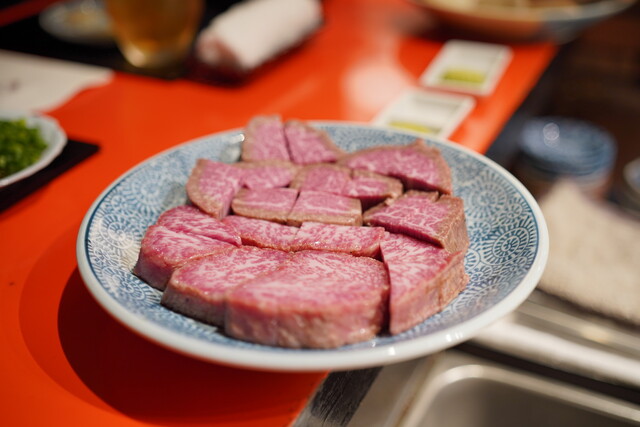
A charcoal yakiniku address near Sendai Station with Tabelog 100 Yakiniku EAST recognition for 2025 and a dinner range of JPY 6,000–7,999. The appeal is less about ceremony than about Sendai’s direct, grill-at-the-table culture: beef, smoke, groups, drinks, and enough structure to make it useful for families as well as serious meat-focused diners.
Pearl is the En Primeur Club membership app — saves, bookings, and concierge access live there. Same editors, same standards.
- Address
- Japan, 〒980-0021 Miyagi, Sendai, Aoba Ward, Central, 4 Chome−3−1 東四市場ビル
- Phone
- +81 22-397-7803
- Website
- yakiniku-gula.com
 Saves & bookings on Pearl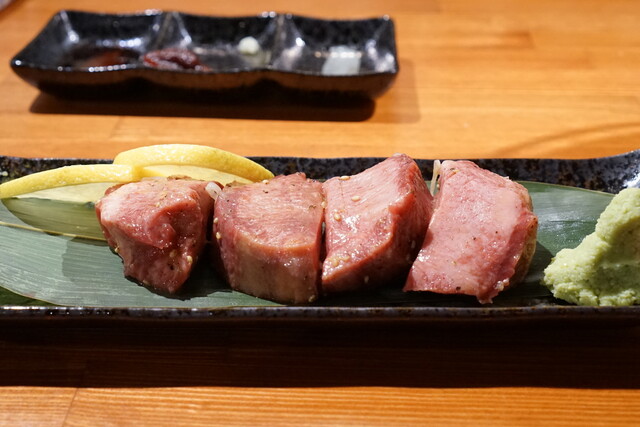
The approach to Sendai’s central market area shifts dinner’s register quickly: station traffic, small buildings, signs stacked above street level, and people heading from work to a table with a grill in the middle. Here, yakiniku is not a rarefied counter performance. It is social, smoky, portioned for conversation, and built around the diner’s timing as much as the kitchen’s.
That matters in Sendai, where beef carries cultural weight beyond generic Japanese barbecue. Miyagi’s capital sits in a region with its own beef reputation, and the local appetite for grilled meat differs from the polished wagyu temples of Ginza or the tourist-facing beef sets of Kobe. The Sendai version is more direct: a room for groups, drinks spanning sake, shochu, wine, and cocktails, and a meal assembled piece by piece rather than surrendered to a tasting menu.
Sumibi Yakiniku Gura Sendai asaichi ekimae ten fits that category, but with a stronger signal than the average station-area grill room. Selection for Tabelog 100 Yakiniku EAST 2025 places it in a regional conversation beyond Miyagi, and repeated appearances across recent Tabelog 100 yakiniku and grill lists give the restaurant a useful credibility marker where local popularity alone can be hard for visitors to read.
Charcoal yakiniku in Sendai is a communal format, not a chef's stage
Yakiniku rewards attention, but it is not passive dining. The table controls heat, pacing, and sequence; the kitchen sets cuts and preparation, then the meal depends on how the group cooks and shares. Capacity and layout matter more here than at a small sushi counter. A five-seat counter and many tables indicate a restaurant built for different evenings: solo or pair dining at one end, family and group meals at the other.
Charcoal also places the cooking closer to older Japanese grill traditions than gas-led convenience. It does not automatically improve a meal, but it changes the diner’s responsibilities: smaller batches, closer attention, and a rhythm suited to beef eaten progressively. In a city where many visitors first think of gyutan, yakiniku gives a broader view of Sendai’s meat culture. Tongue may be the headline, but grill rooms show beef as everyday celebration, post-work meal, and family dinner.
Compared with Sendai’s higher-priced sushi rooms such as Sushi Yui, or mid-to-upper Japanese dining addresses such as sou and Shiogama Sushi Tetsu S-PAL sendai ten, the appeal is the lack of hushed formality. It competes less with omakase than with other beef-focused nights out, including Sendai Gyuu Yakiniku Hana Gyuu, where the choice often comes down to whether the diner wants a larger charcoal yakiniku setting or another beef-house register. That distinction is useful: Sendai dining is not one ladder of prestige, but several parallel tracks with different rules.
The recognition says more about consistency than spectacle
Tabelog’s Hyakumeiten lists tend to reward category strength rather than imported luxury cues. For yakiniku, the fundamentals have to hold: sourcing discipline, cut selection, grill compatibility, room flow, and enough repeat appeal for local diners not dazzled by novelty. A 2025 EAST selection is therefore more relevant than a generic travel accolade, because the restaurant is assessed within its cuisine type and regional field.
The Sendai branch also has a practical identity rather than a precious one. The head office is in Shiogama City, a port town food travelers know better for seafood, giving the group a local Miyagi footing instead of the feel of a transplanted metropolitan brand. The Sendai location opened in 2017, long enough to move past opening buzz into the more demanding phase where repeat local use matters.
For visitors, expectation is the point. This is not the place for a long chef biography, a named signature dish, or a highly scripted progression. Read it culturally: a Japanese BBQ room close to transport, set up for charcoal cooking, with English menu support and enough recognition to separate it from generic grill options around major stations. It is a smart Sendai choice for travelers who want regional dining without turning every dinner into a formal reservation project.
How it fits into a Sendai eating itinerary
Sendai is often underestimated as a food city because its famous dishes are easy to reduce to a checklist. Gyutan, zunda, seafood from the wider Miyagi coast, and sake from Tohoku all deserve attention, but stronger itineraries alternate formats: a grill night, a sushi or seafood-led meal, a casual market stop, and a bar or tea break. For broader planning, Our full Sendai restaurants guide gives the clearest overview, while Our full Sendai hotels guide, Our full Sendai bars guide, Our full Sendai wineries guide, and Our full Sendai experiences guide help build the rest of the stay around the table.
Within the city, it pairs well with smaller-format stops rather than another heavy dinner in the same category. Consider contrasting it with achaar, Ademain, Ako, ankoya Ekimae ten, or Baisaou across a multi-day Sendai schedule. Travelers comparing Japanese grill formats elsewhere can also look at -Grilled beef Sukiyaki- KAMAKURA TANUKIAN 鎌倉 たぬき庵 in Kamakura and. 鮪と炭火焼き うお炭 秋葉原店 in Tokyo, though the comparison is about format and mood rather than direct equivalence.
For a wider Japan-and-beyond reading list, the contrast with.cafe in Osaka,.know in Kumamoto, (Shoku) Vietnam in Kawasaki, [Curry Senmon Ten] Maruyama Kyoju. in Sapporo, Jōdo Saké Bar in Los Angeles, and Onigiri Time in Pasadena shows how Japanese casual and specialist formats travel across cities. Sumibi Yakiniku Gura Sendai asaichi ekimae ten is strongest in that context: not a temple of beef, but a confident Sendai grill room with credible category recognition and a format that makes sense for the city.
A Pricing-First Comparison
Nearby venues at a similar price tier for orientation.
| Venue | Cuisine | Price | Awards | Notes |
|---|---|---|---|---|
| Sumibi Yakiniku Gura Sendai asaichi ekimae tenThis venue — the venue you are viewing | Aoba-ku, Japanese Yakiniku BBQ | $$ | , | |
| 鮨德 | Sendai, Japanese Restaurant | , | , | |
| Genji | $$ | , | Aoba Ward / Bunka Yokocho (Culture Alley), Traditional Sendai Izakaya | |
| Kanmidokoro Hikoichi | $ | , | Aoba Ward, Traditional Japanese sweets cafe (kanmidokoro) | |
| 松石 | Sendai, Traditional Japanese Kaiseki | $$$ | , | |
| Shiogama Sushi Tetsu S-PAL sendai ten | $$ | , | Aoba Ward, Traditional Sushi from Shiogama at Sendai Station |
At a Glance
- Lively
- Cozy
- Classic
- Group Dining
- Family
- Casual Hangout
- Late Night
- Standalone
- Beer Program
- Sake Program
- Local Sourcing
- Street Scene
A casual, energetic charcoal-grill atmosphere centered on shared tables and counter seating, designed for a fun meal with friends or family.