Sumi



Sumi occupies a bright, convivial corner of Westbourne Grove where Endo Kazutoshi's more accessible Japanese restaurant trades the choreographed omakase of its sibling for an à la carte format built around robata grills and high-quality raw fish. Holding a Michelin Plate in both 2024 and 2025, it draws a consistently full room in Notting Hill's affluent W11 postcode, with sake, exotic cocktails, and wines all available by the glass.
Pearl is the En Primeur Club membership app — saves, bookings, and concierge access live there. Same editors, same standards.
- Address
- 157 Westbourne Grove, London W11 2RS, United Kingdom
- Phone
- +44 20 4524 0880
- Website
- sushisumi.com
- Directions
- Get directions
 Saves & bookings on Pearl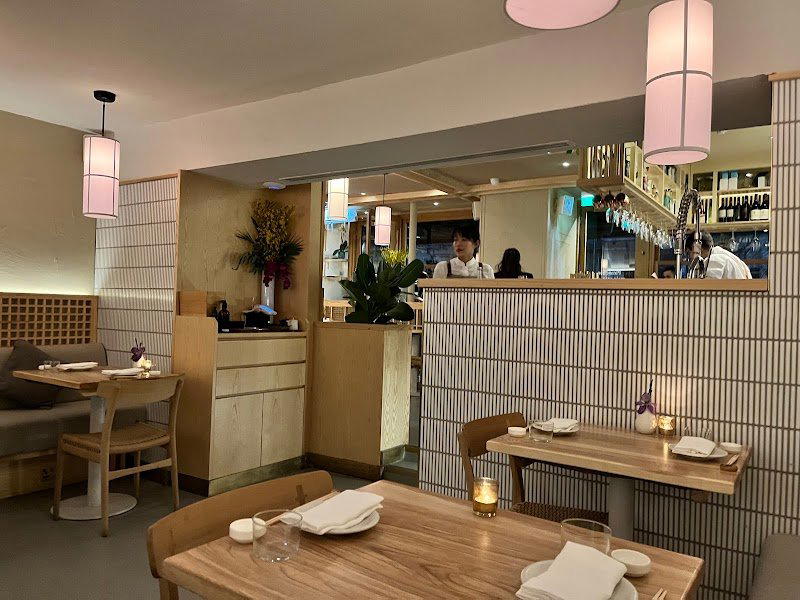
Notting Hill's Japanese Carte, From the Endo Lineage
When Endo Kazutoshi opened Sumi on Westbourne Grove, he named it after his mother and pitched it at a register quite different from his harder-to-book omakase counter, Endo at the Rotunda. That distinction matters in London's Japanese dining scene. The capital's premium tier has increasingly split between chef-led omakase experiences with limited seats and fixed progression, and more open, convivial formats where the diner sets the pace. Sumi belongs firmly to the second category: a Michelin Plate restaurant (recognised in both 2024 and 2025) running an à la carte menu across sashimi, nigiri, temaki, robata grills, and gohan rice bowls in a room that fills early and stays full.
The expansion in 2022, when the restaurant took over the neighbouring unit on Westbourne Grove, was a telling signal. Demand had outrun the original footprint, and the additional seating filled quickly. That kind of organic growth in a neighbourhood already dense with options points to something more durable than novelty. For context on London's wider Japanese dining range, the scene stretches from counter-led precision at places like Umu and Humble Chicken down through robata-focused neighbourhood restaurants, with Sumi occupying a position in that mid-to-upper tier where quality of raw material is non-negotiable but the atmosphere is deliberately relaxed. For a broader view of what London's Japanese restaurants offer across formats and price points, Akira, Chisou, and Ginza St James's.
How a Meal Here Actually Progresses
The structure of an evening at Sumi follows a logic that rewards sequencing rather than ordering everything at once. The carte's divisions are functional: starters and salads open the meal, raw fish commands the middle section, and the robata grill anchors the heavier, more sustained part of the progression.
The Opening: Vegetable and Dressed Plates
Lighter end of the menu carries more ambition than its placement implies. A garden salad drawing on ten different vegetables, dressed in wasabi wafu, demonstrates the kitchen's ability to calibrate acidity and heat without blunting crunch or sweetness. These opening plates set the palate rather than just filling time, which is worth bearing in mind when the temptation is to skip straight to the fish.
The Raw Fish Middle Section
This is where Sumi earns its Michelin recognition. The nigiri selection includes chutoro (medium fatty tuna) and sea bass, both of which depend entirely on sourcing and temperature discipline to work. The temaki hand-rolls extend the format: a version built around diced scallop with shiso flowers and soy offers the kind of textural interplay, soft, creamy fish against the structural bite of nori, that distinguishes serious Japanese kitchens from decorative ones. For diners who come specifically for raw fish and want to compare London's offering against the precision of Tokyo's counter culture, a useful frame of reference is Myojaku and Azabu Kadowaki. Sumi operates in a different register, but the sourcing is serious enough to justify that comparison as a frame of reference.
The Robata Anchor
The robata grill is where the meal's progression finds its most distinctive note. The charcoal format amplifies rather than dominates: an Ibérico secreto cut of pork, a cut taken from the shoulder blade area prized for its fat marbling, is finished with yuzu kosho, whose gentle chile heat and citrus acidity cut against the fat without overpowering the pork's inherent nuttiness. This kind of restraint in seasoning is consistent with Japanese grilling tradition, where the heat does structural work and the condiment clarifies rather than competes. The robata dishes are the section to prioritise if you are building a meal with a clear arc. Watch the bill here, as this section accumulates cost efficiently.
Rice Bowls and the Close
The gohan section offers a more grounded, substantial close to the meal for those who want it. Rice bowls in the Japanese format tend to be filling and direct, functioning as a reset after the more delicate fish courses. Whether you treat them as a main or a supplement depends on how broadly you've ordered across the preceding sections.
The Room and the Crowd
Interior, reconfigured after the 2022 expansion, uses pale wood and grey banquettes in an arrangement that keeps the space feeling open rather than cluttered. An open kitchen to one side allows the cooking to remain visible without being performative. The crowd skews young by the standards of the W11 postcode, and the atmosphere is consistently lively, a function of both the cocktail list and the format, which invites sharing and reordering rather than a fixed march through courses.
Drinks merit attention as a standalone. The sake selection is present, and wines are listed with every bottle available by the glass from £9. That full-by-the-glass policy is practically useful: it allows matching across multiple small plates without committing to bottles, which is exactly how the carte is structured to be eaten.
Where Sumi Sits in London's Dining Picture
London's most formally recognised restaurants in 2025 operate at a different price point and in a different format. The Fat Duck in Bray, L'Enclume in Cartmel, Moor Hall in Aughton, Gidleigh Park in Chagford, Hand and Flowers in Marlow, and Le Manoir aux Quat' Saisons in Great Milton all represent the set-menu, destination-dining tier. Sumi's proposition is the reverse: a neighbourhood restaurant with serious sourcing, an accessible format, and a room that absorbs a range of occasions from a quick solo dinner to a larger group sharing across the full carte. Within London's Japanese subset, it earns a 4.5 on Google from 682 reviews, and was busy enough to expand into the neighbouring unit. That combination of critical recognition and sustained commercial demand is a reasonable proxy for reliability. It is priced at £££, which positions it above casual Japanese dining in London.
For anyone building a London trip that includes Japanese dining, Sumi functions as the practical, repeatable option in the Endo stable, less structured than a reservation at the Rotunda counter, but not a lesser experience so much as a different one.
Quick reference: Sumi, 157 Westbourne Grove, London W11 2RS. Price range: £££.5 (682 reviews).
Side-by-Side Snapshot
Comparable venues nearby, for context on price, style, and recognition.
| Venue | Cuisine | Price | Awards | Notes |
|---|---|---|---|---|
| SumiThis venue — the venue you are viewing | Modern Japanese Sushi & Robata | $$$ | Michelin Plate | Not listed |
| Paulette | Traditional French Bistro | $$$ | Michelin Plate | Little Venice |
| Olivomare | Sardinian Seafood | $$$ | Michelin Plate | Belgravia |
| Tamil Prince | Modern South Indian Desi Pub | $$$ | Michelin Plate | Barnsbury |
| Llewelyn's | Modern European Bistro | $$$ | Michelin Plate | Brixton |
| Darjeeling Express | Authentic Bengali Home Cooking | $$$ | Michelin Plate | Soho |
Recognition history
Dated appearances from independent guides and award organizations, with the underlying list record or original source where available.
Michelin Plate
Michelin
Opinionated About Dining Top Restaurants in Europe Recommended
Opinionated About Dining
Michelin Plate
Michelin
The Good Food Guide GFG Very Good
The Good Food Guide
Michelin Plate
Michelin
Continue exploring
More in London
Restaurants in London
Browse all →
Bars in London
Browse all →
Hotels in London
Browse all →



At a Glance
- Lively
- Modern
- Elegant
- Sophisticated
- Date Night
- Special Occasion
- Celebration
- Group Dining
- Open Kitchen
- Chefs Counter
- Terrace
- Extensive Wine List
- Craft Cocktails
- Sake Program
- Beer Program
- Sustainable Seafood
Current opening hours
- Monday
- 5:30–9:45 PM
- Tuesday
- 12–3 PM, 5:30–9:45 PM
- Wednesday
- 12–3 PM, 5:30–9:45 PM
- Thursday
- 12–3 PM, 5:30–9:45 PM
- Friday
- 12–3 PM, 5:30–9:45 PM
- Saturday
- 12–3 PM, 5:30–9:45 PM
- Sunday
- 12–3 PM, 5:30–9:30 PM
Hours can change for holidays and private events. Last verified .