Humble Chicken






Humble Chicken places Soho’s Japanese dining conversation in a tighter, more counter-led register: izakaya energy, tasting-menu discipline, and a room built around direct contact with the kitchen. Angelo Sato’s format has moved far beyond yakitori while keeping the social rhythm of skewers, sake and bar seating at its centre.
Pearl is the En Primeur Club membership app — saves, bookings, and concierge access live there. Same editors, same standards.
- Address
- 54 Frith St, London W1D 4SJ, United Kingdom
- Phone
- 0207 4342 782
- Website
- humblechickenuk.com
- Directions
- Get directions
 Saves & bookings on Pearl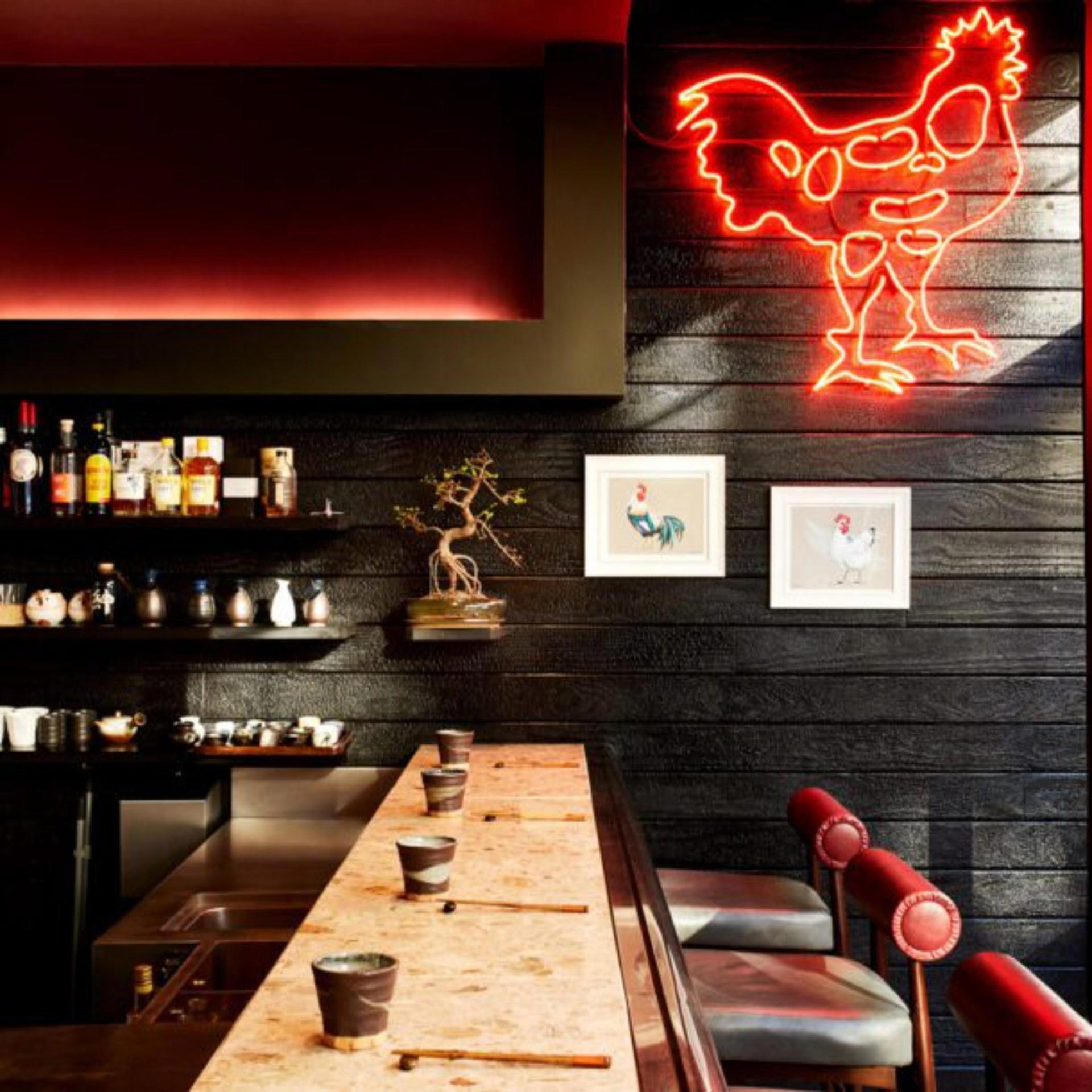
London gives restaurants a useful test: the room has to make sense before the first course lands. In a city where pre-theatre traffic, late drinking and destination dining overlap, Japanese-influenced cooking ranges from specialist counters to polished high-end dining. Humble Chicken belongs to the smaller counter-dining tier, where the experience is built around proximity as much as the sequence of plates. Staff movement, close-range service and tasting-menu choreography make the meal social rather than remote.
London’s Japanese scene is no longer defined by one model. Sushi remains a status category, but the sharper split is between formality and proximity. Ginza St James's sits at the polished end, while other London dining rooms carry different versions of Japanese-influenced luxury. Humble Chicken works another seam: a once simpler skewer-led idea, compressed into a high-spec omakase experience.
London counter energy, rebuilt as fine dining
The key context is the counter, not as decoration, but as a social operating system built around attention, pace and repeated small moments. London has often translated Japanese dining into either relaxed rooms or more formal high-end settings. Here the translation is sharper: the seat becomes part of the theatre, the kitchen’s rhythm shapes the evening, and service is part of the meal’s identity rather than a background function.
The restaurant’s early identity was as a relatively simple seller of chicken skewers, still a clue to its character after the format changed. The 16-course menu, priced at £235 per person, did not erase that foundation; it made the references denser. Japanese and European inspirations now sit together, widening the frame without turning the room into a conventional luxury restaurant. That is a London move as much as a Japanese one: the city’s better counter restaurants increasingly borrow from several traditions while keeping the format disciplined.
Angelo Sato’s role matters because the room’s grammar depends on technical cooking without the stiffness that can flatten tasting menus. The Tokyo-born chef’s hybrid register is part of the story, but the stronger point is structural: this is a chef-led counter using sociability to loosen fine-dining conventions. The comparison is not only with Japanese peers. It belongs in the broader UK movement of small rooms built around direct chef-to-diner contact, where format, proximity and pace can feel as important as geography.
The menu reads Japanese, but the pacing is London now
London diners are more fluent in omakase, but not every counter meal chases the same effect. Classic omakase depends on trust, seasonality and repetition of form; this room uses the counter to keep energy high across multiple courses. Recognition has followed: Humble Chicken won two Michelin stars in the 2025 awards, and it is among the more talked-about upper-end Japanese experiences in our annual diners’ poll, in close contention as the highest rated. Those credentials matter less as decoration than as evidence of where London now places serious Japanese-influenced cooking.
The format also says something about capital price culture. At the upper end, Japanese dining in London is no longer judged only against sushi orthodoxy, but against tasting menus, modern counters, luxury dining rooms and private-club-adjacent spaces. In that company, a 13-seat counter can feel less formal but no less ambitious. Interaction and proximity soften the edges; technical cooking and recognition put it in a harder competitive bracket.
There is a useful distinction between intimacy and quietness. The restaurant is intimate because the action is close, not because the room retreats from the city. Liveliness and staff interaction are part of the appeal, which matters for readers deciding whether the format fits. Anyone seeking silent, ceremonial sushi should look elsewhere. Anyone interested in London turning Japanese and European inspirations into tasting-menu language will find the room more revealing.
How it fits into London's Japanese map
The city now has several Japanese registers worth separating. Some restaurants connect Japanese cooking with larger design-led settings; others point to contemporary small plates, wine-bar conversation or quieter specialist counters. Ginza St James's, Umu, NIJŪ, Maru and HIMI each occupy different positions by polish and format, which is why the city’s Japanese category needs more than a single ranking mentality.
The restaurant’s place in that map is clear. It is not reproducing Tokyo sushi etiquette, and it is not a broad casual restaurant built for quick turnover. It takes the communal instincts of counter dining, tasting-menu precision and chef’s-counter immediacy, then puts them in London rather than treating the meal as a sealed luxury ritual. The city changes the experience: the restaurant becomes part of an evening out, not a dining event detached from London’s night economy.
For planning, the wider city context helps. EP Club’s full London restaurants guide is the starting point for building a dining sequence across Japanese counters, modern British rooms and wine-led kitchens. Travellers pairing dinner with a stay can cross-check our full London hotels guide, while late-night drink planning belongs in our full London bars guide. The broader London index also includes our full London wineries guide and full London experiences guide, useful for readers treating the city as one part of a longer UK itinerary.
That UK itinerary can stretch beyond the capital without losing the same editorial thread: small rooms, defined formats and chef-led experiences now shape serious dining well beyond London. For a wider Japanese comparison outside Britain, the category travels through different luxury markets without following a single template. London’s sharpest version is less about imitation than compression: fewer seats, closer contact, more technical pressure, and a social energy that keeps the evening from becoming solemn.
Price Lens
Comparable options at the same price tier.
| Venue | Cuisine | Price | Awards | Notes |
|---|---|---|---|---|
| Humble ChickenThis venue — the venue you are viewing | Soho, Modern Japanese Fine Dining | $$$$ | Michelin 2 Star | Not listed |
| Alex Dilling at Hotel Café Royal | Not listed | $$$$ | Michelin 2 Star | Piccadilly Circus, Modern French Fine Dining |
| The Wolseley | Mayfair, Grand European Brasserie | $$$$ | Michelin Plate, World's 50 Best #41 | Not listed |
| Le Gavroche | Mayfair, Classic French Fine Dining | $$$$ | World's 50 Best #19 | Not listed |
| Da Terra | Globe Town, Modern Brazilian Fine Dining | $$$$ | Michelin 2 Star | Not listed |
| A. Wong | Pimlico, Modern Regional Chinese | $$$$ | Michelin 2 Star | Not listed |
Recognition history
Dated appearances from independent guides and award organizations, with the underlying list record or original source where available.
Harden's Top 100 UK Restaurants #7
Harden's
La Liste Top Restaurants
La Liste
Michelin 2 Stars
Michelin
National Restaurant Awards Top 100 #19 · No. 19
National Restaurant Awards · 2026 National Restaurant Awards Top 100
Opinionated About Dining Top Restaurants in Europe Recommended
Opinionated About Dining
Michelin 2 Stars
Michelin
National Restaurant Awards Top 100 #57
National Restaurant Awards
Opinionated About Dining Top Restaurants in Europe Ranked #490
Opinionated About Dining
The Good Food Guide GFG Good
The Good Food Guide
Michelin 2 Stars
Michelin
Opinionated About Dining Top Restaurants in Europe Ranked #406
Opinionated About Dining
Opinionated About Dining Top New Restaurants in Europe Recommended
Opinionated About Dining
Continue exploring
More in London
Restaurants in London
Browse all →
Bars in London
Browse all →
Hotels in London
Browse all →

At a Glance
- Intimate
- Trendy
- Energetic
- Modern
- Sophisticated
- Date Night
- Special Occasion
- Chefs Counter
- Open Kitchen
- Sake Program
Current opening hours
- Monday
- Closed
- Tuesday
- Closed
- Wednesday
- 5:30–9 PM
- Thursday
- 5:30–9 PM
- Friday
- 5:30–9 PM
- Saturday
- 1–1:15 PM, 5:30–9 PM
- Sunday
- Closed
Hours can change for holidays and private events. Last verified .
Relaxed yet energetic atmosphere at an intimate 18-seat counter with controlled chaos in the open kitchen, friendly and passionate service creating a fun, non-pretentious fine dining vibe.