Akira

Michelin Plate
Our verdict
Positioned within Japan House on Kensington High Street, Akira holds a Michelin Plate for 2024 and 2025 and draws on a broad Japanese menu anchored by an open kitchen and robata charcoal grill. Counter and table seating frame the cooking directly, with the skewer program — asparagus with bacon, chicken and shiso meatballs — standing as the clearest expression of what the kitchen does at its most confident.

Pearl is the En Primeur Club membership app — saves, bookings, and concierge access live there. Same editors, same standards.
- Address
- 101-111 Kensington High St, London W8 5SA, United Kingdom
- Phone
- +44 20 3971 4646
- Hours
- Mon ClosedTue–Sat 12–5 PM, 6–10 PMSun 12–4 PM
- Website
- akira-restaurant.co.uk
- Directions
- Get directions
- Booking
- Book on SevenRooms
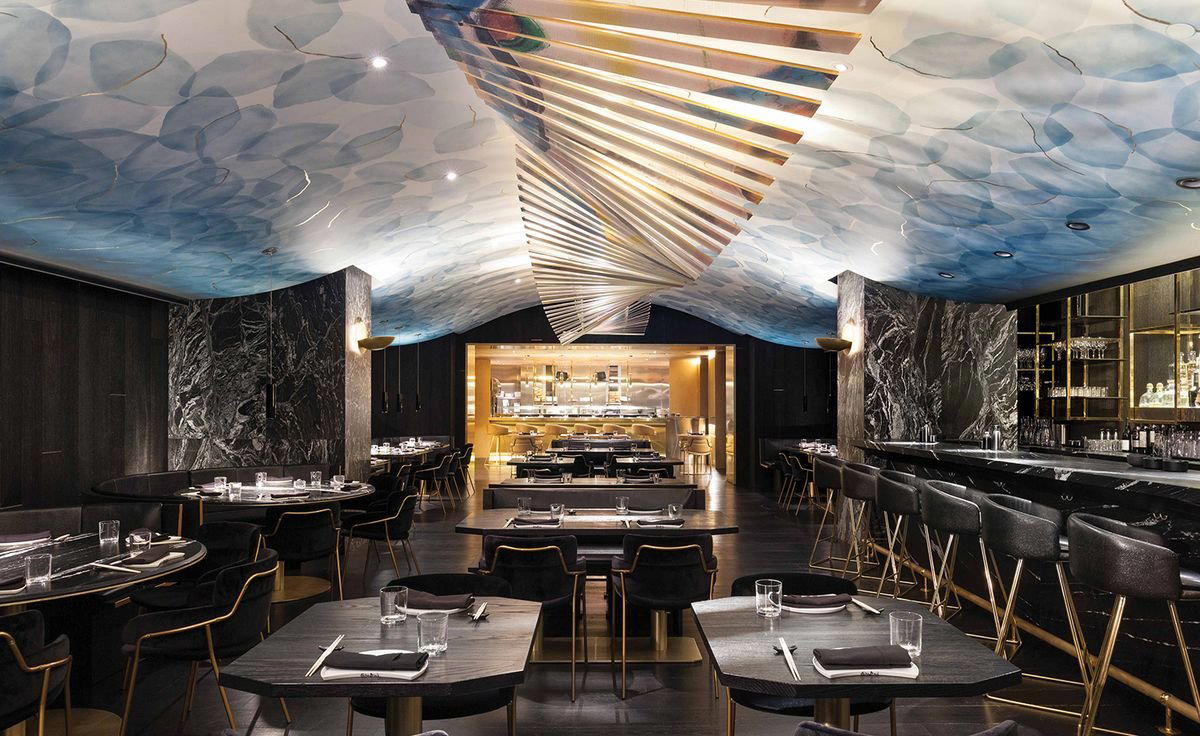
A Japanese Counter in a Cultural Institution
Kensington High Street has never been London's primary address for serious Japanese dining. That distinction belongs further east, to the concentration of specialist counters and izakayas in Mayfair and Soho. What makes Akira worth tracking is its position inside Japan House — a government-backed cultural centre that functions as something between an embassy and a design museum — which gives the restaurant a context most London Japanese venues simply don't have. The room arrives already framed: you ascend from an exhibition floor dedicated to Japanese craft, food culture, and aesthetics, and by the time you reach the restaurant level, the environment has done preparatory work that a standalone venue rarely manages.
The physical space is organised around an open kitchen, with counter seating that places you close enough to watch the robata grill operate and table positions for groups who want more separation. This format has become increasingly common across London's mid-to-upper Japanese tier, where transparency of technique signals confidence rather than theatre. Akira sits comfortably in that bracket, holding a Michelin Plate for both 2024 and 2025, a recognition that places it among restaurants the guide considers worth attention, below star level but above the noise of the city's broader Japanese offering.
The Arc of the Meal
The menu at Akira reads wide rather than narrow. A broad sushi selection anchors one end of the offering, running the range that London diners now largely take for granted at this price tier, nigiri, maki, rolls composed for variety rather than minimalism. That breadth reflects the restaurant's context inside a cultural institution with a generalist audience rather than a specialist one, and it means the kitchen is pitching to curiosity as much as to conviction.
Where the meal finds its clearest argument is on the robata side. The charcoal grill produces skewers that move through a range of produce and protein combinations, and it's here that the kitchen's judgment is most legible. Asparagus wrapped with bacon reads as a confident pairing of sweetness and fat, the vegetable holding its structure against the char. Chicken and shiso meatballs carry the aromatic lift that shiso brings to almost any application, and the grill adds a crust that the typical steamed or pan preparation can't replicate. Robata cooking is inherently sequential, skewers arrive as they're ready, building a pace closer to omakase than to a standard à la carte, and that rhythm shapes how the meal develops.
For those moving through the menu deliberately, the natural progression runs from lighter raw preparations through cooked and grilled courses, arriving at the robata section as the meal's warmest, most substantial act. London's Japanese restaurants at this price point, £££, which in 2025 terms typically places a full dinner somewhere between £50 and £90 per head before drinks, rarely build that arc as cleanly. Comparable venues like Chisou and Humble Chicken operate in a similar price register with their own structural logics, while Umu and Ginza St James's push into a higher bracket where the kaiseki-adjacent format dominates. Akira operates between those poles, which is both its practical advantage and its defining tension.
London's Japanese Tier in 2025
Japanese dining in London has stratified considerably over the past decade. At the leading sits a small number of omakase counters running fixed, chef-led sequences at prices that align them with the city's three-Michelin-star European rooms, places like Hannah in Mayfair, which applies a similar commitment to sequential, produce-driven progression. Below that, a broader middle tier covers everything from ramen specialists to izakayas to hybrid formats that blend sushi bars with robata menus. Akira's Michelin Plate positions it toward the upper end of that middle tier, with the cultural institution setting acting as an additional differentiator.
For context on what Michelin Plate recognition means in London's current field: the city holds multiple three-star venues including Restaurant Gordon Ramsay and The Ledbury, along with two-star operations such as Dinner by Heston Blumenthal. Akira is not competing in that field. What the Plate signals, across two consecutive years, is consistent technical execution and a kitchen that the guide's inspectors consider worth the detour. That's a meaningful credential at the £££ tier, where plenty of restaurants in Kensington don't meet it.
Readers who want to benchmark against Japanese cooking in its home context can explore Myojaku and Azabu Kadowaki in Tokyo, where the robata and kaiseki traditions that inform Akira's menu operate in their native environment. That comparison clarifies what London's Japanese tier is working toward, and what it necessarily adapts for a local audience.
Planning Your Visit
Akira sits at 101-111 Kensington High Street, directly within Japan House, making High Street Kensington station, a short walk, the obvious arrival point. The ground-floor cultural centre is worth time before or after the meal; the exhibitions rotate and tend to run thematically with food, craft, or seasonal Japanese themes, which makes the visit feel integrated rather than incidental.
The menu's breadth and the counter's open format suit a range of group compositions, from two people working methodically through sushi and robata to slightly larger tables treating the skewer selection as a shared centerpiece. Booking in advance is advisable, particularly for counter seats that face the kitchen directly, those positions fill first and offer the clearest view of the robata operation.
For a fuller picture of where Akira sits in the city's broader dining map, see our full London restaurants guide. Those planning wider trips can also consult our London hotels guide, our London bars guide, and our London experiences guide. Outside London, the UK's most decorated kitchens include The Fat Duck in Bray, L'Enclume in Cartmel, Moor Hall in Aughton, Gidleigh Park in Chagford, Hand and Flowers in Marlow, and hide and fox in Saltwood.
Frequently asked questions
What should I budget for a meal at Akira?
Pricing at Akira is listed as £££.
Where exactly is Akira?
Akira is located at 101-111 Kensington High St, London W8 5SA, United Kingdom, London.
Is Akira reservation-only?
The price range sits at £££, signalling a mid-to-upper bracket where walk-in availability tends to be limited at peak times.
Recognition Snapshot
| Venue | Cuisine | Price | Awards | Notes |
|---|---|---|---|---|
| AkiraThis venue — the venue you are viewing | Authentic Japanese Omakase | $50–100 | Michelin Plate | Not listed |
| The Ledbury | Modern British Fine Dining | $300–500 | 3 Michelin Stars · World's 50 Best #42 | Modern European, Modern Cuisine |
| Sketch, The Lecture Room and Library | Modern French Fine Dining | $200–300 | 3 Michelin Stars · World's 50 Best #18 | Modern French |
| CORE by Clare Smyth | Modern British Fine Dining | $150–200 | 3 Michelin Stars · World's 50 Best #97 | Modern British |
| Restaurant Gordon Ramsay | French Fine Dining | $200–300 | 3 Michelin Stars · World's 50 Best #13 | Contemporary European, French |
| Dinner by Heston Blumenthal | Historic British Fine Dining | $200–300 | 2 Michelin Stars · World's 50 Best #45 | Modern British, Traditional British |
Recognition history
Dated appearances from independent guides and award organizations, with the underlying list record or original source where available.
Michelin Plate
Michelin
Full recognition history (3 entries)
Michelin Plate
Michelin
Michelin Plate
Michelin
Continue exploring
More in London
Restaurants in London
Browse all →
Bars in London
Browse all →
Hotels in London
Browse all →



Details
- Elegant
- Sophisticated
- Modern
- Date Night
- Special Occasion
- Business Dinner
- Open Kitchen
- Chefs Counter
- Sake Program
- Omakase
- A La Carte
- Small Plates
- Sake
- Vegetarian Friendly
Current opening hours
- Monday
- Closed
- Tuesday
- 12–5 PM, 6–10 PM
- Wednesday
- 12–5 PM, 6–10 PM
- Thursday
- 12–5 PM, 6–10 PM
- Friday
- 12–5 PM, 6–10 PM
- Saturday
- 12–5 PM, 6–10 PM
- Sunday
- 12–4 PM
Hours can change for holidays and private events. Last verified .
Elegant, spacious, and understated with an open kitchen as the focal point, well-lit, and busy atmosphere.