Tabelog 100 #99
Our verdict
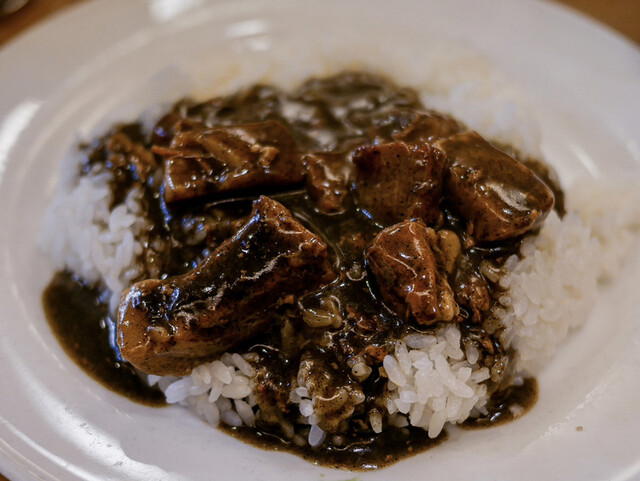
Sumatra Curry Kyoei Do places Jimbocho’s curry culture in its old bookshop setting: basement dining, table seating, and a Sumatra-style idiom folded into Tokyo’s yoshoku vocabulary. Its repeated Tabelog Curry TOKYO 100 selections, including 2024, make it a useful marker for how everyday curry in Tokyo can carry serious local authority without moving into luxury pricing.

Pearl is the En Primeur Club membership app, where members save venues, book tables and use the concierge.
The menu
What to order
- Pork curry
- Beef curry
- Chicken curry
- Shrimp (ebi) curry
- Tongue (tan) curry
- Hayashi rice
Tokyo often announces itself through everyday rhythms before food: bookshops and offices, narrow stairwells, basement signs, and the dense mid-day movement of students, editors, office workers, and collectors moving between shelves and lunch counters. In that setting, curry is not an accessory cuisine. It is part of the city’s working grammar, a fast, affordable plate that has absorbed outside influence, Japanese rice culture, and the habits of a place built around long reading sessions and short meal breaks.
Sumatra Curry Kyoei Do belongs to that older Tokyo register rather than the newer language of chef-led spice bars. Its category on Tabelog spans curry, yoshoku, and sweets, which is a useful clue: this is curry as Tokyo has often understood it, not as a strict reproduction of another regional cooking style, but as a local adaptation shaped by imported ideas and domestic expectations. The venue’s 2024 Tabelog Hyakumeiten recognition gives it measurable standing in a city where curry has become a serious specialist field.
Tokyo curry, filtered through a Sumatra idea
Tokyo curry is often discussed too broadly, as if the category runs from cafeteria roux to spice-counter experimentation without internal borders. The city makes those borders easier to read. It has long supported curry houses that function like cultural infrastructure: informal, quick, and anchored by repeat customers rather than ceremony. Sumatra Curry Kyoei Do sits inside that pattern, and the Sumatra reference gives the restaurant a distinctive identity within a local curry context.
That intersection is the editorial interest here. The plate is not framed as fine dining, and that is precisely why it is useful. Tokyo’s more rarefied restaurants often turn outside technique into tasting-menu language; everyday curry does the opposite, compressing broad influence into a daily meal. The result is not fusion as trend language, but adaptation as a long-running city practice. The experience reinforces that directness: diners come for a clearly defined curry house rather than a room built around grazing, drinking, or café-style lingering.
Within the local set, price also tells a story. Sumatra Curry Kyoei Do is listed in the JPY 1,000 to JPY 1,999 range for both lunch and dinner, placing it among everyday Tokyo choices rather than special-occasion rooms. Nearby comparison can be made with names such as Kanda Brazil, TAKEUCHI Chiyoda kanda jinbou honten, Milonga Nuova, LADRIO, and Ishigama Bake Bread Sabo Tamutamu, but the distinction here is category authority, supported by Tabelog Hyakumeiten recognition in 2024 and a 3.71 Tabelog score.
A practical room with everyday discipline
The physical format matters because it separates this kind of Tokyo curry from counter-only ramen logic or reservation-heavy omakase culture. Rather than asking to be read as a staged chef counter, Sumatra Curry Kyoei Do is best understood as a practical curry specialist with a direct lunch-and-dinner purpose. It suits Tokyo’s pace: people arrive with a reason, eat in a defined sequence, and leave the table for the next part of the day.
There is no need to force luxury language onto the room. The value is in how the format resists drift. Its public identity is not built around an elaborate chef biography, a high-budget setting, or a long luxury ritual. Instead, the restaurant’s appeal sits in its category focus, its affordable bracket, and the way it has earned recognition within a crowded curry field. That makes the experience legible without turning it into a lifestyle concept.
For travellers using Tokyo’s restaurant scene as a map, this is a useful counterweight to the city’s more formal dining rooms and hotel restaurants. It shows how a city with a deep luxury tier also protects low-ticket specialist traditions. Readers building a wider itinerary can pair this kind of Tokyo curry lunch with other unnamed Tokyo dining rooms, then widen the lens through Our full Tokyo restaurants guide, Our full Tokyo bars guide, Our full Tokyo hotels guide, Our full Tokyo wineries guide, and Our full Tokyo experiences guide.
How to read its place in a Tokyo itinerary
The right expectation is precision without ceremony. This is not a restaurant whose appeal needs to be explained through a public chef biography; the authority comes from continuity in a specialist category, 2024 list recognition, and the way the room fits Tokyo’s everyday dining culture. In the city, that can be as meaningful as a formal luxury award, especially in genres where the audience is local, frequent, and price-sensitive.
Tokyo also rewards comparison beyond curry. A traveller moving through Japan’s casual and specialist dining styles can read Sumatra Curry Kyoei Do alongside allowed local peers such as Ishigama Bake Bread Sabo Tamutamu, Kanda Brazil, LADRIO, Milonga Nuova, and TAKEUCHI Chiyoda kanda jinbou honten. Broader comparisons with other unnamed dining rooms in Tokyo can be useful too, because they show how much of the culture depends on city rhythm, payment habits, and a narrow menu contract rather than on spectacle.
The editorial verdict is simple: Sumatra Curry Kyoei Do is strongest as a reading of Tokyo curry culture, not as a luxury detour. It gives travellers a grounded view of how broad spice influence became local habit in Tokyo, with enough recognition to separate it from a random lunch stop and enough restraint to keep the experience in the everyday register.
Frequently asked questions
What time does Sumatra Curry Kyoei Do open and close?
Specific opening hours are not provided here; check directly with Sumatra Curry Kyoei Do before visiting.
What part of town is Sumatra Curry Kyoei Do in?
Tokyo.
Is Sumatra Curry Kyoei Do expensive?
Pricing at Sumatra Curry Kyoei Do is listed as JPY 1,000 - JPY 1,999 JPY 1,000 - JPY 1,999.
What's the standout thing about Sumatra Curry Kyoei Do?
Its strongest credential is the 2024 Tabelog Hyakumeiten recognition, a signal that places it in a selective local tier. The format is also clear: curry, yoshoku, and sweets categories, a 3.71 Tabelog score, and prices in the JPY 1,000–JPY 1,999 range, which makes it a practical Tokyo stop rather than a formal dining room.
Cuisine Context
Comparable options at the same price tier.
| Venue | Cuisine | Price | Awards | Notes |
|---|---|---|---|---|
| Sumatra Curry Kyoei DoThis venue (the venue you are viewing) | Historic Sumatra-style Japanese curry | $10–20 | Tabelog 100 #99 | Not listed |
| Tenfusa (天房) | Tempura | $20–30 | Not listed | Toyosu |
| TIES | Japanese Kissaten / Cafe | $1–10 | Tabelog 100 | Bunkyō |
| Agezuki | Tonkatsu (Japanese Pork Cutlet) | $20–30 | Tabelog 100 #21 | Shinjuku |
| Ginza Hachigo | Modern French-inspired Ramen | $10–20 | Michelin Bib Gourmand · Tabelog 100 #74 | Chūō |
| Yakitori Doromamire Yotsuya honten | Yakitori & Izakaya | $30–50 | Tabelog 100 #66 | Shinjuku |
Recognition history
Dated appearances from independent guides and award organizations, with the underlying list record or original source where available.
Tabelog 100 #99 · No. 99
Tabelog · Tabelog 100 - Curry - TOKYO - 2024