Steam Whistle Kitchen sits inside the Roundhouse at 255 Bremner Boulevard, occupying among the more architecturally distinctive food-and-beverage spaces in Toronto's waterfront precinct. The venue draws from the industrial heritage of the surrounding Steam Whistle Brewery complex, positioning it at the intersection of heritage architecture and contemporary hospitality. Its location puts it within walking distance of the Rogers Centre and CNE grounds, making it a consistent draw for the Entertainment District crowd.
Pearl is the En Primeur Club membership app — saves, bookings, and concierge access live there. Same editors, same standards.
- Address
- 255 Bremner Blvd Bay 6, Toronto, ON M5V 3M9, Canada
- Phone
- +14163622337
- Website
- steamwhistle.ca
- Directions
- Get directions
 Saves & bookings on Pearl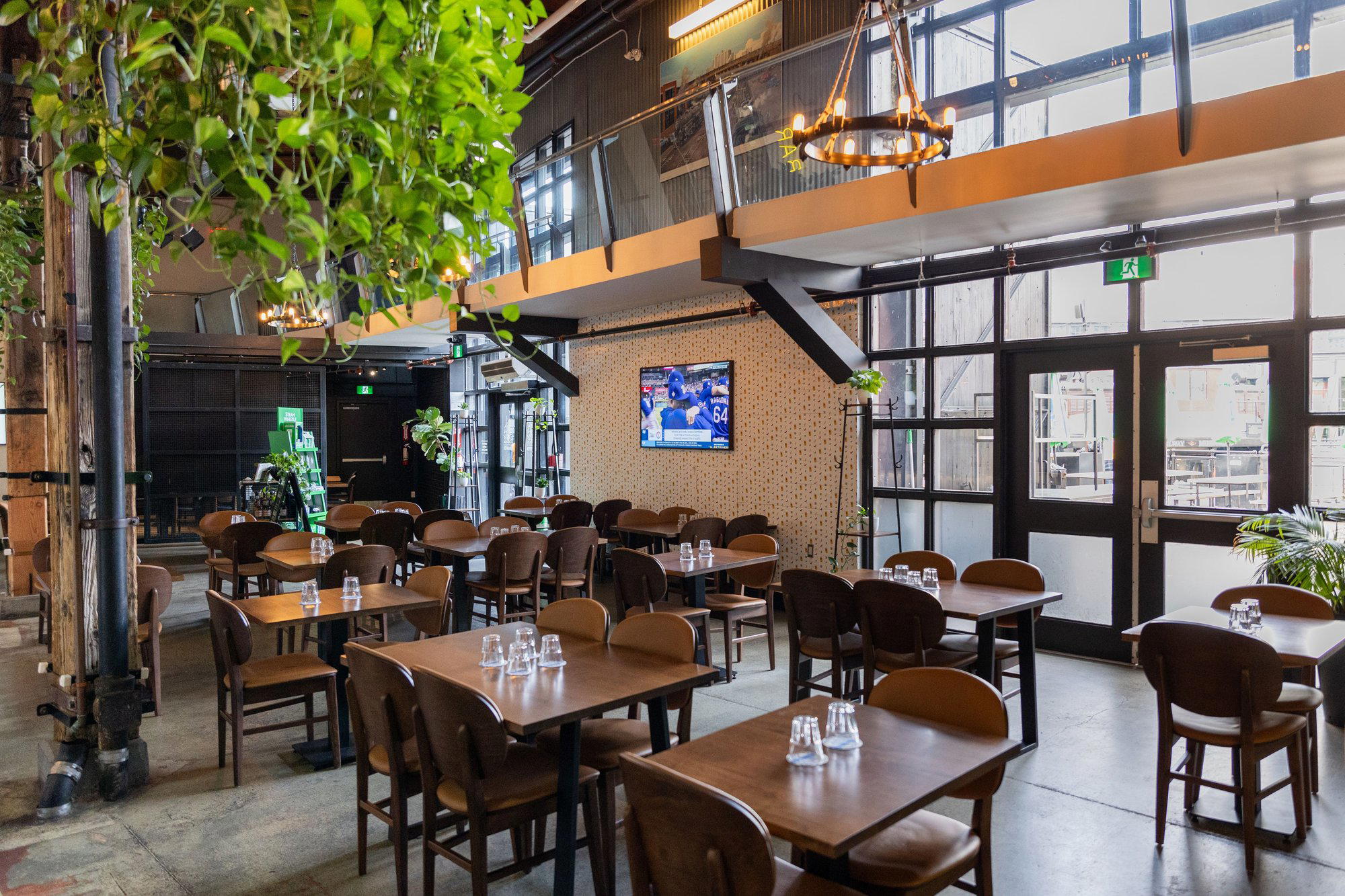
Industrial Heritage as Dining Room: The Roundhouse Precinct
Toronto's waterfront has spent the better part of two decades resolving a tension between its industrial past and its aspirations as a contemporary hospitality district. The stretch of Bremner Boulevard running west from the CN Tower contains some of the city's most architecturally loaded real estate: the Roundhouse, a 19th-century locomotive turntable facility, sits at its centre, and the buildings that radiate from it have been adapted into event spaces, brewery operations, and food-and-beverage venues. Steam Whistle Kitchen, at Bay 6 of 255 Bremner, occupies one of these adapted bays, placing it inside a structure where the architecture does significant work before a single dish arrives at the table.
The Roundhouse format matters here because it shapes the physical experience in ways that a purpose-built restaurant rarely can. Exposed brick, industrial-scale ceiling heights, and the spatial logic of a building designed around locomotive movement create a container that is at once cavernous and specific. Dining inside a heritage-designated industrial structure is a different proposition than dining in a room that merely references industrial aesthetics with pendant lights and bare concrete. The bones here are original, and that distinction registers.
The Brewery Complex as Context
The Steam Whistle Brewery, which anchors the broader complex, is one of the more coherent examples of adaptive industrial reuse in Canadian food and beverage. The brewery has operated on the Roundhouse site since 1998, and the culinary operation at Steam Whistle Kitchen functions within that established context. Toronto's premium dining scene has largely migrated toward the downtown core's western edges, with concentrations in the Entertainment District and King West corridors. The Bremner waterfront sits adjacent to those zones but carries a different character: larger footprints, more visitor traffic from adjacent attractions, and a guest mix that skews toward a combination of event attendees, tourists, and local professionals drawn by the heritage setting.
That guest profile places Steam Whistle Kitchen in a different competitive position than, say, the tasting-menu counters of the Financial District or the neighbourhood-restaurant tier of Ossington and Dundas West. It is also not the kaiseki precision of Aburi Hana or the Italian fine-dining register of DaNico and Don Alfonso 1890. The restaurant sits in a tier defined by setting and accessibility rather than tasting-menu formalism.
Space as the Editorial Argument
Heritage-industrial dining rooms succeed or fail on a relatively narrow set of variables: how the kitchen program speaks to the scale of the room, how acoustics are managed in a space not designed for conversation, and whether the service format can hold up across a wide range of table occasions. A room with 30-foot ceilings and exposed steel trusses invites a certain kind of dining energy, one that tends toward the sociable and informal rather than the contemplative. That energy is not a limitation, it is a specification, and venues that understand it programme accordingly.
The Roundhouse bays are not intimate spaces. They were built to move large machines and large numbers of people, and that spatial generosity reads differently depending on occupancy. At capacity during an event weekend or a summer evening on the waterfront, the scale of the room becomes an asset. At quieter mid-week moments, the same scale can feel underpopulated. This is a structural condition of the venue category rather than a criticism of any specific operation, and it informs how to think about when and why to visit.
Where Steam Whistle Kitchen Fits in Toronto's Broader Scene
Toronto's restaurant scene in 2024 and into 2025 has continued to diversify away from a single fine-dining centre of gravity. The Michelin Guide's presence since 2022 has sharpened the city's attention to its upper tier, but it has also clarified how much of the city's dining energy operates at registers that Michelin does not directly measure. Neighbourhood restaurants, brewpub dining rooms, heritage venue food programs, and market-adjacent casual operations collectively define a larger share of how Torontonians actually eat out than the tasting-menu conversation suggests.
The restaurant belongs to that broader, less-profiled category. It is not in direct conversation with the reservation-required destination tier. It is, instead, part of a pattern visible in cities with strong industrial-heritage precincts: the conversion of significant architectural spaces into food-and-beverage operations that lead with their setting. Similar dynamics play out at Tanière³ in Quebec City, which uses subterranean heritage architecture as a defining element, and in the way venues like AnnaLena in Vancouver and Jérôme Ferrer's Europea in Montreal use their physical environments to anchor an editorial identity. Across Canada, the question of how culinary programming interacts with architectural context is one of the more interesting structural questions in hospitality right now, and the restaurant is a specific local data point in that conversation.
For readers interested in the broader Ontario dining circuit, the contrast with more rurally situated heritage venues is instructive. Eigensinn Farm in Singhampton and Restaurant Pearl Morissette in Lincoln each use their physical environments as core elements of the guest experience, though at different price points and with different levels of destination-dining formalism. The Pine in Creemore and Barra Fion in Burlington operate in smaller-town settings that carry their own spatial and cultural specificity. The restaurant's urban industrial setting is a different category altogether, but the underlying question of how architecture shapes dining experience connects these venues.
Planning Your Visit
The restaurant is located at 255 Bremner Boulevard, Bay 6, within the Roundhouse complex in Toronto's waterfront precinct, directly adjacent to the Rogers Centre. The venue is accessible by TTC (Union Station is the nearest major hub, with a walkable connection west along the waterfront), by bike via the Martin Goodman Trail, and by car with parking available in the Roundhouse lot. Reservations: Walk-in friendly. Timing: Monday 11 AM-9 PM; Tuesday 12-9 PM; Wednesday 12-9 PM; Thursday 11 AM-9 PM; Friday 11 AM-10 PM; Saturday 11 AM-10 PM; Sunday 11 AM-8 PM. Dress: Casual. Budget: About $25 per person.
Fast Comparison
Comparable venues nearby, for context on price, style, and recognition.
| Venue | Cuisine | Price | Notes |
|---|---|---|---|
| Steam Whistle KitchenThis venue — the venue you are viewing | Contemporary Canadian Gastropub | $$ | Not listed |
| Marben | Modern Canadian | $$ | Fashion District |
| Ramona's Kitchen | Comfort Canadian Brunch | $$ | Leaside |
| Stratus | Modern Canadian Fine Dining | $$$$ | Financial District |
| Yakiniku Legend | Dining | Not listed | Kensington-Chinatown |
| The Chefs' House | Contemporary Canadian | $$ | Corktown |
Continue exploring
More in Toronto
Restaurants in Toronto
Browse all →

Bars in Toronto
Browse all →
Hotels in Toronto
Browse all →

At a Glance
- Industrial
- Lively
- Cozy
- Casual Hangout
- Group Dining
- After Work
- Historic Building
- Open Kitchen
- Beer Program
- Craft Cocktails
- Local Sourcing
- Street Scene
Current opening hours
- Monday
- 11 AM–9 PM
- Tuesday
- 12–9 PM
- Wednesday
- 12–9 PM
- Thursday
- 11 AM–9 PM
- Friday
- 11 AM–10 PM
- Saturday
- 11 AM–10 PM
- Sunday
- 11 AM–8 PM
Hours can change for holidays and private events. Last verified .
Relaxed brewpub atmosphere in a former bottling plant with industrial charm and casual vibe.