St. Francis Fountain
St. Francis Fountain on 24th Street is one of the Mission District's oldest continuously operating soda fountains, a neighborhood anchor where diner counter culture and San Francisco's working-class history converge. The all-day menu draws a cross-section of locals that few restaurants in the city can replicate. It sits at the opposite end of the spectrum from the city's Michelin-tracked tasting counters, and that contrast is precisely the point.
Pearl is the En Primeur Club membership app — saves, bookings, and concierge access live there. Same editors, same standards.
- Address
- 2801 24th St, San Francisco, CA 94110
- Phone
- +1 415 826 4200
- Website
- stfrancisfountainsf.com
- Directions
- Get directions
 Saves & bookings on Pearl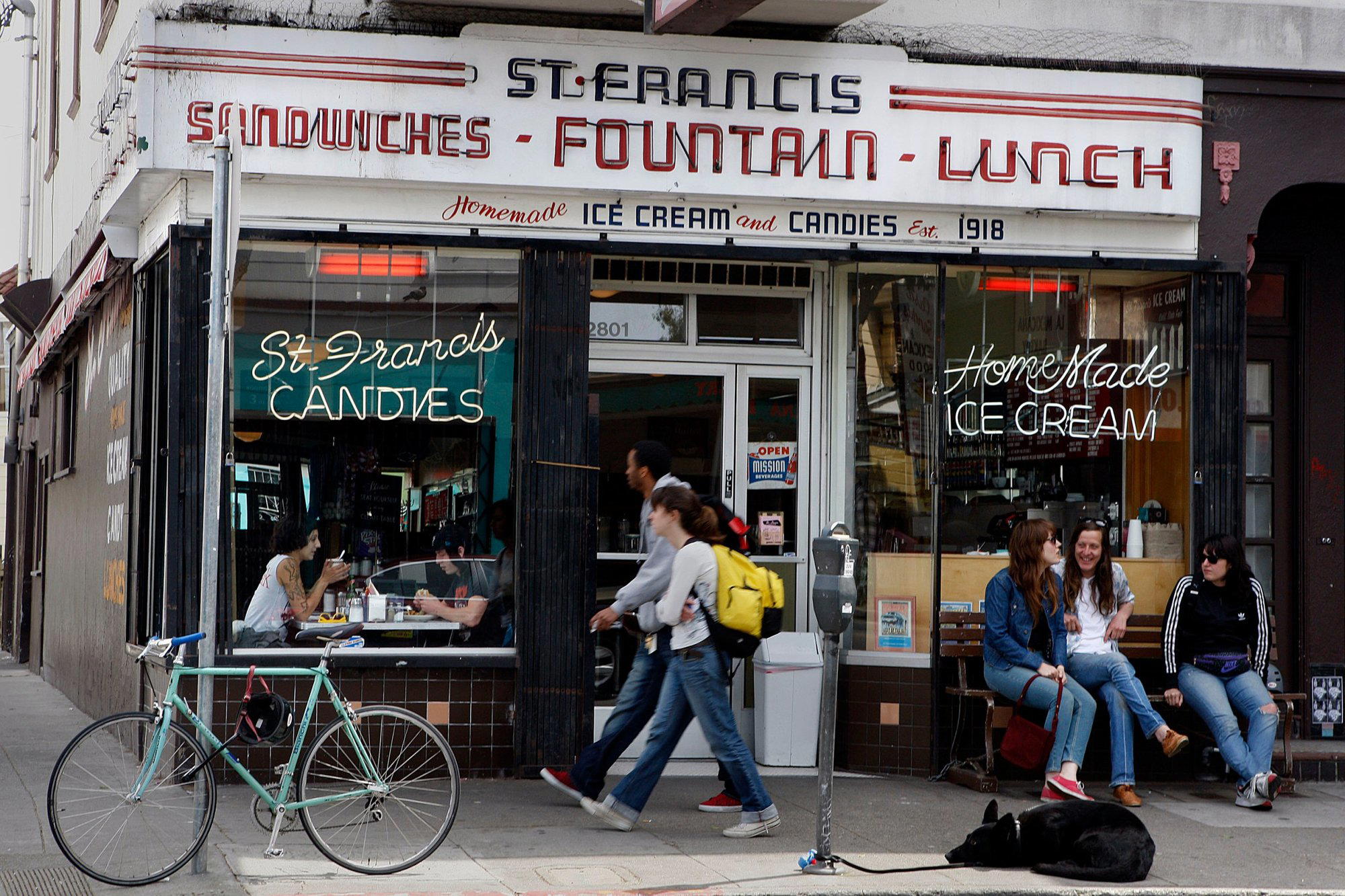
The Mission's Living Room, in Diner Form
St. Francis Fountain is a classic American diner in San Francisco's Mission District, near 24th Street, with a casual walk-in format and an average price of about $15 per person. Walk down 24th Street on a Saturday morning and the line outside St. Francis Fountain tells you something the menu never could. This stretch of the Mission District has absorbed waves of demographic change, gentrification pressure, and culinary fashion over the past century, yet the soda fountain at 2801 24th St has remained a fixed point. The building's vintage signage, the counter stools, the general atmosphere of a place that has not decided to become anything other than what it already is, these are not design choices. They are the residue of longevity.
San Francisco's dining conversation tends to orbit its high-end counters and tasting menus. Lazy Bear, Atelier Crenn, Benu, Quince, and Saison all operate in a $$$$ tier oriented around sourcing narratives and chef credentials. St. Francis Fountain operates in a different register entirely, one where the credential is institutional memory and the sourcing narrative is simply: this is what the neighborhood eats. Understanding why that matters requires understanding what 24th Street is.
24th Street and the Weight of Neighborhood Context
The Mission District's 24th Street corridor functions as one of the city's most legible examples of a neighborhood commercial strip that has held onto a working-class and Latino identity under sustained economic pressure. Taquerias, panaderías, and community murals share blocks with coffee shops and boutiques. Within that mix, a soda fountain that opened in 1918 occupies a specific and increasingly rare position: it predates the current version of the neighborhood, the previous version, and the one before that.
Diner culture in American cities often functions as a social equalizer. Unlike the prix-fixe format of places such as The French Laundry in Napa or the reservation-only structure of Smyth in Chicago, the all-day diner operates on a drop-in model that determines its clientele differently. At the restaurant, that model has produced a room that reflects the Mission more accurately than most restaurants on the same street. The counter, the booths, the general pace of service, these are functional inheritances from the twentieth-century American diner, not nostalgia theatre.
What the Menu Tells You About the Place
American diner menus at their most coherent are edited documents. The range is deliberately broad, eggs, sandwiches, burgers, pancakes, but the choices within that range reflect local taste and operational history. At the restaurant, the all-day format means breakfast and lunch items coexist without a hard cutoff, a structure common to diners that attract both early-morning regulars and late-rising weekend crowds.
The soda fountain component is not incidental. Milkshakes, sodas, and ice cream sodas connect the venue to a category of American food service that has largely disappeared from urban commercial strips. In cities where that format survives, and in San Francisco it survives in few places at this scale, it tends to carry a social function beyond the food itself. The counter seat is a specific kind of public space, one where brief exchanges between strangers are normalized in a way that table service discourages.
For a city whose restaurant culture has increasingly skewed toward tasting formats and reservation-driven dining, the walk-in counter is a meaningful counterpoint. Comparable all-day formats at this price tier exist across the country, from neighborhood institutions in New Orleans to Chicago breakfast counters, but the combination of age, neighborhood rootedness, and the soda fountain format makes the Mission District version a distinct specimen of the type.
Placing It in the Wider San Francisco Picture
San Francisco's dining culture in 2024 is bifurcated in ways that are well-documented. On one side, a constellation of high-investment tasting restaurants with national and international profiles; on the other, a neighborhood dining scene under sustained cost pressure. The middle tier, mid-price, independently owned, walk-in restaurants, has contracted significantly since 2020. What remains tends toward the endpoints: either the destination-dining tier that draws travelers alongside locals, or the deeply embedded neighborhood institution that survives on repeat business and community loyalty.
The restaurant belongs to the second category, which is increasingly the rarer one. Institutions with century-scale operating histories in American cities can be counted across most neighborhoods. In San Francisco specifically, the combination of high commercial rents, post-pandemic attrition, and the pace of neighborhood change has reduced that cohort considerably. By that measure, a soda fountain that has operated continuously since 1918 on a block that has changed its identity multiple times is a data point about durability, not sentiment.
For visitors oriented toward the full range of San Francisco eating rather than just its Michelin tier, the contrast between the restaurant and the city's fine dining addresses is part of the educational value. Elsewhere in the country, comparable anchor-institution logic appears at Emeril's in New Orleans, and the farm-anchored formats of Blue Hill at Stone Barns in Tarrytown or Single Thread Farm in Healdsburg represent a different way American restaurants root themselves in place and time. The methods diverge sharply; the underlying commitment to a specific location is the shared logic.
Other American restaurants worth placing in this regional conversation include Providence in Los Angeles, Addison in San Diego, Frasca Food and Wine in Boulder, and The Inn at Little Washington. For a wider international frame, Le Bernardin in New York City, Atomix in New York City, and Atelier Moessmer Norbert Niederkofler in Brunico each illustrate how differently institutions can define their relationship to place, time, and community.
Know Before You Go
- Address: 2801 24th St, San Francisco, CA 94110
- Neighborhood: Mission District, 24th Street corridor
- Format: All-day diner and soda fountain, walk-in
Peers Worth Knowing
Comparable venues nearby, for context on price, style, and recognition.
| Venue | Cuisine | Price | Notes |
|---|---|---|---|
| St. Francis FountainThis venue — the venue you are viewing | Classic American Diner | $ | Not listed |
| Miyako | Old Fashioned Ice Cream & Candy | $ | Japantown |
| Jerry’s Roast Pork | Philly-Style Roast Pork Sandwiches | $ | Financial District/South Beach |
| The Bird | Fried Chicken Sandwiches | $ | Financial District/South Beach |
| Arguello Market | Classic American Deli Sandwiches | $ | Lone Mountain/USF |
| Hazel's Kitchen (Sandwich Shop) | Classic American Deli Sandwiches | $ | Potrero Hill |
Continue exploring
More in San Francisco
Restaurants in San Francisco
Browse all →
Bars in San Francisco
Browse all →
Hotels in San Francisco
Browse all →

At a Glance
- Classic
- Well Known
- Cozy
- Rustic
- Brunch
- Casual Hangout
- Family
- Solo
- Historic Building
- Standalone
- Street Scene
Current opening hours
- Monday
- 9 AM–2 PM
- Tuesday
- 9 AM–2 PM
- Wednesday
- 9 AM–2 PM
- Thursday
- 9 AM–2 PM
- Friday
- 8 AM–2 PM
- Saturday
- 8 AM–3 PM
- Sunday
- 8 AM–3 PM
Hours can change for holidays and private events. Last verified .
Nostalgic old-school diner atmosphere with vintage charm, retro decor, and a bustling neighborhood energy; warm lighting and classic American diner aesthetic that feels frozen in time.