
Tabelog 100 #63
Our verdict
Tokyo’s curry culture has moved far beyond a single borrowed template, and Spicy Curry House Hangetsu sits in the city’s spice-curry lane rather than the heavy roux mainstream. Its Tabelog Curry TOKYO 100 selection for 2024 gives it a clear local signal, while the small room and casual format keep the focus on everyday precision rather than ceremony.

Pearl is the En Primeur Club membership app, where members save venues, book tables and use the concierge.
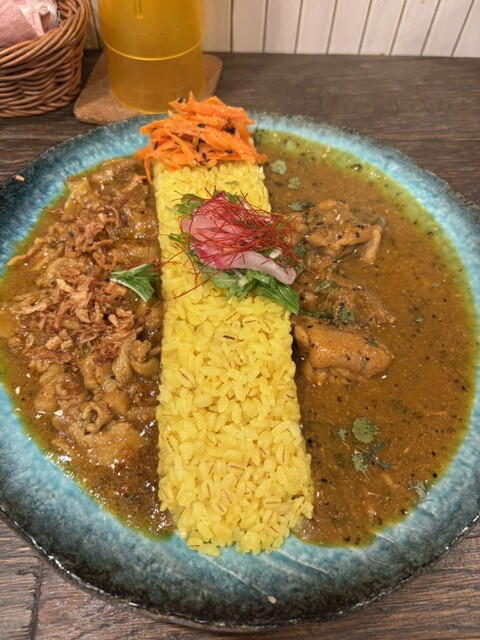
In Tokyo, the curry scene changes scale fast: large station restaurants give way to compact rooms, short menus, and lunch traffic that treats spice as part of the working day, not special-occasion performance. Spicy Curry House Hangetsu belongs to that smaller Tokyo current, where curry is not only yōshoku nostalgia or late-night comfort, but urban craft cooking in which Indian curry, Japanese rice culture, and local appetite meet in tight quarters.
Tokyo curry has always absorbed outside ideas without freezing them. The old Japanese curry-rice model, thickened and mild, remains a daily staple; the newer spice-curry idiom is leaner, more aromatic, and more comfortable with contrast. That shift explains why a modest Tokyo curry shop can sit on the same mental map as destination sushi counters or yakitori rooms: the category has its own hierarchy, regulars, and award language. Hangetsu’s selection for Tabelog Curry TOKYO 100 in 2024 places it inside that specialist conversation, not as luxury, but as a serious address in a low-price, high-scrutiny genre.
Tokyo curry, judged by regulars rather than ceremony
The useful Tokyo comparison is not curry versus fine dining, but curry rooms that behave like everyday canteens versus those drawing cross-town diners. Hangetsu sits in the second group while keeping the habits of the first: small scale, casual pacing, and turnover rather than lingering. In a city where a compact room can gain more authority than a heavily designed dining room, that restraint matters. It keeps attention on spice balance, rice, portion logic, and how much character a kitchen can express without asking for a long meal.
The Tabelog score of 3.79 matters because curry shops compete in a dense, opinionated field. Tokyo diners rank these places with unusual granularity, and Tabelog’s Curry TOKYO 100 list acts as a practical map of specialist confidence. Hangetsu’s 2024 selection gives a clear signal within that field. The recognition suggests the room has held attention in a category where new spice counters appear constantly and regulars move on quickly.
Tokyo sharpens the point. The city can flatten dining into convenience because trains, offices, department stores, and late-night movement organize so much of it. Curry cuts through that noise: quick enough for a weekday, flavorful enough for a detour, informal enough to avoid the pressure of a full restaurant plan. For a wider Tokyo dining day, Hangetsu pairs more naturally with other casual specialists than formal counters; readers can place it alongside Tokyo-focused curry and casual-dining entries such as FISH Shinjuku ten or compare the broader curry category with other Tokyo dining rooms.
The spice-curry lane between Japanese comfort and Indian influence
Japanese curry is often called Western-style, but Tokyo’s current curry culture is more layered. Indian curry categories, broader spice-curry habits, and Japanese rice-plate traditions all circulate through the capital. The result is not fusion as a slogan; it is practical city cuisine, shaped by small kitchens and repeat diners who know how they want heat, acidity, texture, and rice to behave.
Hangetsu is listed in the curry and Indian curry categories, placing it on the aromatic side of the city’s curry spectrum rather than the purely old-school roux side. That distinction matters for travelers. Tokyo’s curry counters are not interchangeable comfort stops. Some lean sweet and thick, some emphasize texture, and some make spice the central identity. In the comparison group, SPICY CURRY Roka, Gyusuji Curry Chiisana Curry Ya, and FISH Shinjuku ten help show how varied the city’s curry conversation can be. Hangetsu’s appeal is its middle position: recognized, compact, and serious without pushing the meal into destination-restaurant formality.
This is where Tokyo’s value logic becomes clear. A city internationally associated with omakase premiums and rare bookings also has a parallel culture of small specialist rooms where the critical standard is severe and the bill stays grounded. Curry can be a better lens on daily Tokyo than another high-gloss tasting menu because it shows how the city rewards repetition, precision, and local consensus. For a broader itinerary, Our full Tokyo restaurants guide gives the restaurant context across categories, while Our full Tokyo bars guide, Our full Tokyo hotels guide, Our full Tokyo experiences guide, and Our full Tokyo wineries guide help separate dining decisions from the rest of the city plan.
How to read a small curry room in a large dining city
The right expectation is casual seriousness. This room does not need haute-cuisine vocabulary; imposing it would miss the pleasure of the format. Limited space, straightforward pacing, and a low-price setting point to a focused meal rather than a social sprawl. The listed budget is lunch at JPY 1,000 - JPY 1,999, a useful reminder that Tokyo’s casual dining infrastructure can be as compelling as its formal restaurant scene.
For travelers comparing Japanese dining styles, curry is a useful reset between more structured meals. It can sit between other Tokyo specialist formats without needing the same ceremony or advance planning. The same casual-specialist logic appears across the city in different forms: narrow menus, quick decisions, and a strong sense that a focused kitchen can express more than a broad one. Even when Tokyo dining turns outward toward international ideas, much of its eating culture still depends on compact formats executed with discipline.
The editorial read is simple: Hangetsu is a Tokyo curry address for readers who want the city’s specialist food culture without dressing it up as fine dining. The draw is not ceremony; it is how a small, recognized curry room reveals a city’s standards at lunch-counter scale.
Frequently asked questions
Is Spicy Curry House Hangetsu child-friendly?
It is a compact Tokyo curry room, so it is better suited to a quick, focused meal than to large family groups.
Is Spicy Curry House Hangetsu formal or casual?
Casual. Its listed price range of JPY 1,000 - JPY 1,999 places it firmly in everyday Tokyo curry territory rather than formal dining.
How much does it cost to eat at Spicy Curry House Hangetsu?
Pricing at Spicy Curry House Hangetsu is listed as JPY 1,000 - JPY 1,999.
What is Spicy Curry House Hangetsu known for?
Spicy Curry House Hangetsu is known as a Tokyo curry and Indian curry venue recognized in Tabelog Curry TOKYO 100 in 2024.
Cost and Credentials
Comparable venues at the same tier.
| Venue | Cuisine | Price | Awards | Notes |
|---|---|---|---|---|
| Spicy Curry House HangetsuThis venue (the venue you are viewing) | Indian Curry | Not listed | Tabelog 100 #63 | Not listed |
| Spice Bar Kozaburo | Spice-focused Indian-style curry bar | $30–50 | Tabelog 100 #10 | Bunkyō, Spice-focused Indian-style curry bar |
| Zero One Curry A.o.D. | South Indian Curry & Natural Wine | $20–30 | Tabelog 100 #25 | Minato, South Indian Curry & Natural Wine |
| Spicy Curry House Ginza Hangetsu | Indian Curry House | $1–10 | Tabelog 100 #14 | Chūō, Indian Curry House |
| Calical Shimbashi honten | Indian Curry | $1–10 | Tabelog 100 #51 | Minato, Indian Curry |
| Bangera's Kitchen | Mangalorean South Indian coastal cuisine | $30–50 | Tabelog 100 #48 | Chiyoda, Mangalorean South Indian coastal cuisine |
Recognition history
Dated appearances from independent guides and award organizations, with the underlying list record or original source where available.
Tabelog 100 #63 · No. 63
Tabelog · Tabelog 100 - Curry - TOKYO - 2024
Continue exploring
More in Tokyo
Restaurants in Tokyo
All restaurants in Tokyo →




Bars in Tokyo
All bars in Tokyo →







Details
- Cozy
- Modern
- Solo
- Casual Hangout
- Group Dining
- Standalone
- A La Carte
- Counter Dining
A calm, relaxing, house-style curry spot with counter seating and an intimate feel.